
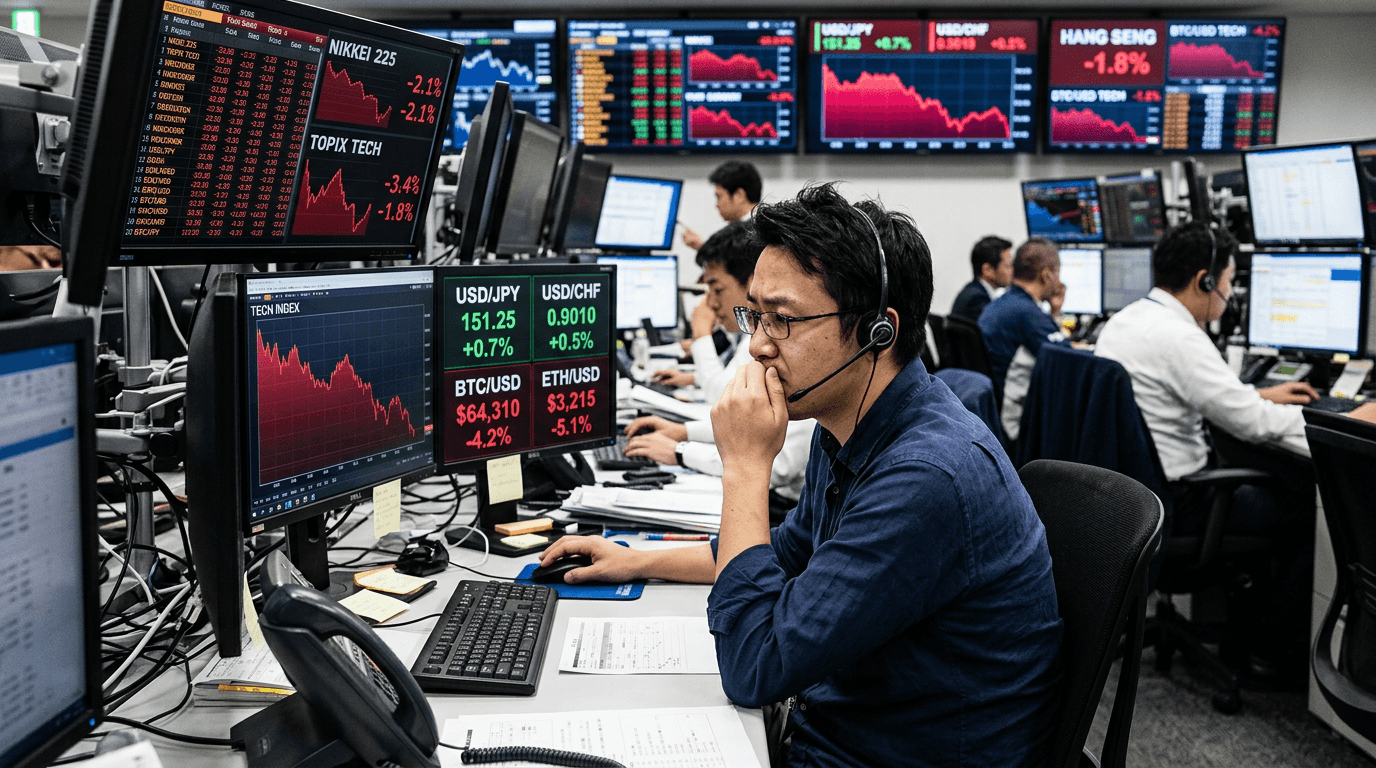
Asian equity markets just reminded traders how quickly sentiment can flip when a dominant theme – in this case AI and semiconductor optimism – is called into question.[1][7] Benchmarks in Japan and Taiwan dropped as much as 6% in a single session, a move many analysts described as a “bloodbath” as a global tech stock rout accelerated.[7][14] The selloff did not stay confined to regional equities: it rippled through risk‑sensitive currencies, equity index futures and cryptocurrencies, while reinforcing flows into defensive FX such as the dollar and yen.[8][13][12] For anyone trading across asset classes, this kind of shock is a live case study in how tech leadership and risk appetite are tightly intertwined.
THE TECH BLOODBATH: WHAT JUST HAPPENED?
The latest slide in Asian equities has centered on tech‑heavy markets like Tokyo and Taipei, which have been among the biggest beneficiaries of the AI and semiconductor boom.[7][12] Japan’s Nikkei 225, packed with chip‑related and automation names, fell over 4% in one recent session and has now confirmed correction territory, down more than 10% from its late‑June peak.[7][14] Taiwan’s Taiex, home to global chip giant TSMC and its supply chain, has seen single‑day drops of around 4–6% as investors offload AI‑linked exposures.[7][12][13] In South Korea, the Kospi has repeatedly triggered circuit breakers after intraday falls of 8%, driven by heavy selling in Samsung Electronics and SK Hynix.[1][10][14]
Several catalysts have converged to puncture the tech optimism. A disappointing earnings report and guidance from Broadcom rattled confidence in the AI hardware trade and triggered a broader rotation away from semiconductor and AI‑exposed stocks.[5][9][13] Apple’s warning on higher AI‑related hardware costs and its own sharp share price decline added to fears that margins across the sector will be squeezed.[2][10] At the same time, talk of tighter U.S. curbs on advanced chip exports to China reinforced geopolitical and regulatory risks that hang over the supply chain.[11] Layered on top of this are macro worries: stronger‑than‑expected U.S. data have pushed markets to re‑price the odds of further rate hikes, while persistent tensions in the Middle East have lifted oil prices and unsettled already fragile risk appetite.[13][9][8]
Why Tech Pain Hits Risk Fx And Crypto
When tech leadership breaks, it tends to drag broader risk sentiment with it. In recent months, AI and semiconductor names have been the primary engines of global equity gains, especially via the Nasdaq and Asian tech hubs.[6][12][14] As those trades reverse, investors often reduce exposure not just in equities but across the risk spectrum – including high‑beta currencies and digital assets.[12] That means currencies like the Australian dollar, New Zealand dollar and many emerging‑market FX pairs can come under pressure as global funds de‑risk, even if the underlying domestic fundamentals have not changed overnight.[13]
Recent price action illustrates this pattern. During the latest wave of tech‑driven selling, the dollar held firm and even pushed the Australian dollar lower, with AUD/USD slipping as investors unwound carry trades and commodity‑linked risk positions.[13] In earlier episodes this year, similar tech‑led corrections coincided with declines in equity index futures and weakness in pro‑cyclical FX, while defensive pairs such as USD/JPY saw volatility as investors reassessed how far the yen could weaken before authorities or market forces pushed back.[8][9][13]
Crypto has increasingly behaved like a high‑beta extension of the equity risk trade. Following reversals in AI‑linked stocks on Wall Street, Bloomberg reported that investors retreated from riskier assets, “including cryptocurrencies,” as skepticism grew over the near‑term returns from massive AI capex.[12] This aligns with the broader pattern: when equity investors are questioning valuations and earnings visibility, they are less willing to hold assets that offer no cash flow and are priced largely on future narratives. For traders, this means that monitoring tech sector sentiment is now a crucial input for anticipating swings in major crypto pairs as well as altcoins.
How Defensive Currencies Respond
While risk FX and crypto typically absorb the downside of a tech shock, defensive currencies often benefit from a flight to quality. The latest Asian selloff unfolded against a backdrop where the U.S. dollar was already firm, trading above 160 yen and strengthening versus several G10 peers.[13][8] As volatility in equities spikes, large investors frequently rebalance into cash, short‑dated Treasuries, or perceived safe‑haven currencies such as the dollar and yen, amplifying these moves.[6][13]
The yen’s behavior is particularly instructive. On the one hand, Japanese equities have been hit hard, with the Nikkei dropping 4–6% on several occasions as tech names sold off.[7][14][13] On the other hand, extreme yen weakness has raised the prospect of policy responses, from verbal intervention to actual FX operations, which can suddenly change the currency’s trajectory.[8][13] When equity volatility is high, many global funds see long‑yen positions – or at least reduced yen shorts – as a cheap hedge against broader risk‑off events, especially if markets start to price in slower Fed tightening or eventual cuts.[12][6]
For traders, the takeaway is that defensive FX can serve either as a portfolio hedge or a directional opportunity, but its role tends to change across regimes. In calm periods, carry and relative growth differentials dominate FX pricing; in stress periods, liquidity and perceived safety matter more. Understanding which regime you are in – and how quickly markets can switch when a concentrated trade like AI tech stumbles – is essential for building robust strategies.
Key Lessons For Traders And Simulated Finance Users
The Asian tech bloodbath underscores several practical lessons for cross‑asset traders.
First, concentrated themes magnify both gains and losses. When a narrow sector such as AI semiconductors drives a large share of index performance, any disappointment in earnings, regulation, or input costs can trigger outsized moves.[1][5][11] Position sizing and diversification matter: even if you are bullish on AI over the long term, short‑term leverage on crowded names can be hazardous.
Second, correlations are dynamic. Crypto’s growing linkage to equity risk and tech sentiment means that old assumptions about “uncorrelated” assets need updating.[12] Traders should regularly review cross‑asset correlations – between tech indices, high‑beta FX, and major crypto pairs – rather than assuming yesterday’s relationships still hold.
Third, macro still matters. The tech rout has been exacerbated by shifting expectations for Fed policy and higher oil prices tied to geopolitical tensions.[13][9][8] Earnings stories, valuation concerns and macro data interact; ignoring one dimension can leave a strategy exposed when conditions change.
Finally, simulated finance environments offer a valuable proving ground. Using a SimFi platform, traders can stress‑test strategies across scenarios where tech indices drop 5–10%, risk FX sells off, and defensive currencies rally, without putting real capital at risk. Building and refining playbooks for “bloodbath” days – including rules for de‑risking, hedging and redeploying capital – can make live trading responses more disciplined when markets turn volatile again.