
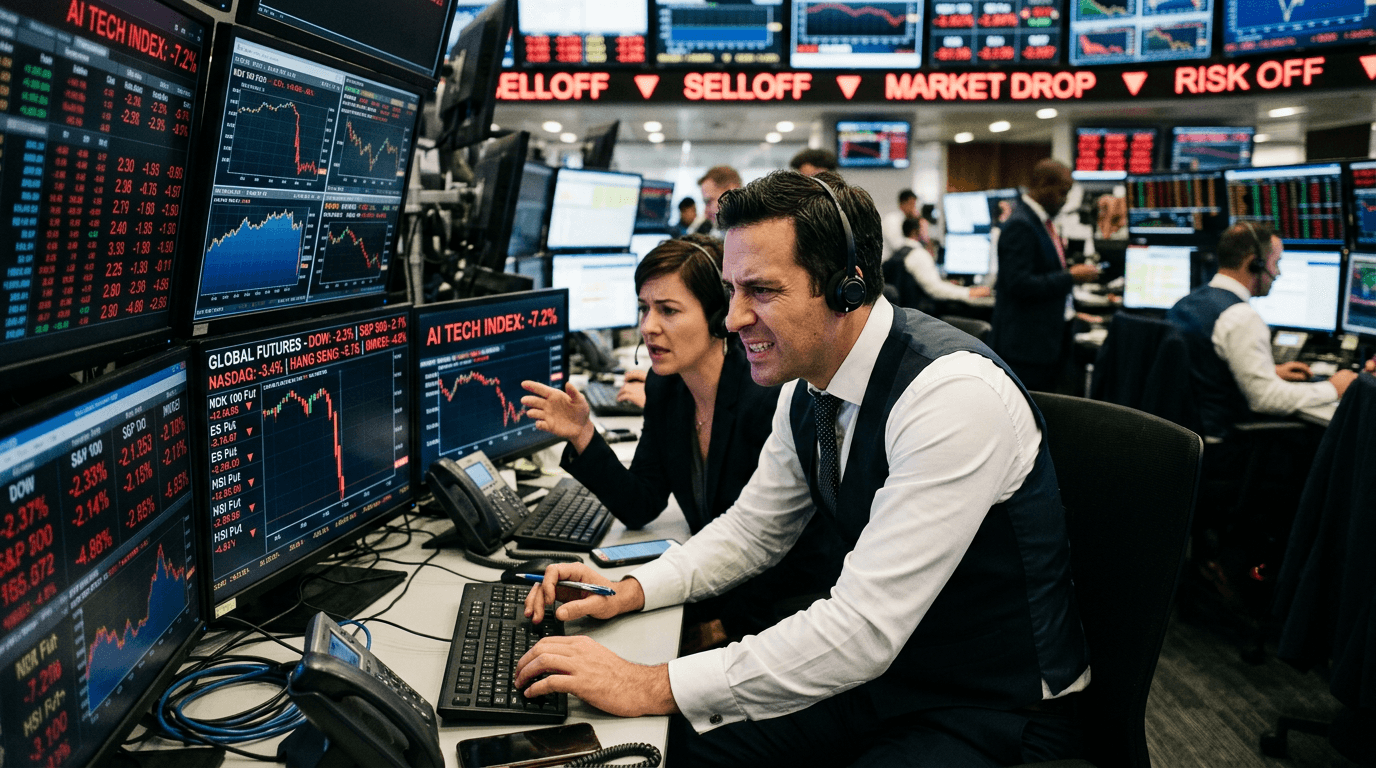
Asian equity markets just experienced one of their most brutal sessions of the year, with tech-heavy indices in Japan and Taiwan plunging as much as 6% in what traders have dubbed a “bloodbath.”[7] A rapid rotation out of semiconductor and AI-linked names has spilled over into global stock index futures, souring risk sentiment and raising uncomfortable questions about how durable the AI-driven equity rally really is.[4][7] For traders, this is more than a scary headline—it is a live stress test of positioning, risk management, and how fast a crowded narrative can reverse.
Markets In Risk-reset Mode
The epicenter of the move has been in markets most leveraged to the AI and semiconductor story.[7] Japan’s Nikkei and Taiwan’s Taiex, both packed with chipmakers and tech hardware suppliers, saw intraday losses approach 6% as investors aggressively unwound positions built up over months of enthusiasm about AI demand.[7] In South Korea, the tech-heavy Kospi has repeatedly featured among the region’s worst performers during recent selloffs, with double-digit single-day declines not unheard of when circuit breakers are triggered.[3][7]
This is not an isolated wobble but part of a broader pattern of foreign capital retreating from Asian equities.[1][8] Recent data show foreign investors pulling tens of billions of dollars from regional markets over just a few weeks, as concerns mount about the massive capital expenditures required to build AI infrastructure and the uncertainty over whether future cash flows will justify today’s valuations.[1][8] When both local and foreign investors move from “fear of missing out” to “fear of being the last holder,” price action tends to overshoot in both directions.
WHY TECH, WHY NOW?
To understand the violence of the move, it helps to step back and look at the structure of the rally that preceded it. For much of the past year, a narrow group of AI and semiconductor leaders have driven a disproportionate share of global equity gains, creating heavy concentration risk in indices and portfolios.[7][11] As long as earnings beats and AI headlines supported the story, investors tolerated—if not embraced—stretchy multiples and aggressive forward narratives.[6][9]
Several catalysts have now converged to challenge that complacency. First, disappointment around parts of the AI supply chain, including some marquee chip and infrastructure names, has prompted investors to revisit earnings assumptions and capital expenditure payback periods.[8] Second, geopolitical tensions—particularly renewed US–Iran jitters and the impact on energy prices and supply chains—have added a layer of macro uncertainty just as valuations were most demanding.[2][9] Third, central banks across Asia have become more vocal about financial stability and currency defense, with surprise moves like Bank Indonesia’s rate hike reminding markets that liquidity and policy support are not guaranteed.[9] Put together, these factors create fertile ground for a sharp valuation reset.
Global Index Futures Feel The Aftershock
The pain is not confined to cash equity markets. Futures linked to major US indices such as the S&P 500 and Nasdaq 100 have traded lower as the Asian tech rout unfolded, extending the prior session’s losses in New York.[4][9] Semiconductor and high-growth tech names, which had led the global rally, are now at the center of a rotation into more defensive, value-oriented sectors.[9][11] For traders active in equity index futures, that means intraday ranges have widened, correlations have shifted, and familiar patterns of tech leadership have temporarily broken down.
This is a textbook example of how a sector-specific shock can morph into a broader risk-off environment.[7][9] As traders cut risk in chip stocks and AI names, risk-sensitive assets—from high-beta currencies to crypto and precious metals—have also seen increased volatility and, in some cases, heavy selling.[4][9] The narrative has shifted from “AI as a structural bull story” to “AI as a crowded trade vulnerable to macro and valuation shocks,” and futures markets are the first place many institutional traders express that reassessment.
What Traders Should Watch Next
For both simulated and live traders, the key is not to predict the exact bottom of the tech rout but to understand the map of potential contagion. Several indicators deserve close attention:
First, monitor index breadth: are declines still concentrated in AI and chips, or spreading decisively into financials, industrials, and consumer sectors? Recent episodes have shown that while tech leads the downside, some cyclical and value sectors can hold up or even benefit from rotation.[9][11] That pattern is consistent with a “rotational bull market” where capital moves rather than exits entirely.[11]
Second, watch foreign flow data and volatility controls. Persistent, large foreign outflows tend to extend drawdowns and keep rallies fragile.[1][8] When exchanges trigger circuit breakers or volatility auctions—as has happened at times in Korea and Taiwan during intense selling—liquidity conditions can change abruptly, affecting execution quality for both intraday and swing strategies.[3][7]
Third, keep an eye on the macro overlay: central bank communication, energy prices, and geopolitical headlines can flip sentiment quickly.[2][9] If policymakers signal concern about market stability or currencies, or if geopolitical risks ease, the same futures that are now pricing in fear can rapidly reprice optimism.
Practical Takeaways For Simulated And Live Traders
Episodes like this Asian tech “bloodbath” are challenging, but they are also rich learning environments—especially on a SimFi platform where traders can test ideas without real capital at risk. Several practical lessons stand out.[7]
One, respect concentration risk. When an index or portfolio is heavily driven by a single sector or narrative—such as AI—it is more vulnerable to sudden, deep drawdowns.[7][11] Diversification across sectors, regions, and factors is not just an academic concept; it is a concrete tool for controlling downside when the dominant theme reverses.
Two, connect the macro dots. AI valuations, chip-capex cycles, central bank policy, and geopolitical risk are interconnected.[6][8][9] Building even a simple macro map—identifying which assets are most exposed to which risks—can help anticipate where stress might appear next, and where opportunities may emerge as capital rotates.
Three, focus on process over prediction. No one can reliably time the exact day or hour of a tech rout, but traders can control how they size positions, place stops, diversify exposures, and adapt to new information.[7] Simulated trading is an ideal environment to rehearse “risk-off playbooks”: how you respond when volatility spikes, correlations change, and narratives flip from euphoria to fear.
Ultimately, the latest selloff in Asian equities is a reminder that narrative-driven rallies, especially in cutting-edge themes like AI, are inherently unstable when valuations stretch and macro uncertainty rises.[6][7][9] Traders who treat these events not just as shocks but as opportunities to refine risk frameworks will be better positioned for the next wave of volatility—whether it starts in Silicon Valley, Seoul, or Tokyo.