
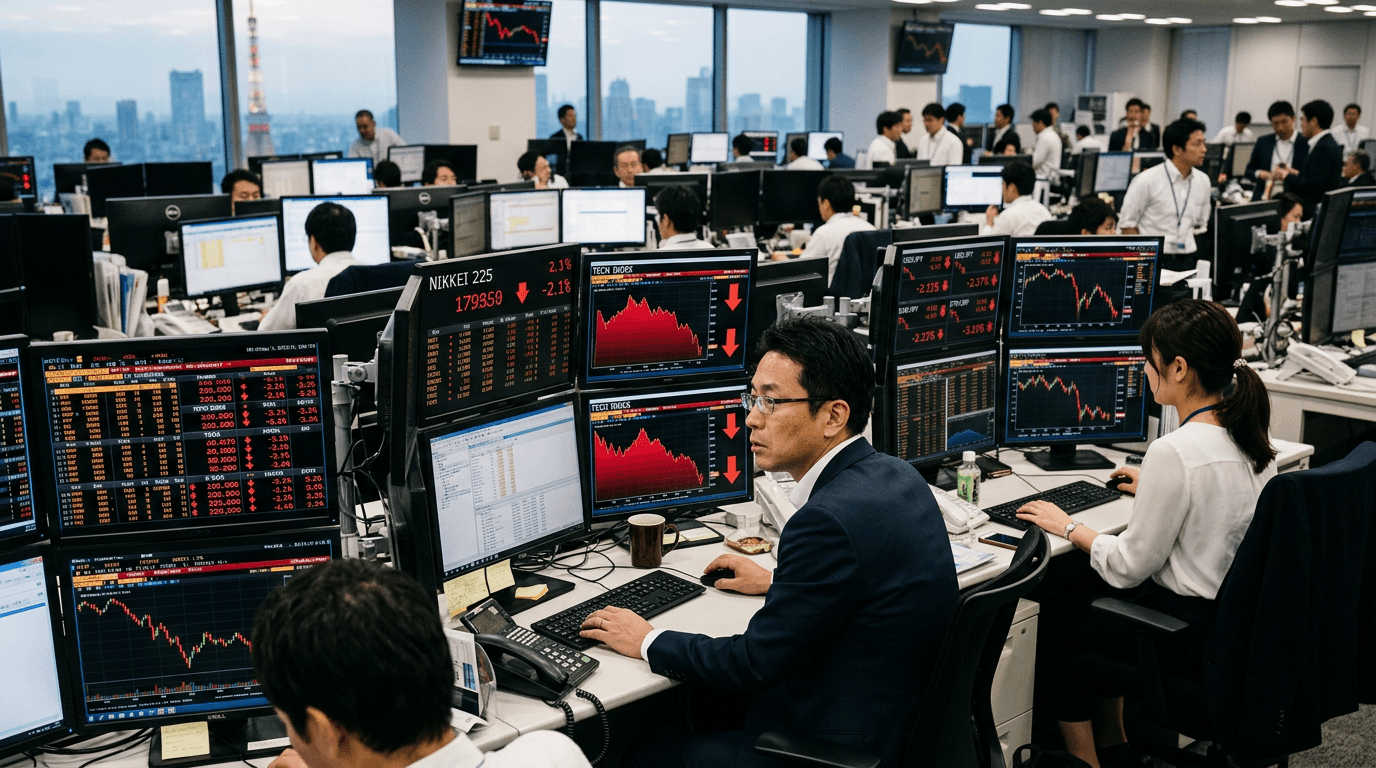
Asian equities are pulling back from record highs, reminding traders that even the strongest rallies pause for breath. A mix of profit-taking in technology, sharp price hikes from Apple, and ongoing weakness in global megacap names has cooled risk appetite, with regional futures pointing to a softer open and volatility spilling into currencies and crypto.
Market Recap: From Record Highs To A Reset
After a powerful run that took several Asian benchmarks to fresh highs, the latest session has seen a broad-based retreat. Investors who had been leaning heavily into growth and AI themes are using the news flow as an opportunity to lock in gains and reassess valuations.
Recent episodes show how quickly sentiment can turn: when Asian stocks last retreated from records, markets like South Korea saw single‑day drops of more than 6%, triggering temporary trading halts as risk assets repriced lower.[2][3] While the current move is more modest, the dynamic is similar — a crowded trade in tech and growth meeting a catalyst that encourages traders to hit the sell button.
This pullback is not yet a full-blown risk crisis. It looks more like a classic “reset” after a strong trend: prices stretched to the upside, an external shock hits (in this case, Apple’s pricing moves and megacap tech softness), and short‑term money steps back. For active traders, these phases are often where both mistakes and opportunities are made.
Why Tech Is Under Pressure
Technology has been the main engine behind recent equity gains in both the U.S. and Asia, particularly names tied to AI, semiconductors, and high-end hardware. That leadership cuts both ways. When tech stumbles, it can drag entire indices with it.
Apple’s sharp price hikes on key products and services have raised questions on two fronts:
First, demand elasticity. When a market leader raises prices aggressively, investors immediately ask: Will end‑demand hold up, or will consumers trade down, delay upgrades, or switch to competitors?
Second, valuation sustainability. If investors already priced in strong growth and stable margins, any sign that demand might soften can feel like a crack in the story. That is especially true when big tech names are trading at premiums to historical multiples.
Ongoing weakness in megacap tech in the U.S. feeds directly into Asia because of how tightly integrated global supply chains and investor positioning have become. Asia is packed with companies that supply chips, components, foundry services, and manufacturing for the same megacap giants now under pressure.[2][3] When those giants wobble, markets logically mark down their suppliers and partners.
Layer on top of this the broader macro backdrop — where previous pullbacks from record highs were driven by rising bets on interest rate hikes and tighter financial conditions — and you get a familiar recipe: higher discount rates plus lofty growth expectations equals more vulnerability in long-duration assets like tech.[2][3]
How Futures Signal A Softer Open
Equity futures are one of the market’s most useful real-time indicators of sentiment. When the headline reads that futures are signaling a softer open, it means that traders in the derivatives market are pricing in lower cash index levels at the next open.
Here is why that matters
Price discovery around the clock Futures for major indices (such as Nikkei, Hang Seng, S&P 500, and Nasdaq) trade nearly 24 hours a day, reflecting how investors digest news from different time zones. If U.S. tech sells off late in the New York session, Asian index futures will often move before local cash markets open, effectively “pre‑marking” the direction.
Risk management and hedging Institutional investors use futures to hedge portfolios quickly. When macro or sector-specific news hits — like Apple’s price changes or a broad megacap tech selloff — selling index futures is often the fastest way to de‑risk. A persistent discount in futures relative to fair value is a sign that hedging demand is elevated.
Signal, not certainty A softer open in futures does not guarantee a weak close. Cash market liquidity, local headlines, and intraday flows can reverse the tone. For short‑term traders, the key is to treat futures as an early signal of sentiment, not a deterministic forecast.
What It Means For Fx, Crypto, And The Dollar
The tech‑led risk‑off tone is not staying confined to equities. When global investors cut exposure to growth assets, the ripple effects show up quickly in currencies and digital assets.
Support for the dollar In risk‑off phases, the U.S. dollar typically benefits as investors seek liquidity and perceived safety. Growth‑sensitive currencies such as the Australian dollar, New Zealand dollar, Korean won, and some emerging Asian FX often weaken against the dollar when equities slide and volatility rises.
Volatility in growth‑sensitive FX Historically, episodes where Asian equities retreated from record highs on macro or rate concerns have coincided with sharper moves in regional FX, especially when foreign investors withdraw capital.[2][3] Even a sector‑driven shock like tech weakness can trigger similar patterns if it changes the broader risk appetite.
Crypto under pressure Crypto assets, particularly those viewed as high‑beta expressions of liquidity and growth sentiment, tend to struggle when equities correct. As volatility rises, leveraged positions are unwound, and traders reduce exposure to the riskiest parts of their portfolios. The result is often an outsized move in crypto relative to the initial shift in equities.
Practical Takeaways For Traders
For both new and experienced traders, these kinds of sessions are critical learning environments. A few practical angles to focus on:
Separate narrative from positioning A headline about Apple’s price hikes or megacap weakness is the narrative; positioning is how crowded the trade already was. If tech and AI had become consensus longs, even a small negative surprise can produce an outsized reaction. Watching sentiment indicators and flow data can be as important as following the news itself.
Use futures as a sentiment dashboard Track index futures alongside spot indices to understand how global news is being digested across time zones. A gap between futures pricing and cash markets can highlight areas where volatility might be higher at the open.
Watch cross‑asset signals Equity pullbacks that are accompanied by a stronger dollar, wider credit spreads, and heavy selling in growth‑sensitive FX and crypto are more likely to be part of a broader risk‑off episode rather than a narrow sector rotation. This helps inform whether to fade the move or step back.
Focus on risk management, not prediction Moves from record highs often feel emotionally charged — traders fear they are “missing the top” or “buying the dip too early.” Position sizing, predefined stop levels, and scenario planning matter more than guessing the exact low. Simulated trading environments can be especially useful here: they allow traders to test how their strategies behave during sharp rotations out of tech and into safer assets, without real capital at risk.
Look for quality amid the noise Not all tech is equal. High‑quality firms with strong balance sheets, diversified revenue, and defensible moats often emerge from pullbacks in stronger relative positions. Using these periods to refine watchlists and valuation frameworks can turn short‑term volatility into long‑term opportunity.
Today’s retreat from record highs is less about a single company or headline and more about how tightly interconnected modern markets have become. Tech leadership, global futures markets, FX, and crypto all feed into one another. Traders who learn to read these cross‑currents — and to respond with disciplined risk management rather than emotion — will be better positioned the next time record highs give way to a reset.