
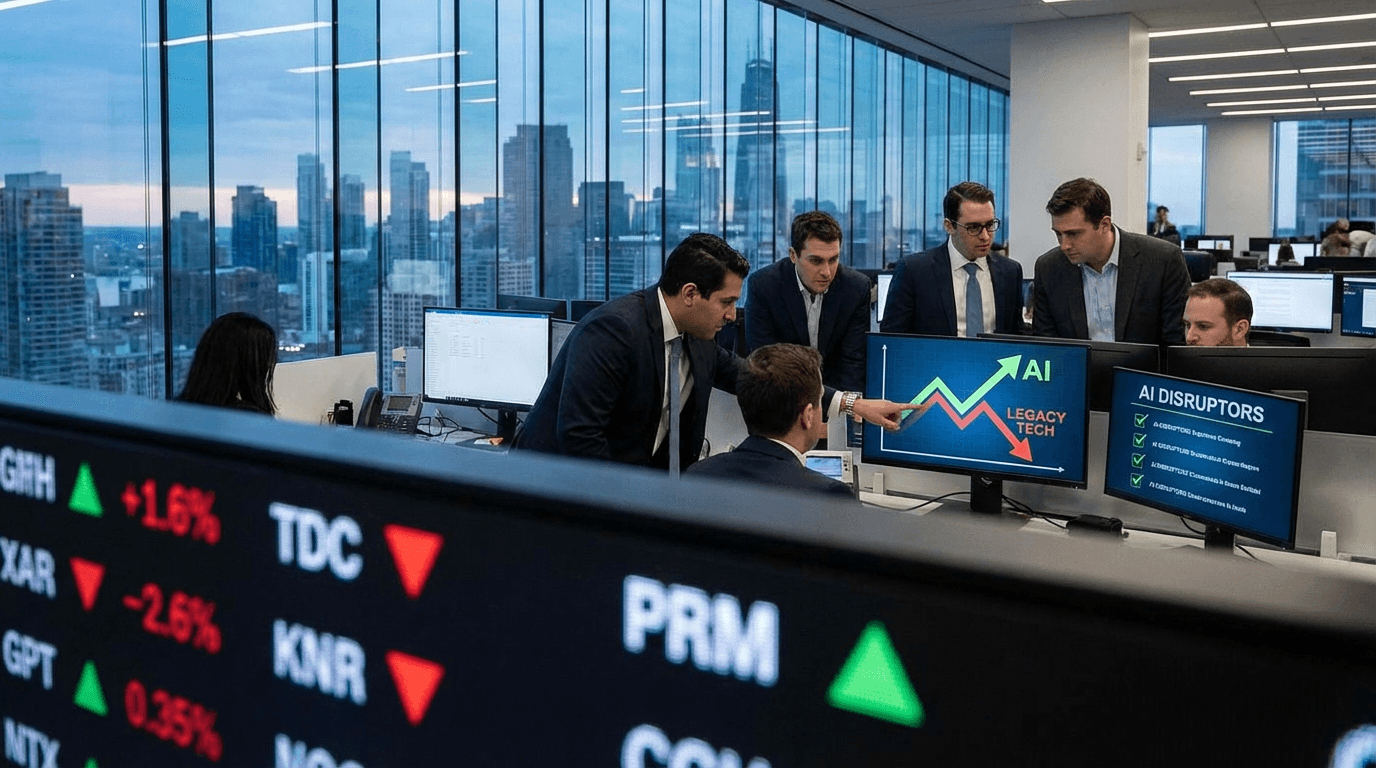
In early 2026, the technology sector finds itself at the center of market turbulence as investors wrestle with the potential upheaval caused by artificial intelligence. While the Russell 1000 index fell almost 2% in early February, the tech sector's steeper 5% decline signals deeper concerns. This downturn extends a worrying trend, with the Magnificent Seven slipping by 3.1% mid-February and the broader tech sector decreasing by 1.2% for the week. These figures, though seemingly minor, reveal a significant shift in market dynamics as investors reassess which companies and sectors will thrive or falter in an AI-dominated landscape.
The Emerging Ai Disruption Trade
The recent market selloff marks a pivotal change in how investors perceive artificial intelligence. Instead of viewing AI as universally beneficial, markets are now distinguishing between AI disruptors—those poised to benefit—and sectors likely to suffer from AI-driven changes. This shift has led to what some call the "AI Armageddon trade," characterized by targeted selling in sectors deemed vulnerable to AI disruption.
Sectors rooted in knowledge-based services, such as finance, real estate, media, medical services, and software, bore the brunt of this rotation during the early-February downturn. Stocks in private credit, data analytics, legal services, logistics, and insurance brokerage have faced selling pressure as investors rethink their exposure to roles that AI could potentially automate or transform.
Signals Of A Healthy Market Adjustment
The current market environment highlights a broader, healthy rebalancing following years of concentrated gains in mega-cap technology firms. The S&P 500's year-to-date performance underscores this shift, with declines in communications services (2.5%), information technology (4.95%), consumer discretionary (4.99%), and financials (5.9%).
Conversely, sectors that previously underperformed are now drawing investment. Basic materials have surged 16.7% year-to-date, with energy climbing 12.9%. Even defensive sectors like consumer staples have seen nearly a 10% gain this year. This diversification away from tech concentration represents a necessary correction after years of disproportionate gains in a select few mega-cap stocks.
Globally, the narrative holds true. While US tech struggles, semiconductor and equipment manufacturers in emerging markets like TSMC, Samsung, and SK Hynix have posted gains from 30% to 75% over the past three months, despite the Magnificent Seven's 4% decline. This suggests that markets are differentiating between various tech sectors and regions, acknowledging that not all face the same disruption risks.
Deciphering Disruption Concerns
The current market behavior reflects a rational assessment of structural economic changes rather than panic. Investors are confronting real questions about AI's impact on labor markets, business models, and productivity. Knowledge-based service sectors, traditionally valued for human expertise, face uncertainty about their competitive standing in an AI-enhanced world.
It's vital to separate temporary market volatility from genuine economic disruption. While the early-February pullback offered insights into AI's long-term effects, it was also influenced by factors like earnings releases. The quick market recovery post-selloff indicates that much of the movement was due to positioning adjustments rather than conviction-driven sales.
Navigating The Evolving Market Landscape
For traders and investors, several key insights emerge. First, diversifying away from tech concentration likely bodes well for market health and stability, as the current rotation corrects years of imbalanced gains in mega-cap tech stocks.
Second, the AI disruption narrative is rapidly evolving, and market positions will continue to shift as new AI capabilities and adoption timelines emerge. Companies that prove themselves as AI adopters, not victims, should continue to attract investment.
Third, the current climate underscores the importance of sector-specific research and fundamental analysis. Blanket tech sector exposure overlooks crucial distinctions between companies driving AI disruption and those facing structural challenges. Within tech, semiconductor equipment manufacturers are drawing different capital flows compared to software companies facing potential disruption.
Though the tech sector's recent weakness reflects economic uncertainty, it also signifies a natural market recalibration. Investors should seize this opportunity to reassess positioning, identify segments aligned with their views on AI disruption, and explore opportunities beyond mega-cap tech stocks.