
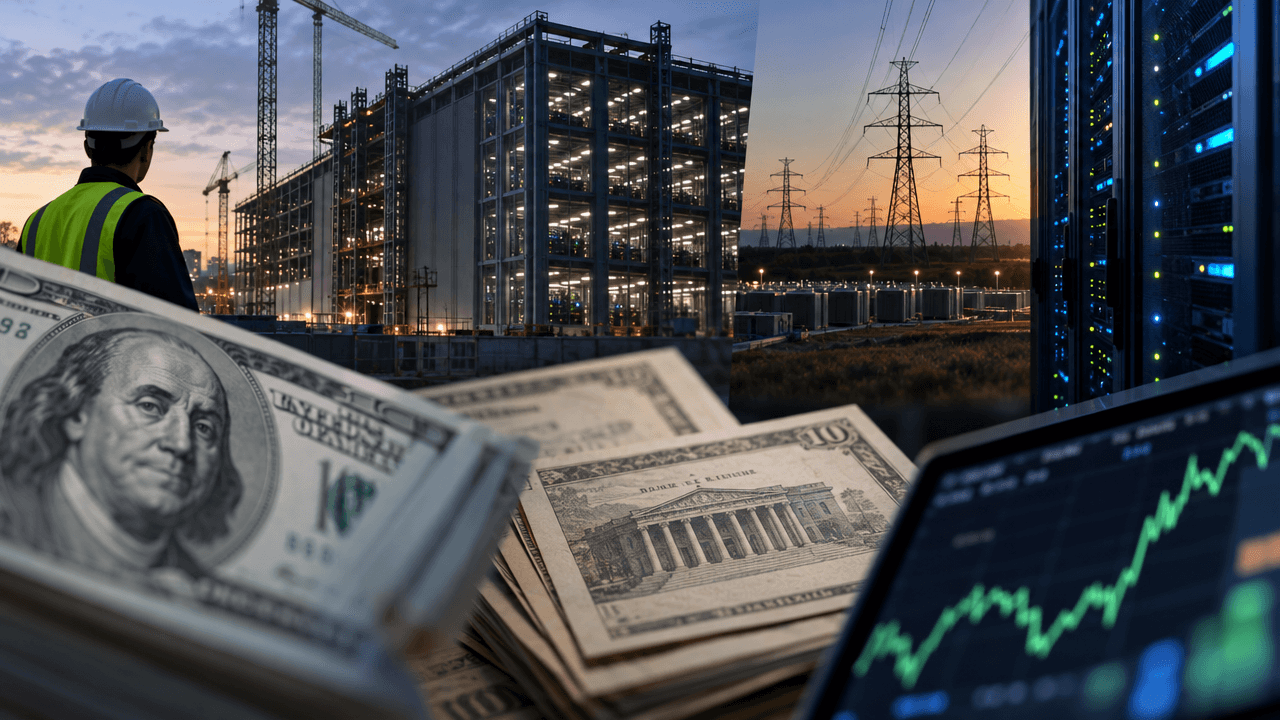
Artificial intelligence is reshaping the U.S. economy through a surge of spending on data centers, advanced chips, software, power generation, and construction. That investment is supporting economic growth, but it is also creating a new policy challenge: the infrastructure required to build the AI economy is competing for scarce labor, energy, materials, and capital.
The result could be a more complicated market environment. AI investment may continue to lift corporate earnings and productivity over time, while its short-term demand shock adds pressure to prices and interest rates. For traders, that tension matters across Treasury futures, the U.S. dollar, technology-heavy equity indexes, and expectations for Federal Reserve policy.
The Scale Of The Ai Buildout
The capital required to support AI has expanded rapidly. Companies have announced more than $2 trillion in specific U.S. data-center construction projects, although only a fraction of those plans has been completed. [3] Spending includes not only buildings, but also servers, networking equipment, semiconductors, cooling systems, electricity infrastructure, and specialized software.
This spending is large enough to influence national economic data. The Federal Reserve has described data-center construction and related equipment investment as major contributors to the recent investment boom. [1] Demand for memory chips, high-performance computing equipment, utilities, and construction services has risen alongside the expansion.
The important point for markets is that AI infrastructure is not isolated within the technology sector. Data centers require inputs used by many other industries. When those inputs become scarce, AI-related demand can raise costs for construction companies, manufacturers, utilities, and businesses competing for the same resources.
In practical terms, the AI boom can produce two effects at once. It can raise productivity and future growth expectations, while also generating near-term inflation through intense demand for limited supplies.
Labor Bottlenecks Create A Second Round Of Pressure
Labor is one of the most important constraints facing the buildout. Data-center projects require electricians, engineers, construction workers, equipment installers, power specialists, and technicians. Many of these roles cannot be filled quickly, particularly in regions where several large projects are competing for the same skilled workforce.
A limited pool of qualified workers can increase wages, extend project timelines, and raise the total cost of construction. Higher labor costs may eventually be passed through to customers, investors, or businesses purchasing electricity and technology services.
The labor story is not uniformly strong, however. The Federal Reserve’s recent review found that AI’s overall labor-market effects remain small and mixed so far. [2] Some industries are experiencing strong demand for specialized workers, while others are beginning to see weaker demand for certain tasks. Federal Reserve Governor Lisa Cook has pointed to cooling labor demand in areas such as software coding and simultaneous translation, along with longer job searches among some younger workers. [3]
That combination creates an unusual economic risk. AI infrastructure may be inflationary because it increases demand for specialized labor, even as AI adoption reduces employment opportunities in selected occupations. A strong headline labor market could therefore conceal significant differences between workers, industries, and regions.
Why Inflation Expectations Matter
The inflation impact of AI infrastructure depends on how quickly supply can respond. If new power capacity, chip production, and construction labor expand fast enough, price pressures may remain temporary. If supply cannot keep pace, the investment boom could keep inflation above the Federal Reserve’s 2% target for longer.
Federal Reserve research indicates that prices have already increased in sectors supplying data centers, including memory chips. It also warns that shortages of key inputs can create supply frictions, raising project costs and delaying completion. [2] A separate Federal Reserve analysis concluded that data-center investment relies on broadly used inputs such as construction labor and energy, creating possible price pressure beyond the technology sector. [4]
This is why the inflation question may be more important than the growth headline. Strong AI spending can produce impressive economic activity, but if it pushes prices higher, the Federal Reserve may have less room to cut interest rates. In a more persistent scenario, policymakers could even consider keeping rates elevated for longer or tightening policy further.
The market does not need to see an immediate rate hike for expectations to change. A series of hot inflation readings, higher wage data, or rising electricity costs could be enough to move futures markets.
What Traders Should Watch
Treasury futures are particularly sensitive to this theme. If investors believe AI investment is increasing inflationary pressure, Treasury yields may rise and futures prices may fall as expectations for rate cuts are reduced. The most exposed maturities will depend on whether traders view the pressure as temporary or persistent.
The dollar could also receive support from a more restrictive Federal Reserve outlook. Higher expected U.S. interest rates generally make dollar-denominated assets more attractive, although a sharp equity selloff or concern about fiscal risks could complicate that relationship.
Technology-heavy equity indexes face a two-sided reaction. AI spending supports revenue expectations for chipmakers, cloud providers, equipment manufacturers, and data-center operators. At the same time, higher interest rates raise the discount rate applied to future earnings and increase the cost of financing new infrastructure.
Traders should therefore separate company-specific AI beneficiaries from the broader valuation effect. A strong semiconductor earnings report may support technology stocks, but a hotter-than-expected inflation report could pressure the entire index by shifting rate expectations.
Practical Takeaways For Simfi Traders
First, track both AI investment data and inflation data. Capital-expenditure announcements reveal future demand, while wages, utilities, chip prices, and construction costs show whether supply is keeping pace.
Second, watch the relationship between Treasury futures and technology indexes. A simultaneous decline in both can signal that rate expectations are overwhelming the positive growth effect from AI spending.
Third, avoid treating labor data as a single headline. Look for differences between skilled infrastructure jobs, software roles, and entry-level positions. Those distinctions may provide a clearer picture of where AI is creating shortages and where it is reducing demand.
Finally, build scenarios rather than relying on one forecast. In a soft-landing scenario, AI investment raises productivity and eventually expands supply. In a higher-inflation scenario, bottlenecks persist and rates remain elevated. The market reaction will depend on which path incoming data supports.
Conclusion
AI infrastructure is more than a technology-sector story. It is becoming a macroeconomic force capable of influencing prices, employment, monetary policy, currencies, bonds, and equity valuations.
The long-term benefits of AI may be substantial, but the transition is creating short-term competition for labor, energy, equipment, and capital. For market participants, the central question is whether supply can expand quickly enough to absorb the investment surge without keeping inflation uncomfortably high.
Until that answer becomes clearer, AI-related growth and inflation risk will remain competing forces. The best-informed traders will monitor both sides of the equation.