
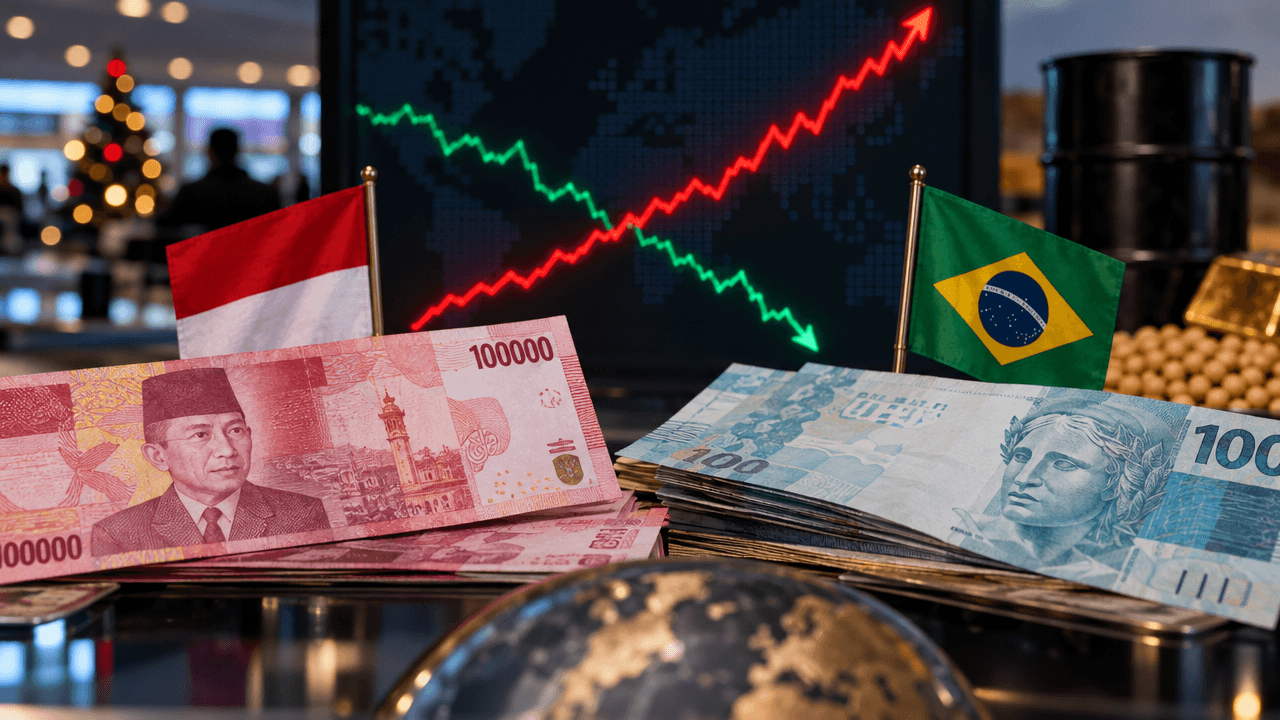
Foreign-exchange markets delivered a sharp reminder this week that liquidity can matter as much as headlines. During a holiday-thinned session, USD/IDR was reported as the strongest listed forex mover, rising 3.31%, while USD/BRL fell 2.95%. Moves of that size are unusual in major currency pairs and suggest that positioning, commodity prices, and emerging-market risk were amplified by lighter trading conditions. Thin liquidity can exaggerate price swings because fewer orders are available to absorb buying or selling pressure. [2]
Why Holiday Liquidity Matters
Currency markets operate around the clock, but they do not trade with equal depth at every hour or on every calendar day. When a major financial center is closed for a holiday, banks, funds, corporates, and market makers may reduce activity. Fewer participants can mean wider bid-ask spreads, less reliable short-term price discovery, and greater sensitivity to individual orders.
Under normal conditions, a large transaction may be absorbed without dramatically changing the exchange rate. In a thin market, the same transaction can push prices through nearby support or resistance levels. That initial move may trigger stop-loss orders, algorithmic strategies, or forced position adjustments, creating a chain reaction.
The effect is particularly important in emerging-market foreign exchange. Pairs such as USD/IDR and USD/BRL can be less liquid than the world’s most actively traded pairs, especially outside local market hours or during regional holidays. Market data providers also note that emerging-market liquidity can be significantly reduced at the start of the week and during local holidays. [5]
READING THE USD/IDR MOVE
A 3.31% rise in USD/IDR means the dollar gained sharply against the Indonesian rupiah. Traders should not automatically interpret that move as proof of a sudden collapse in Indonesia’s economic outlook. It may instead reflect a combination of dollar demand, reduced local participation, portfolio rebalancing, and stop-loss activity.
The rupiah is sensitive to global risk appetite because international investors often treat emerging-market currencies as higher-beta assets. When investors become more defensive, they may reduce exposure to local bonds and equities, exchange rupiah proceeds back into dollars, or favor currencies perceived as safer. Those flows can become especially powerful when the order book is thin.
Commodity prices and U.S. interest-rate expectations can also influence USD/IDR. Higher U.S. yields may attract capital toward dollar assets, while rising energy or import costs can affect countries that rely heavily on imported fuel and other external inputs. Recent market commentary has highlighted a stretched dollar, renewed oil strength, and the potential for late-session moves to become larger than usual in shortened holiday weeks. [1][2]
WHY USD/BRL MOVED IN THE OPPOSITE DIRECTION
The 2.95% decline in USD/BRL indicates that the Brazilian real strengthened against the dollar. That reversal is notable because the real is closely linked to global risk sentiment, commodity markets, domestic interest-rate expectations, and political developments.
Brazil’s position as a major exporter of agricultural products, metals, and energy means commodity prices can influence the real’s appeal. Stronger export expectations may support foreign-currency inflows, while weaker commodity prices can undermine them. However, the relationship is not automatic. A rally in one commodity may benefit Brazil while simultaneously increasing inflation concerns or changing expectations for domestic monetary policy.
The contrast between USD/IDR and USD/BRL illustrates why emerging-market currencies should not be treated as a single trade. Two developing economies can respond differently to the same dollar trend because of differences in central-bank policy, external balances, commodity exposure, investor positioning, and local political risk.
For traders, the key lesson is to examine relative performance rather than simply conclude that “emerging markets” are strengthening or weakening. Divergence often contains more information than a broad index move.
Positioning Can Turn A Small Catalyst Into A Large Move
Price action during thin sessions can reveal how crowded a trade has become. If many traders hold similar positions, even a modest move against them can prompt rapid unwinding. A currency that has been sold heavily may rebound sharply when short positions are covered. Conversely, a currency supported by leveraged long positions can fall quickly when traders rush to reduce exposure.
This is why percentage moves should be considered alongside volume, time of day, market depth, and the news calendar. A large move on low participation may carry less information about long-term fundamentals than a smaller move confirmed by broad, sustained flows.
That does not make the move irrelevant. Thin-market volatility can establish technical levels that remain important after normal liquidity returns. It can also expose weaknesses in risk management, particularly when traders use excessive leverage or place stops too close to current prices.
Practical Lessons For Simfi Traders
First, reduce position size when liquidity is expected to deteriorate. Smaller exposure gives a strategy more room to withstand spread widening and temporary price spikes.
Second, avoid assuming that a familiar technical setup will behave normally during a holiday session. Breakouts can fail, spreads can expand, and slippage can increase. Traders should test their strategy under variable execution conditions rather than relying only on historical average spreads.
Third, monitor correlated markets. For USD/IDR, watch the dollar index, U.S. Treasury yields, Asian equities, and commodity prices. For USD/BRL, include Brazilian rates, agricultural and energy markets, and broader risk appetite. Correlations are not constant, but they can help distinguish a currency-specific move from a wider macro shift.
Finally, wait for confirmation when the initial move appears extreme. A return of normal liquidity can either validate the breakout or expose it as a temporary positioning event.
Conclusion
The sharp opposite moves in USD/IDR and USD/BRL show how quickly holiday conditions can magnify regional currency differences. Thin liquidity does not create every market trend, but it can accelerate price discovery, widen the impact of individual orders, and turn positioning into volatility.
For SimFi traders, the most valuable takeaway is simple: market conditions are part of the trade. Understanding liquidity, execution risk, commodities, and positioning is just as important as identifying a chart pattern. When participation is reduced, patience and disciplined risk controls often provide a greater edge than chasing an unusually large candle.