
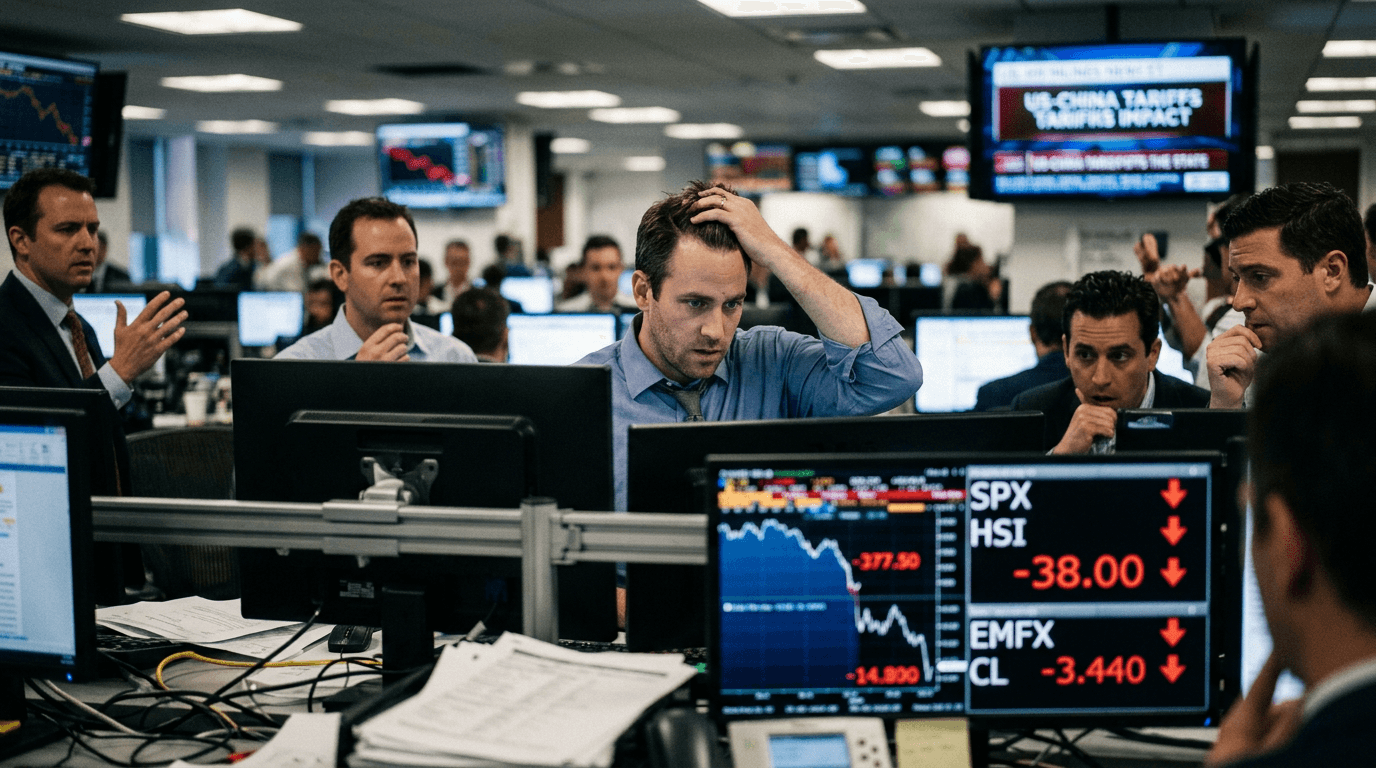
Financial markets have been jolted back into “trade war mode” after Washington confirmed that tariffs on most Chinese imports are now effectively 145%, higher than earlier headlines suggested. Beijing’s swift retaliation, lifting duties on US goods to around 125% and signaling a willingness to hit US firms through regulatory and administrative measures, has reignited risk aversion across global assets and forced traders to reassess growth and inflation trajectories.
WHAT’S BEHIND THE 145% TARIFF FIGURE?
The 145% headline rate is not a single, newly introduced tax but the result of layered measures built up over time.
Initially, the US imposed a 20% tariff on Chinese goods linked to concerns over fentanyl production and trafficking. More recently, the administration announced a broad 125% levy on Chinese imports in response to what it describes as unfair trade practices, forced technology transfers, and strategic overcapacity in sectors such as EVs, batteries, and solar.
When combined, that earlier 20% and the new 125% hike produce an effective rate of 145% on many Chinese products. Some categories may be exempt or subject to different rates, but for market purposes, the working assumption is that a very large share of bilateral trade is now operating under prohibitively high tariffs.
The message is clear: the US is using tariffs as a primary bargaining tool, not just as a limited pressure tactic. This raises three key economic risks:
1) Cost-push inflation: Higher input costs for US manufacturers and retailers can ripple into consumer prices, particularly in electronics, machinery, consumer goods, and intermediate components where Chinese supply dominates.
2) Supply chain disruption: Firms reliant on China as a key manufacturing hub face a forced rethink of sourcing, logistics, and inventory strategies. Nearshoring and friend-shoring themes gain renewed relevance.
3) Slower global trade volumes: As the world’s two largest economies tax each other’s goods heavily, overall trade flows can slow, weighing on global growth and trade-sensitive sectors.
For traders, it is less about memorizing every tariff line and more about understanding that a large part of US-China trade has effectively shifted from “low-friction” to “high-friction” status overnight.
BEIJING’S RESPONSE: RETALIATION AND SIGNALING
China’s response has been twofold: raising tariffs on US imports to around 125% and signaling that the escalation has crossed from economics into strategic rivalry. Beijing has also hinted at more subtle, non-tariff measures, including:
- Regulatory scrutiny of US firms operating in China
- Slower approvals for mergers, licenses, or product certifications
- Informal pressure on state-owned enterprises and institutions to reduce reliance on US suppliers
Notably, Chinese officials have framed their move as a “final” tariff response, arguing that the absolute percentage points have become symbolic rather than economically rational. Whether this is a genuine ceiling or a negotiating posture remains to be seen, but markets are reading it as a sign that relations have entered a more entrenched and less predictable phase.
For global investors, the takeaway is that US-China tensions now extend well beyond simple tariff math. The risk of targeted corporate actions, export controls, and technology restrictions has increased, particularly in semiconductors, advanced manufacturing, and dual-use technologies.
Market Reaction: Fx, Equities, And Commodities
The immediate market reaction has followed a familiar risk-off pattern, but with some important nuances traders should understand.
1) Foreign Exchange
- Safe-haven FX supported: The Japanese yen (JPY) and Swiss franc (CHF) have firmed as investors unwind carry trades and seek perceived safety. Historically, episodes of tariff escalation have seen JPY strengthen especially versus high-yield and pro-cyclical peers.
- EM and export-sensitive currencies under pressure: Emerging market FX tied closely to global trade and commodities has come under selling pressure. Currencies of open, export-oriented economies—especially those deeply integrated into Asian and global manufacturing supply chains—are also vulnerable as markets price slower trade volumes and investment.
- US dollar mixed: The dollar can benefit from safe-haven flows but faces offsetting dynamics from shifting Fed expectations. If markets fear that weaker global growth will eventually force easier US monetary policy, that can cap USD gains over time.
2) Equities
- Global indices lower, volatility higher: Equity futures have sold off, with volatility indices spiking as traders quickly reprice earnings expectations for multinational firms and trade-dependent sectors.
- Sector differentiation: Export-heavy sectors such as autos, industrials, and technology hardware are particularly sensitive, while domestically focused, defensive sectors (utilities, staples, some healthcare names) often hold up relatively better.
3) Commodities
- Growth-sensitive commodities: Industrial metals and energy have wobbled as markets reassess demand expectations. Copper, often treated as a barometer of global manufacturing health, is especially exposed to trade war narratives.
- Precious metals: Gold and, to a lesser extent, silver tend to find support as investors seek hedges against both financial volatility and geopolitical uncertainty.
Trading Implications: Opportunities And Risks
For traders, the renewed trade conflict is less about predicting political outcomes and more about managing volatility and correlation shifts across assets.
Key implications include
- Higher short-term volatility: Markets will react strongly to headlines, leaks, and official statements. Expect wider intraday ranges in FX, equity indices, and key commodities as algorithms and discretionary traders respond to news in real time.
- Regime shifts in correlations: Correlations can change abruptly. For instance, JPY may decouple from traditional yield-based drivers and trade more as a pure risk barometer. Equity indices may move more in sync across regions as “macro risk” dominates stock-specific factors.
- Time horizon matters: Short-term traders can look for mean-reversion or breakout setups around major announcements, while swing and position traders may focus on broader themes such as prolonged risk aversion or sector rotation from cyclicals into defensives.
Practical risk management is critical
- Use clearly defined stop-loss levels and position sizes sized to account for wider ranges.
- Avoid overexposure to highly correlated trades (e.g., multiple risk-on positions that all depend on a quick trade resolution).
- Consider scenario analysis: how your portfolio behaves if tensions escalate further versus partially de-escalate.
How To Navigate Trade-war Headlines
Because political and trade news is inherently noisy, traders benefit from a structured approach to information rather than reacting emotionally to every alert.
Consider the following process
1) Distinguish signal from noise Is this a concrete policy change (e.g., a signed tariff order) or just rhetoric? Markets typically react more durably to legally binding actions than to speculative headlines or political posturing.
2) Map the transmission channels Ask: Which sectors, countries, and commodities are directly affected? For example, tariffs focused on autos and electronics have different market implications from those targeting agricultural goods.
3) Track official communication cycles Major trade announcements often cluster around scheduled events: summits, ministerial talks, or legal deadlines when tariffs are set to increase or expire. Building a simple calendar of these risk dates helps anticipate volatility spikes.
4) Combine macro themes with technical levels Even powerful macro headlines tend to express themselves through key technical zones. Support, resistance, and volatility bands remain useful reference points for entries and exits, especially when combined with an informed macro view.
Conclusion
The latest escalation in the US-China trade war, with US tariffs effectively at 145% and China retaliating with its own 125% measures, reinforces a message markets have been grappling with for years: strategic competition between Washington and Beijing is not a passing phase. It is an enduring structural theme that will periodically erupt into market-moving episodes.
For traders, the goal is not to guess the exact endgame of this conflict, but to build robust strategies that can weather and, where possible, capitalize on the volatility it generates. That means understanding how tariffs feed into growth expectations, inflation, sector earnings, and cross-asset correlations—and then translating that understanding into disciplined risk management and flexible positioning.
In an environment where trade policy can change the tone of global markets in a single headline, the edge belongs to traders who pair macro awareness with a clear, tested trading process.