
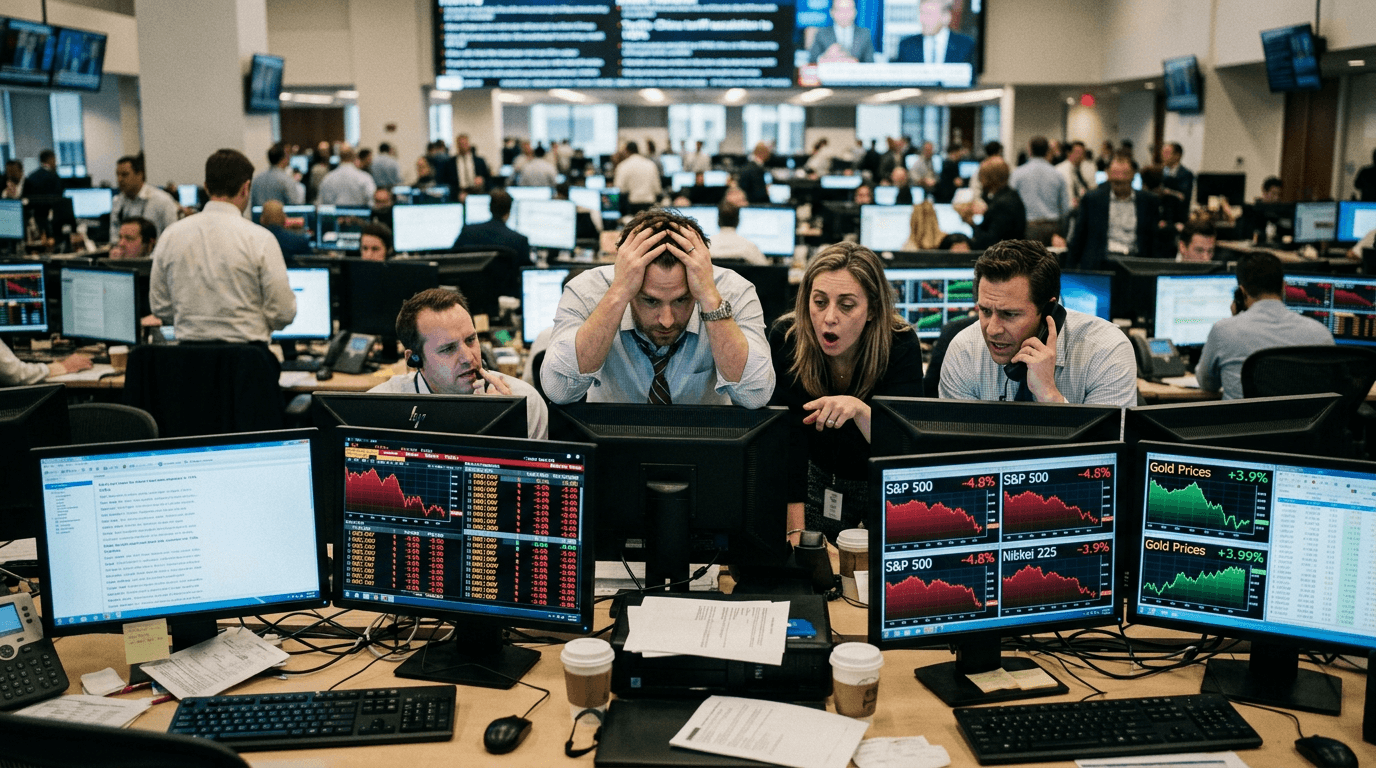
Tariff headlines are once again driving markets instead of following them. The United States has clarified that new duties on select Chinese imports will be lifted to a punishing 145%, up from the 125% previously indicated. Beijing has responded with swift retaliatory tariffs, and the result is a classic risk-off wave: the US dollar and Japanese yen are catching a bid, high‑beta and emerging market currencies are under pressure, equity futures are in the red, and safe-haven assets are finding strong demand.
WHAT JUST HAPPENED IN THE TRADE WAR?
This latest move is part of an aggressive “reciprocal tariffs” framework targeting China. US authorities have layered new duties on top of existing tariffs, pushing the effective rate on affected Chinese goods to around 145%. The policy aims to punish what Washington calls unfair trade practices and to encourage supply chains to shift away from China.
China has responded in kind, lifting its own tariffs on US imports and signaling that it is prepared to “fight to the end” on trade. Officials in Beijing also indicated that at current duty levels, many US exports are effectively uneconomic, implying that future US tariff hikes may not be met with equivalent moves simply because there is little left to tax.
For markets, the key point is not just the level of tariffs but the signaling effect. Investors had been hoping for stabilization or a negotiated pause. Instead, they are facing a renewed escalation that raises questions about:
- Global growth, particularly for trade‑sensitive sectors
- Supply chain resilience and the cost of rerouting production
- Inflation dynamics as tariffs filter into consumer prices
- Corporate earnings for firms heavily exposed to US‑China trade
As long as the trajectory of policy is uncertain and headline risk is high, markets will demand a higher risk premium, and that is exactly what we are seeing now.
How Markets Are Reacting: Risk-off In Full Swing
The immediate reaction has followed a familiar pattern seen in previous trade war episodes, but with sharper moves given how extreme the tariff levels now are.
Currencies: The US dollar and Japanese yen are outperforming as investors unwind carry trades and seek liquidity and safety. High‑beta currencies such as the Australian and New Zealand dollars, as well as Scandinavian FX, are under pressure. Emerging market currencies tied closely to global trade and commodity demand are also weakening, reflecting concerns over slower growth and capital outflows.
Equities: Equity index futures in the US and Europe are trading lower, led by sectors with high exposure to global trade and China: semiconductors, industrials, autos, and luxury goods. Companies that rely heavily on Chinese manufacturing or Chinese consumers face a double hit from higher costs and potential demand destruction.
Rates and credit: Safe-haven demand is supporting government bonds, pushing yields lower at the long end as investors price in weaker growth and potentially easier monetary policy down the road. Credit spreads are widening, particularly in high yield and in sectors sensitive to global trade, reflecting a repricing of default risk.
Commodities and safe havens: Gold and other classic safe-haven assets are seeing renewed demand as investors hedge against policy uncertainty and potential financial stress. Crude oil prices are firmer, reflecting a mix of geopolitical risk premia and speculation that supply disruptions or restocking could offset concerns about demand. However, if growth expectations deteriorate further, the balance could quickly shift to the downside for energy markets.
Volatility: Implied volatility gauges across asset classes are rising, signaling higher demand for options hedging and a recognition that the future distribution of outcomes has become wider and more uncertain.
For short‑term traders, this environment offers opportunity but also greater risk. Moves can be fast and nonlinear as headlines cross and liquidity thins, particularly in off-hours.
What This Means For Traders: Playing Defense And Offense
Tariff shocks are a classic test of a trader’s discipline. They tempt overreaction, but they also reward preparation. In a simulated environment, traders can use this period to sharpen their playbook for real capital.
Key tactical implications
1) Respect risk-off flows. Fighting safe-haven demand in the early phase of an escalation is usually costly. Fading USD and JPY strength or trying to bottom-pick high‑beta FX and EM currencies too early can be a recipe for drawdowns.
2) Watch cross‑asset confirmation. When FX, equities, rates, and commodities are all telling the same story—higher risk premia and lower growth expectations—that signal tends to be more durable than a move confined to a single asset class.
3) Trade relative exposure, not just direction. Instead of simply shorting indices, consider which sectors or countries are relatively more insulated from US‑China trade and which are most vulnerable. For example, domestically focused sectors may outperform export‑heavy peers, even if both fall.
4) Focus on volatility, not just price. Option markets often lag the first headline shock and then overshoot. Simulated strategies can explore buying gamma early in the move and later transitioning to volatility selling when markets overprice tail risks.
Risk Management And Scenario Planning In A Tariff World
The deeper lesson from repeated tariff flare‑ups is that geopolitical and policy risk are now structural features of the market landscape, not anomalies. That has direct consequences for risk management.
Scenario planning: Build concrete trade war scenarios into your process. For example:
- Scenario A: Further tariff escalation with no talks, deeper risk‑off, sustained USD/JPY strength, and underperformance in EM and cyclical equities.
- Scenario B: Tactical truce where tariffs remain high but new measures pause, leading to partial mean reversion in risk assets.
- Scenario C: Surprise de‑escalation with tariff rollbacks, triggering a sharp risk‑on squeeze, especially in names and currencies that were heavily sold.
For each scenario, define how you would expect major assets to behave, which positions would be at risk, and what hedges would make sense. Then stress‑test your trading strategy against these paths using simulated accounts before putting real money at risk.
Position sizing and leverage: Elevated volatility means that “normal” position sizes may no longer be appropriate. Using historical volatility that predates the tariff shock can understate risk. Adjust sizes and leverage dynamically; in many cases, that means cutting exposure, not adding.
Time horizon discipline: News‑driven markets can whipsaw intraday even as multi‑day trends remain intact. Align your trade horizon with your thesis. If you are trading the broader macro impact of tariffs, avoid letting minute‑by‑minute headlines knock you out of well‑structured positions with clearly defined risk.
Key Takeaways For Simulated Traders
For traders using SimFi platforms, this kind of environment is invaluable training ground. You can:
- Practice executing a macro event playbook without emotional attachment to P&L.
- Test how your strategies behave when correlations spike and liquidity thins.
- Refine your rules around news trading: when to stand aside and when to engage.
A useful exercise is to document your pre‑event view, the signals you are watching across FX, equities, rates, and commodities, and your exact risk parameters. Then, as the trade war story evolves—whether toward further escalation or a negotiated pause—compare your plan to how you actually traded. The gap between the two is often where the real learning lies.
Trade wars are ultimately about politics and policy, but for traders they are about preparation and process. Tariff headlines will come and go; what will endure is how consistently you manage risk, read cross‑asset signals, and adapt your strategies in a world where policy can change the game in a single announcement.