
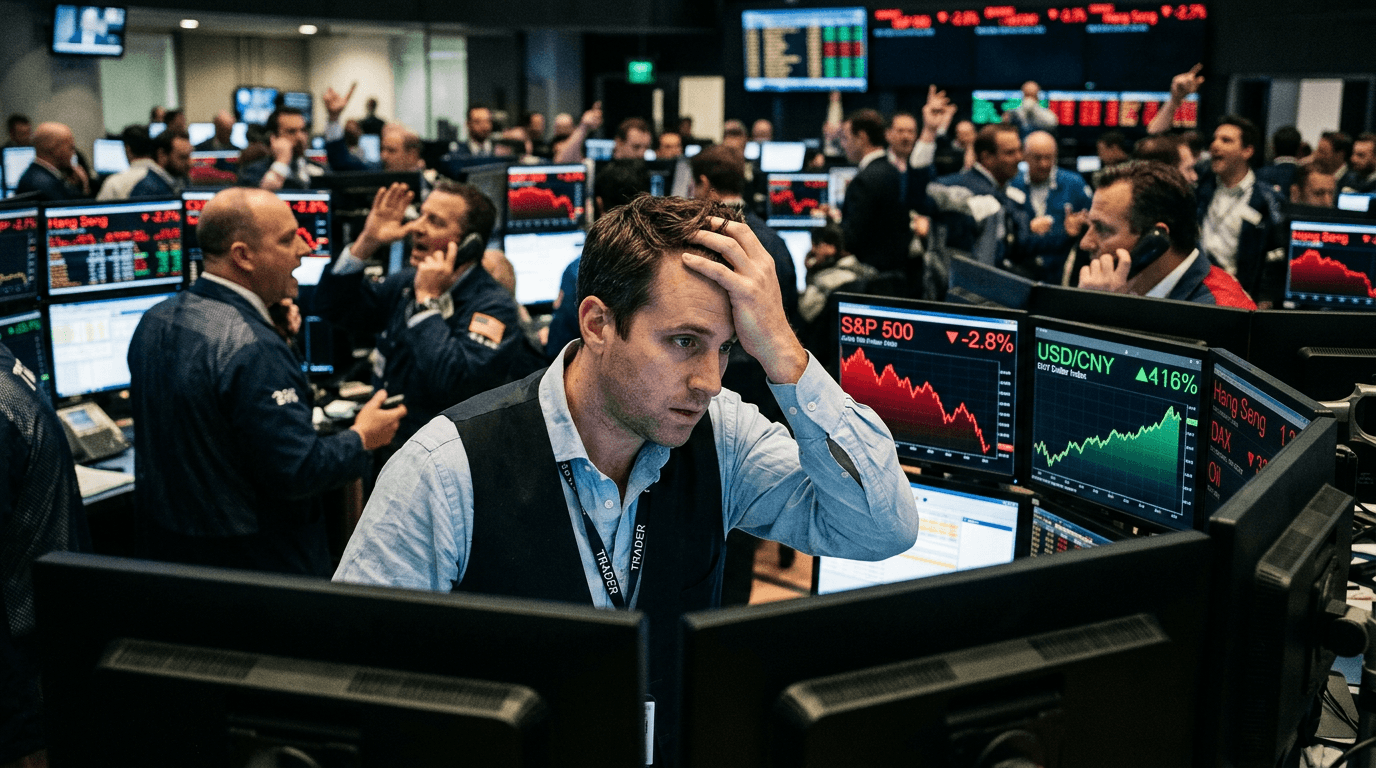
Fresh escalation in US–China trade tensions has once again put markets on edge. Higher tariffs, hardline rhetoric and warnings against retaliation have rekindled memories of previous trade-war flare-ups, sending risk assets lower, supporting the US dollar at times, and reviving questions about the durability of global growth. For traders, this is a classic mix of political uncertainty, macro risk, and fast-moving price action.
Why Tariffs Jolt Markets
Tariffs are, at their core, a tax on cross-border trade. When the world’s two largest economies raise those taxes on each other, investors immediately rethink assumptions about profits, growth and inflation. Markets are forward-looking: as soon as trade barriers rise, earnings forecasts, investment plans and supply-chain models come under review.
The effect is not confined to the directly targeted sectors. Modern supply chains are deeply interconnected. A tariff on an intermediate component shipped from China to the US can ripple through technology, autos, machinery, retail and logistics. That broad web of linkages is why headlines about a relatively narrow tariff list can move entire indices like the S&P 500 or MSCI World.
Uncertainty is the real transmission channel. Companies can adapt to a known tariff structure, but they struggle when they don’t know if duties will be 10%, 25%, or 50% in six months’ time. This policy risk premium shows up as higher equity volatility, wider credit spreads, and sudden rotations between cyclical and defensive sectors.
How Asset Classes Are Reacting
Equities are typically the first to reflect trade-war stress. Export-heavy sectors and companies with complex global supply chains often underperform. Industrials, semiconductors, hardware tech, autos and luxury goods tend to be high beta to trade headlines. Meanwhile, domestic defensives like utilities, consumer staples and healthcare can see relative support as investors seek earnings stability.
Currencies react via growth and risk channels. In recent episodes, the US dollar has been supported as a relative safe haven, especially against emerging market currencies more exposed to global trade. The Chinese yuan is closely watched: sustained depreciation can signal both growth concerns and potential policy responses, and it can feed into broader risk aversion if markets sense a currency-weaponization dynamic.
Fixed income markets often price in lower growth and rising risk premia. Government bond yields may fall as investors seek safety and anticipate easier central bank policy to offset trade-related headwinds. Credit markets can see spread widening, particularly in sectors reliant on global demand or with high leverage. For traders, the combination of equity stress and bond strength is a hallmark of risk-off driven by policy shocks.
Commodities add another layer. Industrial metals, energy, and some agricultural products are directly linked to trade volumes and tariff regimes. Trade tensions can depress demand expectations for copper, aluminum or oil, while specific tariffs on agricultural exports can trigger sharp moves in soybeans, corn or pork. Gold, in contrast, often benefits as a classic hedge when geopolitical and policy uncertainty spike.
What It Means For Traders And Investors
For market participants, the renewed trade-war narrative changes both the opportunity set and the risk profile. Volatility is no longer driven purely by data releases and earnings, but by statements, tweets and negotiator soundbites. That means headline risk is elevated, and price gaps around news can be larger and less predictable.
Short-term traders may find more intraday opportunity in indices, FX majors and key commodities as they respond to each trade development. However, the speed of moves can punish overleveraged or undisciplined positions. Tight risk management, clear invalidation levels and an awareness of news calendars are essential.
For medium-term investors, the core questions are: How durable is the hit to global trade and investment? Which sectors can pass on higher costs, and which will see margin compression? Those answers guide portfolio tilts. Under persistent trade stress, portfolios often migrate toward quality balance sheets, stable cash flows, and companies with more domestic revenue exposure.
In a simulated trading environment, this is a real-time lesson in how macro shocks propagate across markets. It gives traders the chance to test strategies for risk-off scenarios, from hedging equity exposure with index futures or volatility products, to trading relative value between sectors, currencies or yields.
Scenario Planning: What Could Come Next
Trading a trade war is really about trading probabilities across scenarios. At a high level, three paths usually matter:
1. Escalation: Further tariff hikes, broader product coverage, and more aggressive rhetoric. This scenario typically supports the US dollar and safe-haven assets, pressures global equities (especially cyclicals), and flattens growth expectations. Volatility stays elevated.
2. Stalemate: Tariffs remain high, negotiations drag on, but there is no clear resolution or further escalation. Markets may oscillate in ranges, with recurring headline-driven spikes in volatility. Sector dispersion becomes more important than index direction as investors distinguish relative winners and losers.
3. De-escalation: Signals of compromise, partial rollbacks, or new trade frameworks. Risk assets typically rally, led by the most beaten-down cyclicals and trade-sensitive names. The dollar’s safe-haven bid can fade, while pro-growth currencies and emerging markets may outperform.
Traders should think through how their preferred instruments react in each of these scenarios. Mapping out expected directional moves, correlations and volatility helps prevent emotional decision-making when the next headline hits.
Practical Takeaways For Sim Traders
Use this environment to build and test a structured approach rather than chasing every headline. A few practical steps:
Define your risk regime: Treat elevated trade tensions as a distinct regime. Backtest how your strategies perform during past trade-war episodes or similar macro shocks. Adjust position sizing, leverage and stop distances accordingly.
Watch cross-asset signals: Don’t just follow the equity index. Monitor the dollar, yuan, long-dated government yields, credit spreads and key commodities. Confirmations or divergences across these markets often provide better information than a single index move.
Plan for gaps and spikes: Headline risk means slippage and sudden moves are more likely. In simulation, practice using contingent orders, reducing exposure ahead of major announcements, and scaling into positions rather than going all-in at a single level.
Think in relative terms: Instead of only trading outright direction, explore relative trades—such as cyclicals versus defensives, export-heavy indices versus more domestic ones, or a trade-exposed currency versus a safe haven. These can express a trade-war view while reducing dependence on the broader market trend.
Finally, remember that policy shocks are recurring features of modern markets. Learning to navigate them in a risk-controlled, simulated environment builds skills that are directly transferable when conditions stabilize or when the next macro narrative takes center stage.