
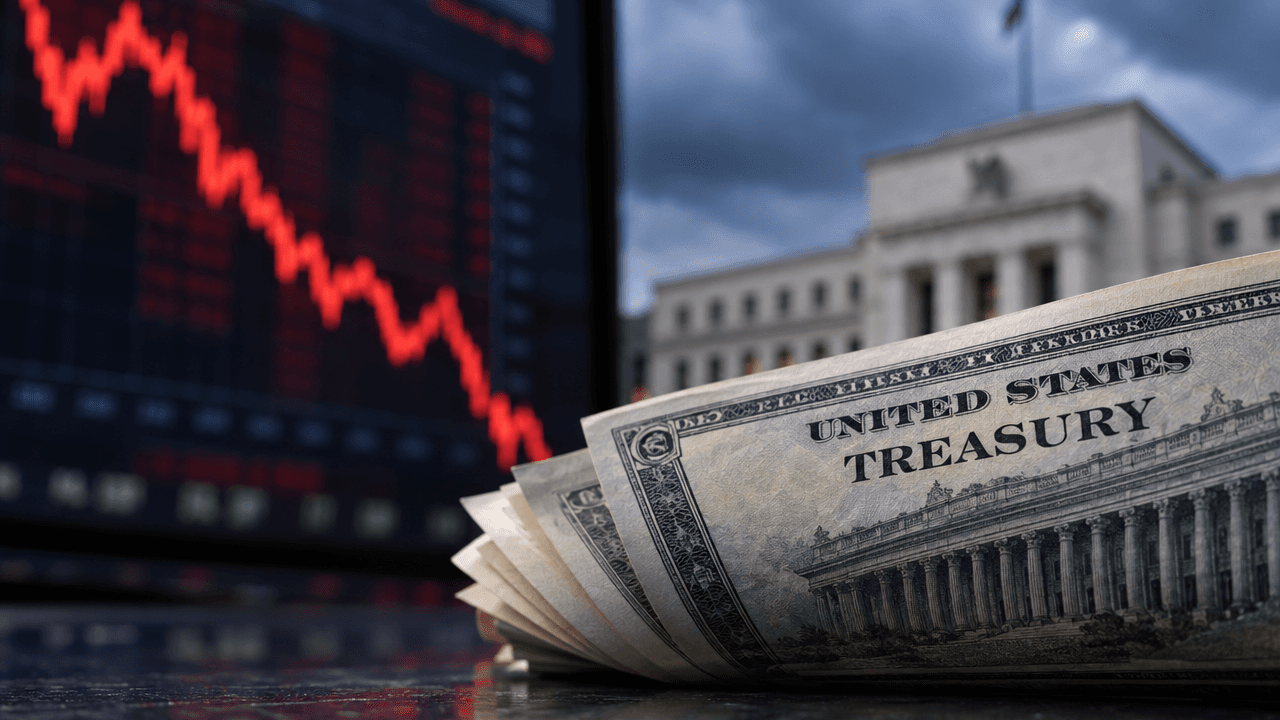
Treasury futures rallied across the curve as investors moved toward government bonds, pushing yields sharply lower despite continued expectations for a hawkish Federal Reserve. December contracts gained in the two-year, five-year, 10-year and long-bond futures, while Treasury yields declined roughly 15 to 20 basis points during the week. The move showed how quickly risk aversion can overwhelm interest-rate expectations when equity markets come under pressure. [2]
What Drove The Treasury Rally
The main catalyst was weakness in equities, particularly as investors questioned the sustainability of the technology and artificial intelligence trade. When stocks sell off, investors often reduce exposure to riskier assets and seek the relative safety and liquidity of U.S. government debt. That defensive rotation increases demand for Treasury securities.
Bond prices and yields move in opposite directions. When investors buy Treasury notes and bonds, their prices rise. Because the fixed coupon represents a smaller percentage of the higher purchase price, the effective yield falls. Treasury futures reflect expectations for those future bond prices, which explains why futures can rally as yields decline.
The move was broad rather than limited to one maturity. Reports showed declines of approximately 20 basis points in the two-year yield, 22 basis points in the five-year yield, 19 basis points in the 10-year yield and 14 basis points in the 30-year yield. [7] Such synchronized movement typically signals a major shift in positioning, not just a technical adjustment in one part of the curve.
Why Hawkish Fed Expectations Did Not Stop The Rally
Ordinarily, expectations for higher interest rates pressure Treasury prices. Shorter-dated securities are especially sensitive because their valuations are closely linked to expectations for the Federal Reserve’s policy rate. If traders anticipate another rate increase, two-year yields generally rise and two-year futures tend to decline.
That relationship was temporarily disrupted because markets were responding to two competing forces. Federal Reserve officials continued to signal that inflation remained a concern and that additional tightening was possible. At the same time, equity-market weakness raised concerns about growth, financial conditions and the risk that policymakers could overtighten.
The result was a repricing of the balance between policy risk and economic risk. Investors may accept the possibility of a near-term rate hike while simultaneously buying longer-duration Treasuries because they expect weaker growth or lower inflation later. In other words, a hawkish Fed can coexist with a bond rally when investors believe restrictive policy will eventually reduce economic momentum.
Market pricing also shifted during the week. Earlier reports indicated that traders had been assigning a high probability to a quarter-point December hike, while the equity selloff caused some participants to reduce the conviction behind that outlook. [5] This helped reinforce gains in shorter-dated Treasury futures.
Reading The Curve
The performance of different maturities can provide clues about what the market is pricing. The two-year note is closely tied to expectations for the Fed over the next several meetings. A sharp decline in its yield suggests that traders are beginning to question how long restrictive policy can remain in place.
The 10-year and long-bond futures provide a broader view. Their prices reflect not only expected short-term rates but also inflation, economic growth, government borrowing and the term premium investors demand for holding longer maturities. Strong gains at the long end can indicate a flight to safety, falling inflation expectations or concern about future growth.
However, the long end did not rally as strongly as shorter maturities. The 30-year yield’s smaller decline compared with the two-year and five-year yields suggests that investors remain cautious about inflation, fiscal deficits and the large supply of government debt. Structural pressures can limit how far long-term yields fall, even during a substantial risk-off move. [6]
This type of price action can also change the shape of the yield curve. If short-term yields decline faster than long-term yields, the curve may steepen. Traders often interpret that pattern as a sign that markets expect the central bank to remain restrictive in the immediate future but eventually respond to slower growth or easing inflation.
What Traders Should Watch Next
The next phase of the Treasury rally depends on whether equity weakness continues. If stocks stabilize and investors regain confidence in economic growth, some safe-haven demand may unwind. That could push yields higher and reverse part of the futures gains, as happened when a stock rebound caused short-term Treasury yields to rise. [15]
The Federal Reserve’s communication will remain important. A clearly hawkish message could pressure the front end of the curve, particularly if officials emphasize that inflation is not yet under control. Conversely, signs that policymakers are increasingly concerned about economic weakness could support two-year and five-year futures.
Economic data will matter just as much. Inflation reports, labor-market figures, consumer spending and manufacturing surveys can all alter expectations for future policy. Traders should also monitor auction demand and Treasury issuance, since weak demand for new government debt can lift yields even when risk sentiment is deteriorating.
For SimFi traders, the key lesson is to avoid treating a bond rally as a simple one-factor trade. A Treasury future can rise because investors expect lower rates, because they are seeking protection from falling stocks, or because inflation expectations are declining. These drivers can produce similar price action but have different implications for the next move.
Practical Takeaways For Simfi Traders
First, track the relationship between Treasury futures and equities. A bond rally accompanied by falling stock prices is often a defensive move. If both bonds and stocks rise together, the market may instead be responding to improving liquidity or expectations for easier policy.
Second, compare the front and long ends of the curve. Stronger gains in two-year and five-year futures may signal changing Fed expectations, while stronger performance in 10-year and long-bond futures may reflect growth or inflation concerns.
Third, manage duration risk carefully. Treasury futures can move sharply when yields change by only a few basis points, and leverage can amplify both gains and losses. Define a risk limit before entering a position and avoid assuming that a recent trend will continue.
Finally, separate the economic narrative from the immediate trade. The market can price a rate hike and still buy bonds if investors are focused on future slowdown risks. Understanding that distinction is more valuable than relying on a single headline.
Conclusion
The Treasury futures rally demonstrated that markets can look beyond hawkish central-bank guidance when equity weakness creates a powerful demand for safety. Yields fell across the curve, but the uneven performance between maturities showed that investors were balancing several risks at once: monetary tightening, economic slowdown, inflation, fiscal borrowing and market volatility.
For traders, the episode is a reminder that Treasury futures are both interest-rate instruments and risk-sentiment instruments. The most effective analysis combines Fed expectations with equity-market behavior, economic data and yield-curve structure. In a fast-moving market, that broader framework can help traders distinguish a temporary safe-haven surge from a more lasting change in the interest-rate outlook.