
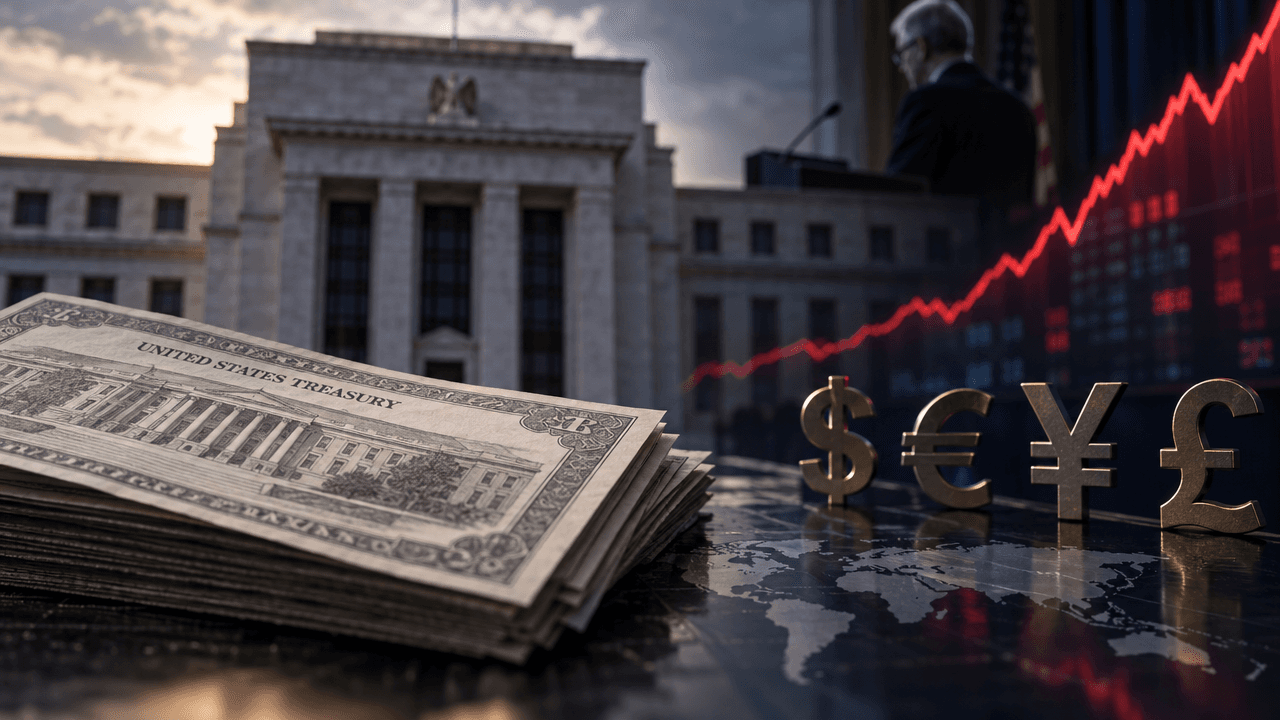
US Treasury futures weakened as investors reassessed the likely path of Federal Reserve policy, with markets increasingly prepared for interest rates to remain higher for longer. Because Treasury futures prices move inversely to bond yields, the decline in futures pointed to renewed upward pressure on yields when the cash market reopened after the Veterans Day holiday.
The move was especially important because regular Treasury trading was closed for Veterans Day. With cash-market prices unavailable, futures became the clearest real-time indicator of how investors were responding to recent inflation data, Federal Reserve commentary, and expectations for the next policy decision. Treasury futures pointed to a roughly 2- to 4-basis-point increase in yields when cash trading resumed. [8]
The Federal Reserve Path Moves Back Into Focus
The central issue for bond markets is no longer simply whether the Federal Reserve will cut rates. Instead, traders are evaluating whether persistent inflation and resilient economic activity could require additional rate increases.
Recent market pricing reflected a sharp shift in expectations. The probability of a December rate increase moved toward 91%, while some investors began considering the possibility of further tightening in January and beyond. The 10-year Treasury yield hovered near 5% as markets absorbed stronger-than-expected inflation data and more hawkish remarks from Fed policymakers. [2]
Federal Reserve Governor Christopher Waller indicated that a 50-basis-point increase could be justified under certain inflation conditions. Dallas Fed President Lorie Logan also supported the possibility of at least two additional 25-basis-point increases if price pressures remain persistent. These comments reinforced the idea that policymakers may be willing to tolerate slower growth in order to restore price stability.
For traders, this creates a more restrictive policy outlook. A higher expected policy rate generally pushes short-term Treasury yields higher first, while longer-term yields respond to both interest-rate expectations and views on future economic growth, inflation, and government borrowing.
WHY INFLATION HAS BECOME THE MARKET’S MAIN CATALYST
The latest pressure on Treasury futures followed inflation data that exceeded expectations. When inflation is stronger than forecast, investors typically reduce expectations for near-term monetary easing and increase the premium required to hold fixed-income securities.
This dynamic is most visible in two-year Treasury yields, which are highly sensitive to anticipated changes in the federal funds rate. The 10-year yield, meanwhile, reflects a broader combination of factors, including expected short-term rates over the coming decade, long-term inflation risk, economic growth, and the supply of government debt.
A rise toward or above 5% in the 10-year yield can influence markets well beyond government bonds. Higher Treasury yields increase borrowing costs for households, businesses, and governments. They can also place pressure on equity valuations because future corporate earnings are discounted at a higher rate. Growth-oriented sectors and highly leveraged companies are often particularly sensitive to this change.
For SimFi traders, the lesson is practical: inflation releases can affect multiple asset classes simultaneously. A hotter reading may support the dollar and short-term yields while weighing on Treasury futures, equity index futures, and interest-rate-sensitive commodities.
Reading The Futures Market
Treasury futures are quoted as prices, but traders often interpret them through their implied yield. When a futures contract falls, it generally signals that the market expects a higher yield on the underlying Treasury security. The size and speed of the move can provide clues about the strength of changing rate expectations.
However, futures prices should not be viewed in isolation. A decline may reflect expectations for Fed tightening, but it can also result from stronger economic data, increased Treasury issuance, a shift in global bond markets, or reduced demand for safe-haven assets.
The Veterans Day trading interruption also matters. With no normal cash-market close to anchor pricing, futures may react more sharply to incoming news or thin liquidity. Once cash Treasury trading resumes, the relationship between futures prices and actual bond yields can become clearer.
Traders should also compare different maturities. If two-year yields rise much faster than 10-year yields, the market may be focusing primarily on near-term Fed policy. If longer-term yields rise more forcefully, investors may instead be pricing stronger growth, greater inflation persistence, or increased concern about government borrowing needs.
Practical Takeaways For Traders
First, monitor the front end of the yield curve. Two-year Treasury futures and other short-duration instruments can reveal whether markets are increasing or reducing expectations for a near-term policy move.
Second, track inflation and labor-market releases together. Inflation determines how much pressure the Fed faces, while employment data helps determine how much economic weakness the economy can absorb before policy becomes less restrictive.
Third, watch Federal Reserve communication for changes in language. References to persistent inflation, upside risks, or the need for additional restraint can move rate markets even when no policy decision is announced.
Fourth, manage volatility around market reopenings. Holiday-thinned sessions can produce misleading price swings, wider spreads, and faster moves than normal. SimFi traders can use smaller position sizes, predefined risk limits, and scenario planning to avoid treating every futures move as a confirmed trend.
Finally, remember that a yield increase is not automatically bearish for every asset. Higher yields can reflect stronger economic growth, but they become more concerning when driven by inflation and expectations of aggressive tightening. The underlying catalyst matters as much as the headline move.
The Bigger Market Signal
The weakness in US Treasury futures shows that investors are recalibrating to a Federal Reserve that may remain restrictive for longer than previously expected. With the 10-year yield near 5% and rate-hike probabilities rising, markets are entering a period in which inflation data and central-bank communication may generate outsized reactions.
The most important question is whether the upward pressure on yields becomes a sustained trend or a temporary response to hot inflation data. Traders should focus on confirmation across futures prices, cash yields, the yield curve, and upcoming economic releases. In a market driven by shifting policy expectations, disciplined interpretation is more valuable than reacting to a single headline.