
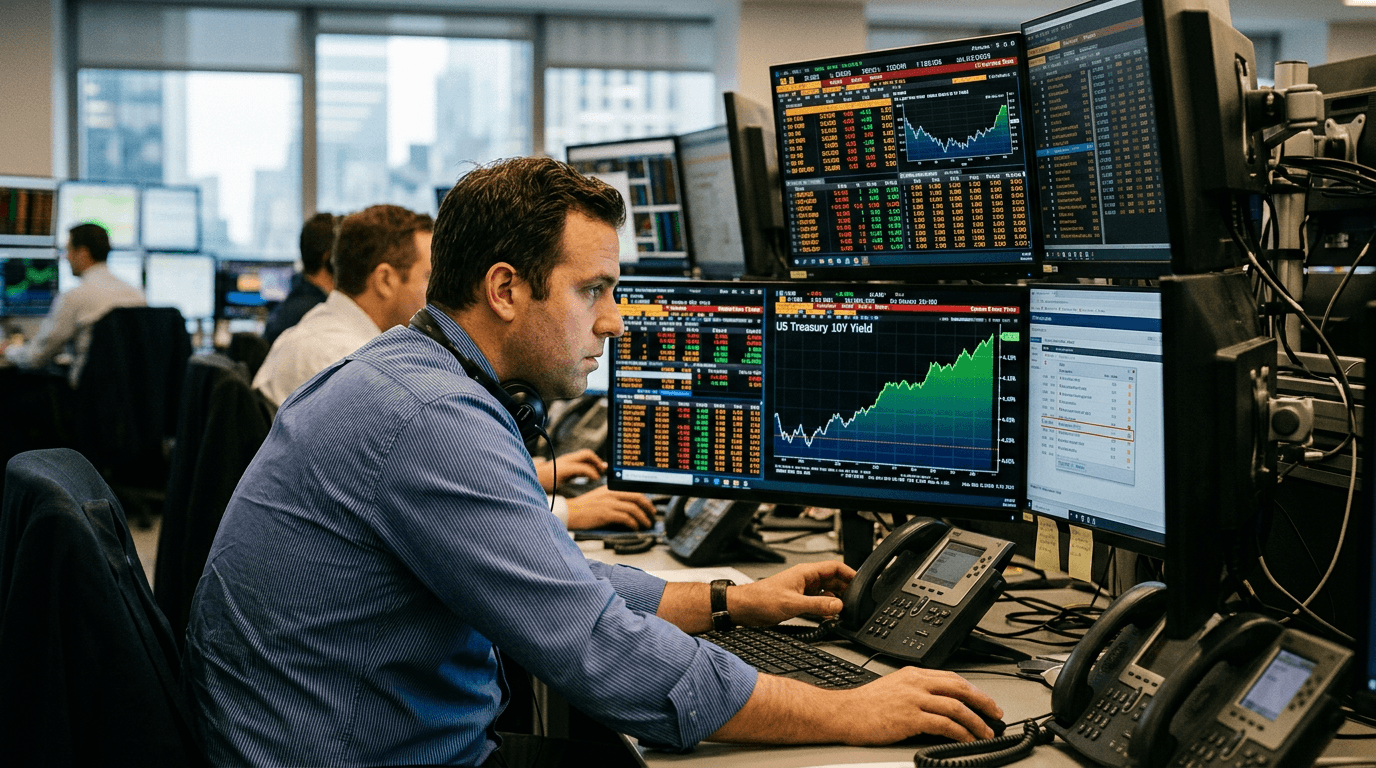
Bond markets are once again setting the tone for global trading as U.S. Treasury yields edge higher ahead of the latest Federal Reserve meeting minutes, with investors bracing for language that could challenge the market’s current belief in rapid rate cuts.[3][5] The move in yields is already filtering through to dollar FX pairs, interest-rate futures, and risk assets, forcing traders to reassess how long policy might stay “higher for longer.”[3][5]
Why Treasury Yields Are Edging Higher
U.S. Treasury yields have been grinding up rather than spiking, reflecting a steady stream of selling pressure across the curve as investors demand more compensation for duration and policy risk.[3][5] The benchmark 10-year note has edged toward the mid‑4% area, while the policy‑sensitive 2-year yield has climbed just above 4.1%, signaling greater skepticism that the Fed will cut aggressively in the near term.[5]
This repricing is not happening in isolation. Stronger‑than‑expected economic data and resilient investor sentiment in key regions have reduced demand for safe‑haven government bonds, pushing yields higher as prices fall.[5][7] When growth looks solid and inflation risks linger, bond markets tend to lean toward tighter policy or, at minimum, a slower path to easing.
Importantly, the current move is being driven by expectations rather than a fresh policy decision. Traders are positioning for minutes that could emphasize persistent inflation risks and a willingness to keep rates elevated until price pressures are firmly on a 2% trajectory.[1][5] That subtle shift—from “cuts soon” to “cuts later and slower”—is what markets are now trying to price in.
WHAT A “HAWKISH” TONE IN THE MINUTES REALLY SIGNALS
Fed minutes are essentially a detailed transcript of the committee’s debate: how policymakers weigh inflation data, growth trends, labor markets, and financial conditions.[1][4] A “hawkish” tone means the discussion leans more toward guarding against inflation and less toward cushioning growth, even if headline rates are left unchanged.
In practice, traders will look for language that:
- Stresses “upside risks” to inflation or price stability
- Downplays recession risks or labor-market weakness
- Emphasizes the need to keep policy restrictive for longer
- Shows limited appetite for near‑term rate cuts[1][4][7]
History shows that when minutes reveal a more hawkish debate than markets expected, shorter‑dated yields tend to react first, as they are tightly linked to the expected path of the Fed funds rate.[1][6][7] Longer maturities move as investors reassess how long restrictive policy will persist and what that means for growth and inflation over several years.
For traders, the nuance matters. Even small changes in wording—removing references to a “bias toward easing,” for example—can trigger a meaningful repricing of rate expectations and a shift in the probabilities embedded in Fed funds futures.[4][7] That repricing is what we are seeing pre‑minutes: the market hedging against the risk that the Fed pushes back on dovish narratives.
Market Ripple Effects: Dollar, Futures, And Risk Assets
Higher Treasury yields, especially at the front end of the curve, typically support the U.S. dollar as global capital flows chase higher real and nominal returns in U.S. assets.[3][5] In recent sessions, the grind higher in yields has helped the dollar against lower‑yielding currencies and those where central banks are closer to cutting, widening yield differentials in the dollar’s favor.[3][5]
Interest‑rate futures have also adjusted, with implied probabilities of rapid rate cuts being trimmed as traders price a more extended period of restrictive policy.[1][3][7] This affects everything from swap curves to corporate financing plans, as the “risk‑free” benchmark moves higher.
Risk assets feel the impact in multiple ways
- Equities, particularly growth and tech names with long‑dated cash flows, tend to underperform when discount rates rise.[1][3]
- Rate‑sensitive sectors like REITs, utilities, and parts of the credit market face higher funding costs and potential outflows as investors rotate back into government bonds.[3]
- High‑yield credit and emerging‑market currencies often struggle when U.S. yields rise and the dollar strengthens, as the global cost of capital effectively increases.[3][5]
At the same time, higher yields improve nominal returns on cash and short‑duration fixed income, prompting portfolio reallocations from equities into bonds, especially for investors who had been underweight duration during the low‑rate era.[1][3]
Playbook For Traders And Simfi Participants
For active traders and those using SimFi platforms to hone their strategies, the current setup is a textbook example of an expectations game: the event (Fed minutes) is known, but the market’s reaction will depend entirely on the tone relative to what is already priced.[3]
A practical approach is to map out scenarios
- Hawkish surprise: Minutes highlight inflation risks, limited appetite for cuts, and comfort with staying restrictive.
- Likely outcomes: Front‑end yields rise further, the dollar strengthens, growth equities and high‑beta assets come under pressure.[3][5]
- Dovish surprise: Minutes show more concern about growth and employment, with discussion of conditions under which cuts could come sooner.
- Likely outcomes: Yields dip, particularly in the 2‑ to 5‑year sector; dollar softens; rate‑sensitive equities and weaker‑yielding currencies could see relief rallies.[3][5]
In a simulated trading environment, this is an ideal moment to test:
- FX strategies based on yield differentials and dollar strength
- Equity rotations between growth vs value and cyclicals vs defensives
- Fixed‑income positioning along the curve (short vs long duration)
- Hedging tactics using options around major event risk
Because the minutes can shift sentiment without changing the actual policy rate, they are a pure expectations catalyst—perfect for practicing event‑driven trading and risk management without real capital at risk.
Key Takeaways As Markets Brace For The Minutes
Several themes are worth watching as the Fed minutes hit and markets digest the details:
- The balance of risks: How clearly do policymakers frame inflation as the dominant concern versus growth or employment?[1][4]
- The language on “higher for longer”: Any reinforcement of the idea that rates must stay restrictive until inflation is firmly on track back to 2% will validate the current drift higher in yields.[1][4][7]
- Divergence inside the committee: Signs of widening disagreement—some members arguing for hikes, others signaling comfort with cuts later—can add volatility as traders parse whose view will ultimately prevail.[4][7]
- Market pricing vs Fed tone: If the minutes sound more hawkish than the path implied by futures, the market may need to further reprice rate‑cut expectations, extending the upward pressure on yields.[3][5]
For now, the key message from the rates complex is that the easy‑money era is behind us and the path forward is more data‑dependent, with inflation risks still commanding attention at the Fed.[1][3][5] Whether the minutes confirm that view or soften it will shape the next leg in Treasuries, the dollar, and risk assets—and provide a rich learning environment for traders navigating a genuinely hawkish cycle.