
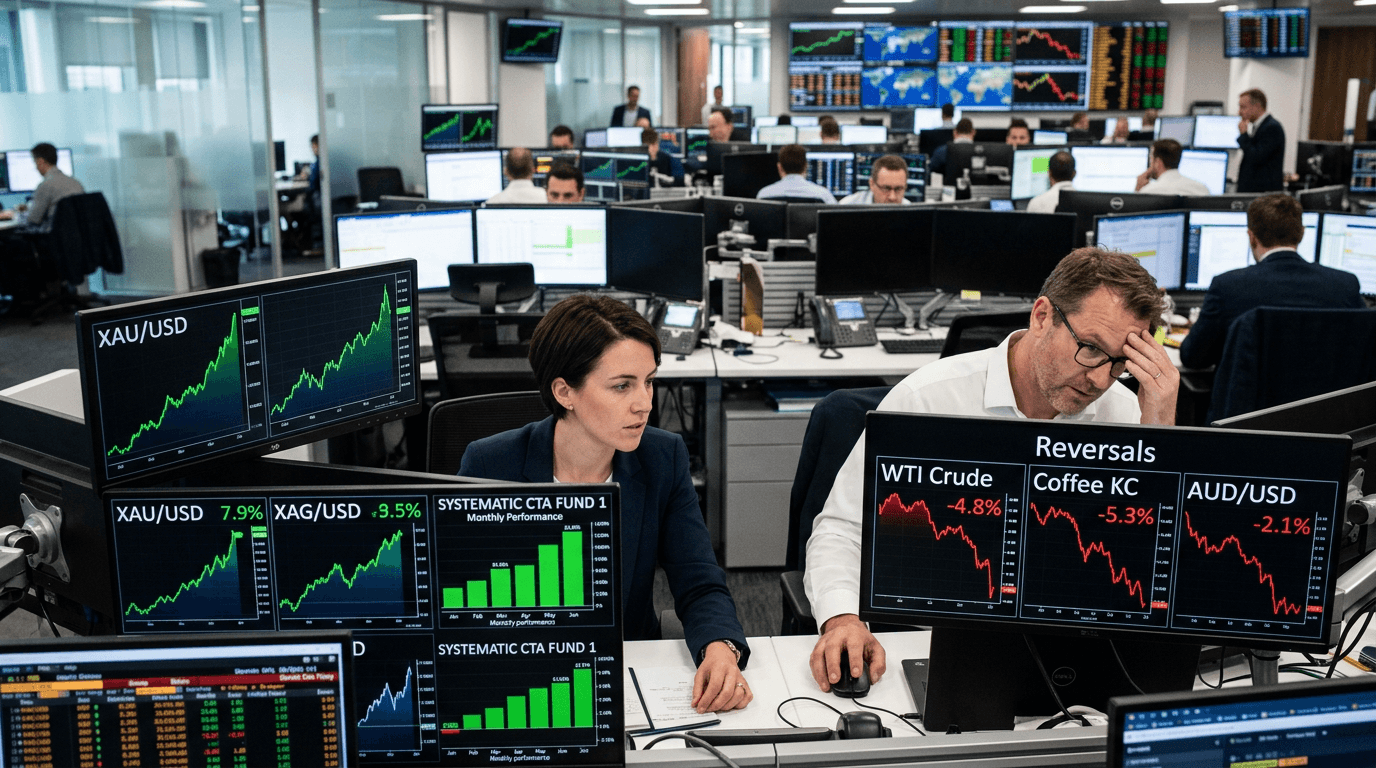
Trend-following hedge funds just learned a familiar yet painful lesson: even when part of the book works beautifully, a handful of volatile markets can drag overall performance into the red. In June, profitable positions in gold and silver were not enough to offset losses in crude oil, coffee and the Australian dollar, leaving many CTA and trend-following funds slightly negative for the month[3]. For traders, this is a textbook case of how cross‑asset volatility can overwhelm seemingly strong signals.
MARKET BACKDROP: VOLATILITY VS. SYSTEMATIC STRATEGIES
Trend-following hedge funds—often categorized as CTAs (Commodity Trading Advisors)—are built to thrive in extended moves, up or down, across futures and FX markets[3]. These managers rely on rules‑based models to identify and ride trends rather than make discretionary macro calls[3][4]. When markets move in clear, persistent directions, these systems can produce strong, uncorrelated returns and act as portfolio diversifiers[3].
The challenge arises when markets become choppy, with sharp reversals and overlapping themes. Recent research shows that trend-following hedge funds have struggled, declining around 9% in the first half of the year and heading toward their weakest annual results since at least 1998[2]. That weakness comes despite many hedge funds broadly enjoying their best first-half performance in more than a decade[1]. The takeaway: the environment has been unusually hostile for strategies that depend on clean, sustained trends.
How Trend-following Strategies Really Work
At its core, trend following is simple in concept: buy what is going up, sell what is going down[4]. In practice, sophisticated algorithms scan price data across commodities, currencies, rates and equities to detect persistent directionality[3][4]. Once a trend is identified, positions are scaled up, with risk controls designed to cut exposure if the move fades or reverses.
Most CTAs run diversified portfolios across dozens of futures contracts and currency pairs. The idea is that while any single market can be noisy, broad diversification across asset classes should smooth returns over time[3]. Risk is typically allocated based on volatility, not nominal position size, so a highly volatile contract like crude oil can still have a large impact on performance even with a modest notional exposure.
Crucially, these models are backward‑looking by design. They respond to what prices have done, not what they “should” do. That discipline is a strength when trends persist, but it can be a weakness when markets repeatedly whipsaw around key macro themes.
Why Crude And The Australian Dollar Hurt June Returns
The June performance pattern—gains in precious metals offset by losses in crude, coffee and the Australian dollar—reflects how different markets can send conflicting signals at the same time[3]. Gold and silver have benefited from ongoing demand for defensive assets, interest rate expectations and currency dynamics, providing profitable long trends for systematic funds positioned in those metals[3].
Crude oil, however, has been caught between competing forces: shifting growth expectations, supply changes, and geopolitical risk. That mix has produced sharp price swings rather than a smooth, directional move. Trend-following models that had built positions in line with prior momentum were hit when those moves reversed or stalled, turning what looked like strong signals into losing trades.
The Australian dollar sits at the intersection of commodity demand, regional growth and global risk appetite. It often trades as a “proxy” for broader macro themes, which can change quickly. For CTAs holding FX trend positions, sudden shifts in expectations around China, global growth or central bank policy can flip AUD trends and trigger losses. Coffee futures, another commodity exposure, added to the drag as weather and supply headlines drove abrupt reversals, challenging systems that needed more stable moves to work.
The key observation is that diversification did not fully protect these strategies in June. When several high‑volatility markets reverse simultaneously, they can overwhelm gains in steadier, trending assets like gold and silver.
Lessons For Futures And Fx Traders
For active traders in futures and FX—whether discretionary or systematic—June’s pattern offers several practical insights.
First, trend strength matters more than trend existence. A market that looks like it’s trending but frequently retraces a large portion of its move is dangerous for mechanical trend strategies. Traders can improve robustness by overlaying measures of trend quality, such as volatility‑adjusted momentum or drawdown analysis, rather than relying on simple price breakouts.
Second, cross‑asset context is critical. The same macro theme can drive conflicting behavior in different markets. For example, changing growth expectations might push gold higher while making crude and AUD far more volatile. Risk management should reflect correlations that rise in stress periods, not just long‑term averages.
Third, position sizing and diversification cannot be static. Even if models target a constant volatility level, realized volatility can spike and correlations can shift, causing unintended concentration in a handful of macro‑sensitive assets. Regular stress testing—simulating scenarios where crude, AUD and other cyclical markets reverse together—can help identify exposures that look diversified on paper but cluster in practice.
What Simulated Finance Traders Can Do Next
For traders using simulated finance platforms, episodes like June are valuable learning laboratories. Because real capital is not at risk, participants can deliberately test how their systems behave when multiple correlated markets misfire at once.
Practical takeaways for SimFi and systematic traders include:
– Build and test simple trend-following models across commodities and FX, then evaluate performance during periods of elevated volatility similar to recent conditions[3][4].
– Introduce a “trend quality” filter that reduces or delays entries when volatility is high and price action is choppy, even if standard trend indicators flash a signal.
– Run scenario analyses where winning trades in one sector (e.g., gold and silver) are offset by simultaneous losses in crude, soft commodities and cyclical FX, mirroring the June pattern[3]. Use the results to refine position sizing rules.
– Track drawdowns by asset class and theme, not just by individual market. If most losses come from a single macro cluster—energy plus commodity currencies, for instance—consider tightening risk limits for that cluster during turbulent periods.
Ultimately, the recent slip into negative territory for trend-following hedge funds is not a failure of the strategy itself, but a reminder of its sensitivities. These models remain powerful tools for exploiting sustained moves and diversifying portfolios[3][4]. For traders and investors, the lesson is to respect the impact of volatility clusters, understand where trend signals are most reliable, and design systems that can survive the inevitable periods when a handful of noisy markets overpower otherwise solid positioning.