
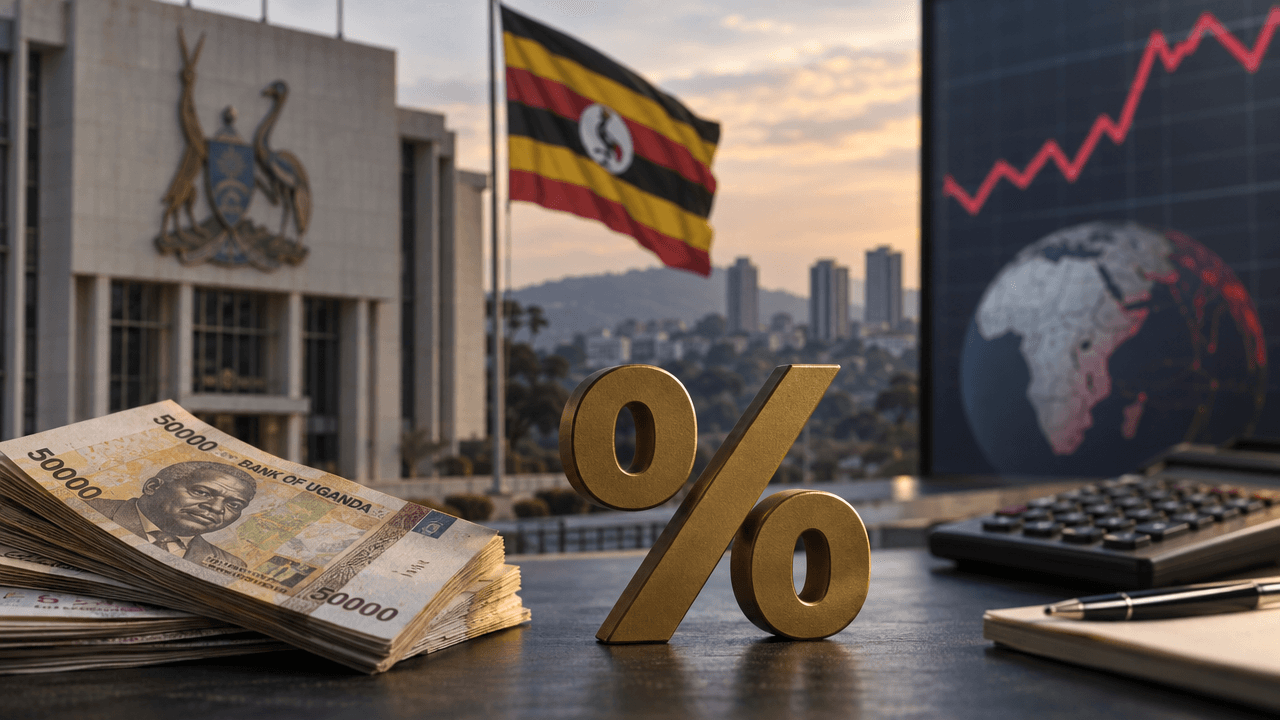
Uganda’s central bank has delivered a sharp emergency rate hike after the shilling fell to a record low, underscoring how quickly currency pressure can turn into an inflation and financial-stability problem. The Bank of Uganda raised its Central Bank Rate by 225 basis points, from 9.75% to 12%, at a special Monetary Policy Committee meeting on October 14, 2026. It was the largest monthly increase in 15 years. [1][3]
The decision was not simply a routine adjustment to borrowing costs. It was a defensive move aimed at supporting the currency, containing imported inflation and restoring confidence in Uganda’s financial markets. For traders and investors, the episode offers a useful case study in how emerging-market central banks respond when exchange-rate weakness, energy costs and capital flows begin reinforcing one another.
The Shilling Under Pressure
Uganda’s shilling had endured a prolonged sell-off before the emergency meeting. The currency fell to approximately 4,143 shillings per US dollar, its weakest level since 1993, after eight consecutive sessions of losses. It had also lost more than 11% of its value against the dollar during the year, according to local reporting. [12][15]
Several forces contributed to the decline. Demand for dollars from fuel importers increased as global energy and shipping costs rose. At the same time, foreign investors were reportedly selling Ugandan government bonds, creating additional demand for foreign currency and reducing demand for the shilling. [2][13]
Currency depreciation matters because Uganda imports many goods priced in dollars. A weaker shilling raises the local cost of fuel, machinery, transport, food inputs and other imported products. Businesses may initially absorb some of those expenses, but persistent weakness can eventually feed through to consumer prices.
That creates a difficult policy challenge. A central bank may want to support economic growth with low interest rates, but allowing the currency to weaken too far can cause inflation expectations to become entrenched.
Why The Rate Hike Was So Large
The Bank of Uganda’s 225-basis-point increase took the benchmark rate to its highest level since late 2016 and ended eight consecutive meetings at the previous rate. [3][7]
A higher policy rate can support a currency through several channels. First, it increases the potential return available on shilling-denominated assets. This can encourage investors to hold local bonds and deposits rather than convert funds into dollars. Second, higher rates can reduce domestic demand and credit growth, limiting the ability of businesses to pass rising costs into prices. Third, the move signals that policymakers are prepared to act decisively rather than tolerate a disorderly decline.
The Bank of Uganda also increased the cash reserve requirement from 11% to 13.5%, a measure designed to manage excess liquidity in the banking system and strengthen the transmission of monetary policy. [4]
However, a rate hike cannot directly create more dollars, lower global oil prices or reverse foreign investors’ decisions. Its effectiveness depends partly on credibility. If markets believe the central bank will maintain disciplined policy, the move may stabilize expectations. If investors view the action as too late or insufficient, selling pressure can continue.
The Cost Of Defending The Currency
Currency defense comes with economic trade-offs. Higher interest rates increase the cost of loans for households and companies. Businesses considering expansion may delay investment, while consumers may reduce spending on credit-sensitive purchases such as vehicles, housing and durable goods.
The government may also face higher borrowing costs, especially if it needs to issue domestic debt to finance spending. Analysts have warned that Uganda’s public financing needs could make the policy environment more complicated. [6]
For banks, tighter liquidity can reduce loan growth and increase pressure on borrowers with variable-rate debt. Smaller companies may be especially vulnerable because they often have less access to foreign funding or large cash reserves.
The central bank’s calculation is that these short-term costs are preferable to a deeper currency crisis. A disorderly depreciation could produce a more damaging combination of imported inflation, capital flight and falling investor confidence. The challenge is finding a rate level that stabilizes markets without causing an unnecessarily severe slowdown.
A Broader Emerging-market Warning
Uganda’s experience reflects a wider problem facing emerging economies. These markets are often more exposed to changes in global energy prices, US interest rates, investor risk appetite and international capital flows.
When oil prices rise, countries that import energy can suffer a double shock: their import bills increase while their currencies weaken. If global investors simultaneously move money toward safer or higher-yielding assets elsewhere, local currencies can come under even greater pressure.
This dynamic is important for traders because exchange-rate moves can become self-reinforcing. A weaker currency raises inflation concerns. Those concerns increase expectations for further rate hikes. Higher rates can support the currency, but they also weaken growth and increase debt-servicing costs. Markets then reassess whether policymakers can maintain the strategy.
Uganda’s move also shows why central-bank decisions should be viewed in context rather than in isolation. The size of the hike matters, but so do liquidity measures, foreign-exchange intervention, inflation forecasts and communication from policymakers.
What Traders Should Watch Next
The immediate market reaction to a large rate hike is not always a reliable guide to its long-term impact. Traders should monitor whether the shilling holds its gains after the initial announcement, whether foreign-exchange reserves are being used to smooth volatility and whether local bond yields attract new investment.
Inflation data will be crucial. If fuel and exchange-rate effects continue moving through the economy, the Bank of Uganda may need to keep policy restrictive for longer. If inflation expectations stabilize and the shilling recovers, policymakers could eventually pause to assess the impact on growth.
Position sizing and risk management are particularly important in this environment. Emerging-market currencies can move sharply when liquidity is thin, and high interest-rate differentials do not eliminate the risk of further depreciation. Traders should distinguish between a temporary rebound caused by short covering and a durable change in capital flows.
The practical lesson is straightforward: a central bank can buy time with higher rates, but lasting currency stability depends on broader confidence in the economy, fiscal policy and external financing position.
Conclusion
Uganda’s emergency rate hike is one of the clearest examples this year of a central bank prioritizing currency and inflation stability over cheaper credit. Raising the Central Bank Rate to 12% may help defend the shilling and anchor expectations, but it will also test households, businesses and government borrowers.
For SimFi traders, the episode provides a valuable framework for analyzing emerging-market policy decisions. Watch the currency, inflation, energy prices, capital flows and central-bank communication together. The most important signal is not just the size of a rate move, but whether the policy response restores confidence before financial pressure spreads into the wider economy.