
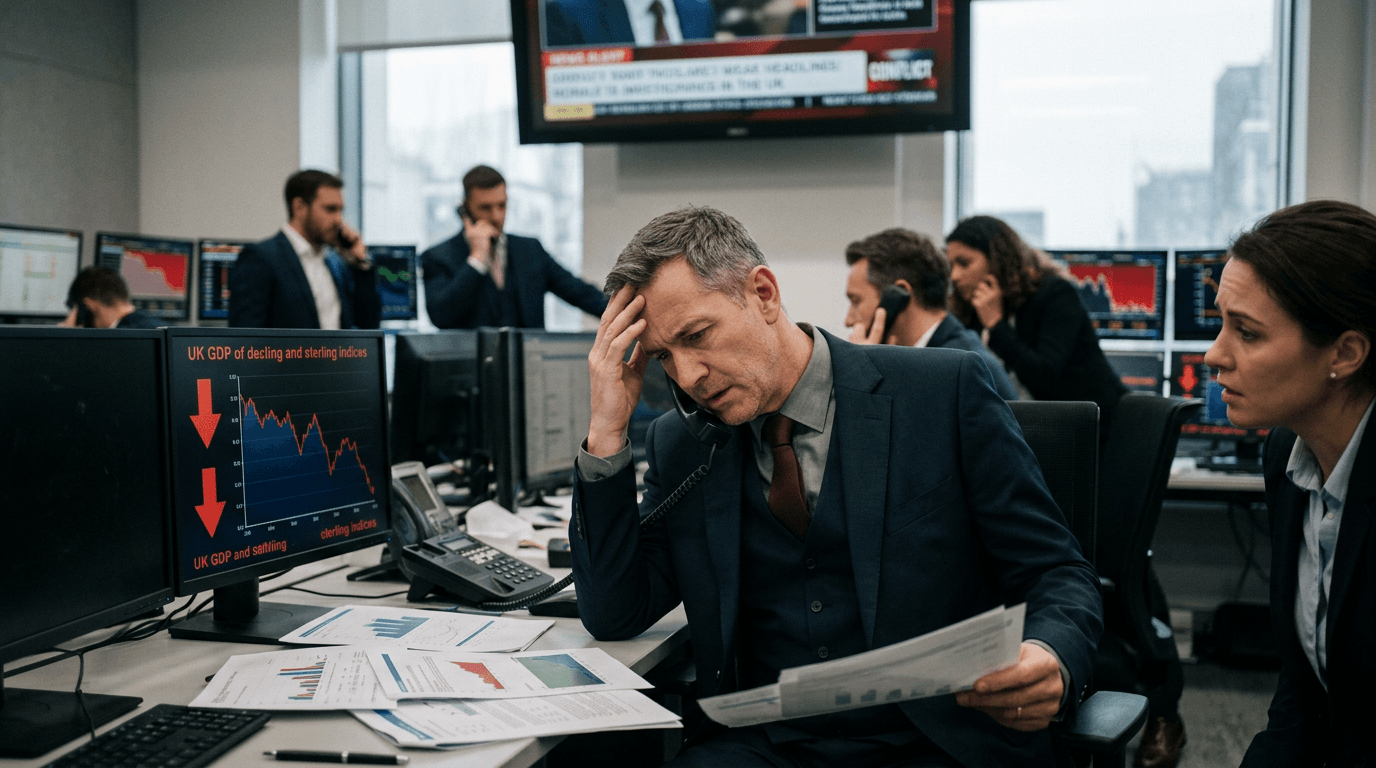
British business leaders are turning noticeably more cautious as geopolitical tensions with Iran ripple through supply chains, push up input costs and cloud the outlook for sales. New survey data show UK business confidence has fallen to its weakest level since 2022, raising fresh questions about the durability of the country’s still-fragile economic recovery.[1][2][6] For traders and investors, this is not just a domestic sentiment story: it is a macro signal with implications for growth, interest rates and sterling pricing.
What The Latest Survey Is Telling Us
A recent survey of accountants and finance professionals found that British business confidence has dropped to its lowest level in roughly four years, with respondents citing the Iran war as a key driver of rising costs and weaker sales expectations.[1][2][6] This decline in morale reflects a combination of squeezed margins, uncertainty about future demand and growing caution around investment plans.[1][2]
Input prices—a core measure of what firms pay for materials, energy and other essentials—rose by around 4.1% in the three months to June, underscoring how cost pressures have accelerated.[1] For many companies, especially in manufacturing, transport and energy-intensive industries, that kind of increase can quickly erode profitability if they are unable to pass higher costs on to customers.
The same geopolitical shock is feeding through to broader economic activity. Separate reporting points to the UK economy showing its first contraction since 2025, with businesses experiencing their sharpest broad-based decline in activity in over a year as the Iran conflict’s impact intensifies.[5] When sentiment weakens at the same time as activity slows, it often signals more than a temporary wobble—it suggests firms are reassessing their growth plans in a more fundamental way.
How Geopolitical Shocks Become A Domestic Growth Problem
At first glance, a war involving Iran might seem geographically distant from British high streets and industrial parks. In practice, the connection is direct and powerful. Iran is a significant player in global energy and shipping routes, so conflict in the region tends to drive up oil prices, insurance costs and freight rates, while increasing the risk of supply disruptions.[1][5] When those shocks occur, UK businesses that rely on imported inputs—everything from fuel to raw materials—see their cost base rise.
Higher input costs force firms into difficult trade-offs. Some will absorb part of the increase, putting pressure on margins and leaving less room for investment, hiring and wage growth. Others will raise prices, adding to inflationary pressures and potentially dampening consumer demand. Over time, these adjustments can slow the pace of economic expansion as businesses delay capital spending, scale back expansion plans or become more cautious about credit and inventory.
The psychology of uncertainty matters too. When companies face a volatile external environment, their natural response is to build buffers—holding more cash, trimming discretionary spending and rethinking strategic projects. That defensive posture can be rational at the firm level but collectively it translates into weaker aggregate demand and slower growth.
Economic Growth, Rates And Sterling: Why This Matters For Markets
From a macro perspective, slumping business morale is a leading indicator worth watching. Weak confidence and rising costs typically feed into softer investment and hiring, which in turn weigh on GDP growth. With the UK already experiencing its first contraction since 2025 amid war-related pressures, markets will be focused on how persistent this slowdown becomes.[5]
For the Bank of England, the situation creates a delicate balancing act. On one hand, geopolitical cost shocks can be inflationary in the short term, especially through higher energy and shipping prices.[1][5] On the other, deteriorating business sentiment and slowing activity increase downside risks to growth. That tension can complicate decisions on the timing and pace of any future rate cuts or hikes, as policymakers attempt to distinguish between temporary price spikes and more entrenched economic weakness.
Sterling, meanwhile, tends to be sensitive to both growth expectations and interest rate trajectories. If markets conclude that weaker business morale will translate into softer GDP and bring forward rate cuts, that can weigh on the currency. Conversely, if inflation risks dominate and the Bank of England is seen as staying hawkish for longer, sterling might find support—but at the cost of tighter financial conditions for businesses and households. For traders on simulated finance platforms, this environment offers a rich backdrop to test macro and FX strategies tied to sentiment data, growth indicators and central bank expectations.
Pressure Points For Businesses And Practical Responses
On the ground, UK businesses are already grappling with the fallout. Reporting highlights how companies across sectors are facing mounting pressure from the economic shock associated with the war on Iran, especially smaller firms with less pricing power and thinner cash buffers.[9] Rising costs for energy, shipping and insurance are particularly challenging for SMEs that cannot easily pass them on.
Practical responses are emerging. Many businesses are:
Re-examining supply chains to diversify away from the most volatile routes and suppliers.
Investing in energy efficiency and hedging strategies to manage fuel price risk.
Reviewing pricing and contract structures to allow more flexible adjustments when costs surge.
Strengthening cash and liquidity management to cope with shorter-term shocks.
For decision-makers, the key takeaway is that geopolitical risk is no longer a peripheral issue—it is a core part of operational and financial planning. Integrating scenario analysis around conflicts, sanctions and trade disruptions into budgeting and strategy can help firms stay resilient when sentiment and activity turn.
What Traders And Investors Should Watch Next
For market participants, the slump in UK business morale tied to the Iran war offers a timely reminder that surveys and soft data can be powerful early signals. The fact that confidence has fallen to its lowest level since 2022, alongside a clear rise in input prices and signs of contracting activity, suggests this is more than noise.[1][2][5][6]
Over the coming months, traders and investors will be watching:
Business and consumer confidence surveys for confirmation of sentiment trends.
Official growth and activity data to see whether contraction broadens or stabilises.[5]
Inflation releases for evidence of cost pass-through versus demand weakness.
Bank of England communications and decisions as they weigh growth risks against price pressures.
FX and rates markets for shifts in expectations around sterling and UK yields.
For users of simulated finance platforms, this environment is an opportunity to stress-test macro strategies: for example, constructing scenarios where UK growth slows more sharply than expected, or where inflation proves stickier due to geopolitical cost shocks. Practising how portfolios respond to shifts in sentiment, policy expectations and cross-asset correlations can build the kind of discipline that real-world markets demand.
As UK business morale weakens under the weight of war-driven cost pressures, the signal for the broader economy is clear: geopolitical shocks are now a central driver of domestic growth dynamics. How businesses, policymakers and markets adapt to that reality will shape the next phase of the UK’s economic story.