
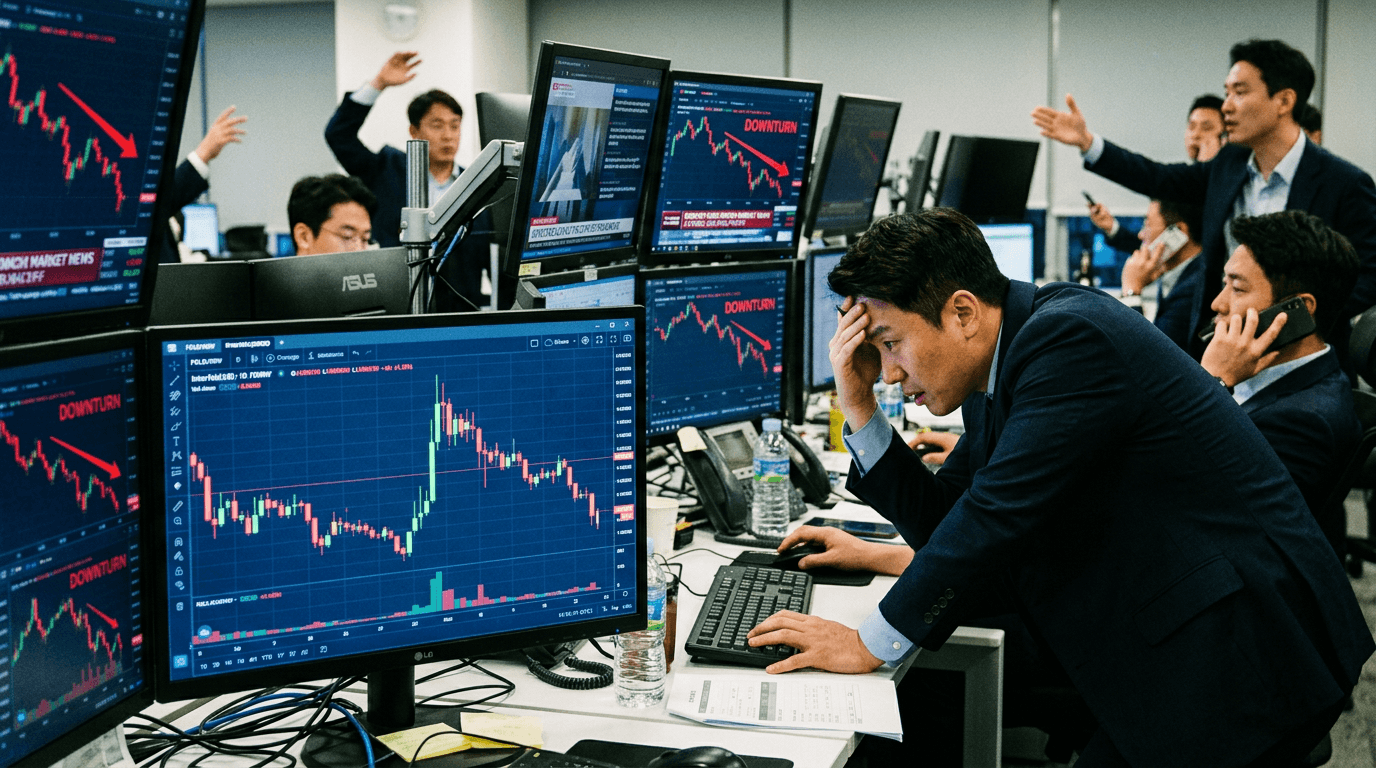
In the middle of a rapid crypto selloff, South Korea’s Upbit has chosen to list Interfold (FOLD) against the Korean won (KRW), Bitcoin (BTC), and Tether (USDT), turning a single-token event into a broader signal about liquidity and sentiment. While prices across majors and altcoins have been under pressure, a fresh listing on a top regional exchange introduces new dynamics that traders should understand—especially if they are navigating this environment through both live markets and simulated finance platforms.
Market Backdrop: Volatility Meets New Supply
When markets are selling off, most participants instinctively move toward safety—rotating into stablecoins, fiat, or simply reducing leverage and exposure. A new listing during such a period cuts against that instinct, because it effectively introduces “new supply” in terms of tradable opportunities at a time when risk appetite is weak. This contrast is precisely what makes the FOLD listing noteworthy.
New spot listings often attract short-term speculators, arbitrageurs, and liquidity providers, who are less concerned with broader market sentiment and more focused on microstructure: spreads, order-book depth, and short-lived price dislocations. Even amid a drawdown, this can produce sharp intraday moves in the listed token as traders test fair value and discover where real demand sits. For portfolio-oriented traders, the key is recognizing that token-specific momentum can diverge sharply from the market’s overall trend, particularly around listing events.
UPBIT’S STRATEGIC MOVE WITH FOLD
Upbit has announced trading support for Interfold (FOLD) in KRW, BTC, and USDT markets, with trading scheduled to begin at 12:30 KST on August 23.[4][6][13] That tri-market structure matters. KRW pairs open the listing to South Korean retail traders who primarily fund accounts with local currency, while BTC and USDT pairs create bridges to global crypto liquidity and cross-exchange flows.[4][9][13]
The exchange has also specified operational details designed to manage listing risk. Deposits and withdrawals are supported via the Ethereum network only, reinforcing the importance of network selection and on-chain fees for participants who plan to move FOLD between venues or wallets.[6] In addition, Upbit has indicated that initial trading will be subject to certain restrictions—such as a brief period where buy orders are limited and only limit orders are accepted—aimed at reducing disorderly price action in the crucial first minutes after listing.[6] These controls highlight how major exchanges balance user demand for new tokens with their responsibility to maintain orderly markets.
From Upbit’s perspective, listing FOLD during a selloff can be seen as a way to refresh its product offering and capture volume in an otherwise risk-off environment. For FOLD, securing KRW, BTC, and USDT markets on a large exchange instantly broadens its investor base and liquidity profile, even if initial trading is dominated by short-term flows rather than long-term holders.
Liquidity, Price Discovery, And Risk
Every new listing is, at its core, a liquidity event. Before a token appears on a major exchange, price discovery is often fragmented across smaller venues and on-chain pools. Once a large, regulated, or regionally dominant exchange lists that token, liquidity becomes more centralized, spreads can narrow, and the reference price becomes clearer.
During a selloff, however, liquidity is more fragile. Volumes can be high, but they may be skewed toward forced sellers, de-risking behavior, and defensive positioning. For newly listed tokens like FOLD, that means price discovery happens in a stressed context: bids may be cautious, and any aggressive buying can move the price quickly. Early data from FOLD markets on Upbit show significant percentage moves and concentrated volume in the KRW pair, which underscores how a single venue can dominate liquidity in the early stages of a listing.[3][5][8]
For traders, the main risks around listing events in volatile markets include:
1. Extreme intraday volatility as order books fill out. 2. Thin liquidity outside core trading hours. 3. Potential for sharp reversals once initial speculative interest fades.
Understanding these dynamics is critical whether you are trading live capital or experimenting within a simulated environment.
How Traders Can Use Simulated Finance To Prepare
Simulated finance (SimFi) platforms like E8 Markets give traders a controlled sandbox to practice strategies around events like the FOLD listing without putting capital at risk. That is particularly valuable when the backdrop is a fast-moving selloff, where emotions and rapid price swings can easily distort decision-making.
Here are practical ways traders can use simulation around listing events:
1. Test opening strategies: Simulate different approaches for the first hour of trading—such as waiting for the initial spike to fade, using staggered limit orders, or focusing on only one of the three pairs (KRW, BTC, or USDT). 2. Stress-test risk management: Model worst-case scenarios, including slippage, gaps, and sudden drops, to understand how various position sizes and stop levels would have behaved. 3. Explore cross-market relationships: Use historical data and synthetic scenarios to see how FOLD behaves relative to BTC and broad market indices during risk-on and risk-off phases. 4. Build playbooks: Document rules for future listings—when to engage, when to stand aside, and what liquidity and volatility thresholds must be met before trading.
By refining these playbooks within SimFi, traders can create repeatable frameworks they can deploy when similar opportunities arise, whether on Upbit or other exchanges.
Key Takeaways For Active Crypto Traders
The FOLD listing on Upbit offers several lessons that extend beyond a single token:
1. New listings can be opportunity-rich even in down markets. Volatility and concentrated liquidity can create short-term trading edges, but they demand disciplined risk management. 2. Exchange controls matter. Details such as limit-only periods, buy-order restrictions, and network-specific deposit rules can materially shape the early trading landscape, so reading the full announcement is essential.[1][6][12] 3. Regional fiat markets can drive price action. The KRW pair is likely to be a major driver of FOLD’s early volume, illustrating how local investor bases and fiat on-ramps influence token-specific behavior.[3][5] 4. Simulation is a powerful training tool. Practicing listing-event strategies in a risk-free environment builds confidence and helps traders avoid impulsive decisions when real capital is on the line.
Conclusion
Upbit’s decision to list Interfold (FOLD) amid a fast-moving crypto selloff is more than a simple token addition; it is a case study in how liquidity, sentiment, and risk management intersect at the exchange level. For the FOLD project, the listing opens access to a broad set of traders across KRW, BTC, and USDT markets and accelerates price discovery.[4][9][13] For market participants, it is a reminder that even in risk-off conditions, micro-level events can create targeted opportunities—provided traders approach them with clear plans, robust risk controls, and an understanding of how exchange mechanics shape the opening minutes and days of trading.
Whether you are trading live or through a SimFi platform, the core message is the same: treat listing events as structured scenarios, not lottery tickets. By combining data-driven analysis with disciplined execution, traders can navigate volatile environments like the current selloff while still harnessing the unique opportunities that new listings like FOLD bring to the market.