
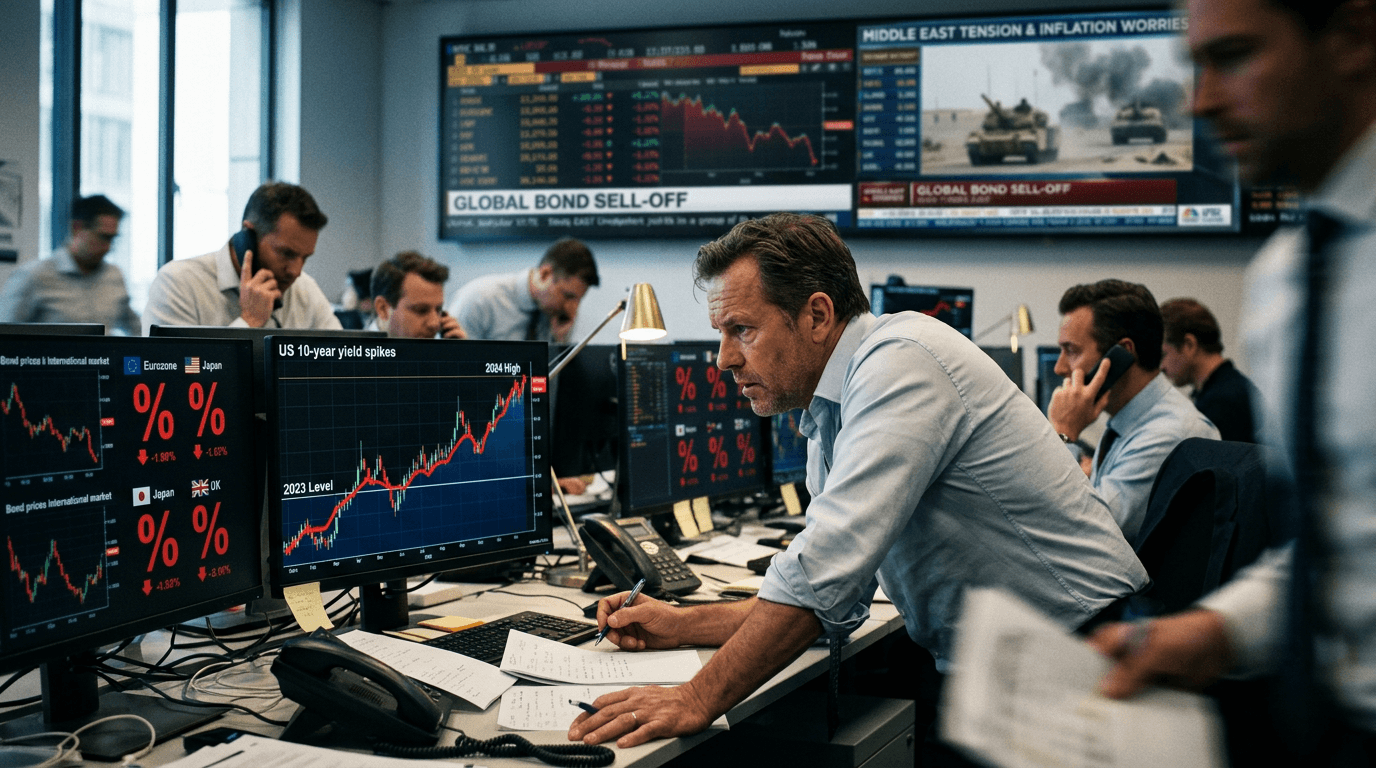
The US 10‑year Treasury yield has surged to around 4.8%, its highest level since late 2023, as a global bond sell‑off unfolds in response to escalating conflict in the Middle East and mounting inflation fears.[1][7][11] This move is rippling across rate‑sensitive assets, pressuring stock index futures and lifting the US dollar against lower‑yielding currencies.[2][3][11][14] For traders and investors, the shift signals a regime where the cost of capital, valuation frameworks, and risk management assumptions all need to be revisited.
GLOBAL BOND SELL‑OFF: A SNAPSHOT
The latest leg higher in the US 10‑year yield caps a multi‑session rally that has pushed borrowing costs toward levels last seen in October and November 2023.[1][7] Benchmark yields across Asia‑Pacific and Europe have joined the move, with Australian and Japanese 10‑year government bond yields jumping by 6–12 basis points in a single session.[2] Broad global benchmarks such as the Bloomberg Global Aggregate Bond Index have logged their biggest one‑day declines in months, underscoring the scale of the sell‑off.[2]
Conflict‑related risk has been a critical catalyst. War involving Iran and heightened US‑Iran tensions have repeatedly jolted sovereign bond markets in 2026, driving longer‑dated yields to multi‑year or even multi‑decade highs before partial reversals.[5][6][8] In several episodes, 30‑year US Treasury yields have traded above 5.2%, levels last seen around the 2007–2008 financial crisis, highlighting how sensitive the long end of the curve is to inflation and fiscal concerns.[5][12][15] The upshot is that bonds, traditionally viewed as defensive, have been at the center of market volatility rather than a haven from it.[2][8]
Middle East Conflict, Oil Prices, And Inflation Fears
The underlying mechanism linking geopolitical tension to bond yields is energy‑driven inflation risk. Escalating clashes in the Middle East, including US‑Iran strikes and disruptions around the Strait of Hormuz, have pushed Brent crude toward the psychologically important $100 per barrel area at times.[3][12] Higher oil prices filter directly into transportation and production costs, raising headline inflation and inflation expectations.[3][6] When markets perceive a durable inflation shock, they rapidly reassess the path of policy rates, term premia, and real yields.
Recent coverage emphasizes that investors are increasingly pricing the risk that the Federal Reserve and other major central banks may need to raise interest rates again, despite earlier hopes for easing.[3][6][11] The fear is not just a short‑term spike in prices, but a sustained period of elevated inflation that erodes purchasing power and forces policymakers into a more restrictive stance.[6][9][12] Bond traders are “surrendering” to the idea that inflation may be stickier than previously assumed, leading them to demand higher yields across the curve as compensation for inflation risk.[12] In this environment, yield curves can steepen as long‑dated rates rise faster than short‑term policy expectations.[9]
Why Higher Yields Matter For Traders And Investors
When yields rise, bond prices fall—an inverse relationship that is foundational for fixed‑income trading.[6][9] For investors holding longer‑duration portfolios, sharp moves in benchmark yields translate into immediate mark‑to‑market losses and larger swings in net asset value. Longer‑dated debt is especially exposed because its cash flows are discounted at higher rates over more years.[5][9] This is why the recent rout has hit long‑maturity sovereign bonds hardest, while shorter‑dated paper has been somewhat less volatile.[5][6]
The US 10‑year yield in particular is a critical reference rate for the real economy. It influences mortgage rates, auto loans, and corporate borrowing costs, making it a key determinant of household and business balance sheets.[11][12] As it climbs, discount rates used in equity valuation models rise, which tends to pressure growth stocks and other long‑duration assets that depend on future cash flows.[11][14] At the same time, higher US yields relative to other markets support the dollar, challenging lower‑yielding currencies and tightening financial conditions globally.[2][3][11] For traders, these cross‑asset linkages mean that moves in the 10‑year are rarely isolated events; they reverberate through stocks, FX, commodities, and credit.
STRATEGIES FOR NAVIGATING A HIGH‑YIELD REGIME
In a regime of rising yields and elevated geopolitical risk, disciplined risk management becomes more important than directional calls. Duration control is the first line of defense: shortening portfolio duration reduces sensitivity to rate shocks, while targeted use of futures or options can hedge exposures more efficiently. Traders can also explore curve strategies—such as positioning for steepening if they expect long‑end yields to rise faster than short‑end rates—rather than betting purely on the level of yields.
For those learning or refining their approach on simulated finance platforms, this environment offers a rich laboratory for testing macro strategies without real‑world capital at risk. Scenario analysis around oil price spikes, surprise central‑bank decisions, or conflict escalation can help traders understand how bond markets, stock index futures, and FX typically respond and how correlations can change under stress. Practicing clear rules on position sizing, stop‑loss placement, and diversification across asset classes builds habits that transfer directly to live markets. The goal is not to predict every move, but to design robust playbooks that can withstand periods of heightened volatility.
What To Watch Next
Looking ahead, three clusters of drivers will shape whether the current yield surge persists or reverses. First, the trajectory of the Middle East conflict and any disruption to energy supply will remain central, given their direct impact on oil prices and inflation expectations.[3][5][8][11] Headlines around ceasefire talks, escalation, or sanctions can reprice risk premia rapidly, so traders should integrate geopolitical monitoring into their daily routine.
Second, inflation data and central bank communications will determine whether markets are correct in anticipating further rate hikes or a prolonged plateau in policy rates.[3][6][11] If incoming data show inflation moderating despite higher energy costs, yields could stabilize or retrace as fears of a persistent shock fade.[6][9] Conversely, upside surprises in inflation prints or hawkish guidance from the Federal Reserve and peers would likely reinforce elevated yields and keep pressure on bonds and rate‑sensitive assets.[3][6][12]
Third, the reaction of the real economy—consumer confidence, corporate earnings, and fiscal policy—will influence how sustainable high yields are.[6][12] If higher borrowing costs begin to materially weigh on growth, markets may eventually price a weaker macro outlook, which could cap yields even if inflation stays above target. For traders, the challenge is to balance these interacting forces, recognizing that yield moves often reflect shifting probabilities rather than certainty about any single scenario.
Conclusion: Turning Volatility Into A Learning Edge
The climb in the US 10‑year yield to its highest level since 2023, driven by global bond selling amid Middle East conflict and inflation fears, marks a meaningful shift in the market landscape.[1][7][11] It highlights how quickly macro narratives can change and how interconnected geopolitics, energy markets, and monetary policy have become. While the environment is challenging for traditional buy‑and‑hold bond investors, it offers abundant opportunity for active traders and for those honing their skills in simulated settings. By understanding the drivers of the move, mapping its cross‑asset implications, and building robust strategies suited to a high‑yield, high‑volatility regime, market participants can turn a complex moment into a valuable learning edge.