
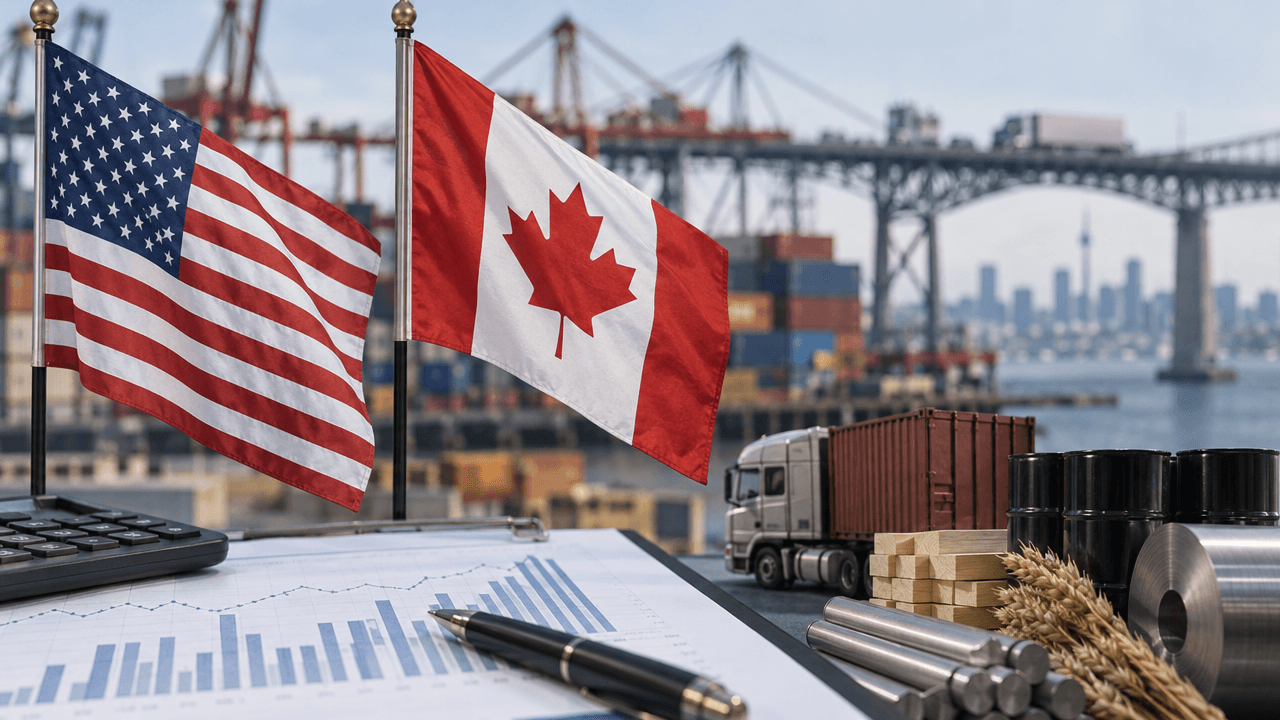
A potential rollback of US tariffs on selected Canadian imports has become a market story with implications far beyond a handful of product categories. The White House has announced that certain Canadian goods will be removed from an additional 50% duty, while other imports will be added to the tariff list. The changes are scheduled to take effect on October 30, creating both relief for some exporters and fresh uncertainty for others. [2]
What The Tariff Shift Means
The latest action is best understood as a targeted reshuffling rather than a broad return to normal trade relations. Products reportedly being removed from the 50% tariff list include plywood sheets, selected paper products, agricultural and industrial machinery, refrigeration equipment, and certain packing crates and boxes. The administration is adding other products, including some valves, carpets, waste products, cocoa powder, vinyl flooring, and shampoos. [1][11]
The precise economic effect depends on the value and composition of the goods moving in each direction. If the newly exempted products represent a similar dollar value to the goods being added, the change may not materially reduce the overall tariff burden. Instead, it would shift pressure from politically sensitive industries to other Canadian exporters.
That distinction matters. A genuine rollback would reduce the average cost of cross-border commerce and improve confidence among businesses planning investment and inventory. A product-for-product swap would provide targeted relief without changing the broader direction of US-Canada trade policy.
Why Canadian Exporters Are Watching Closely
Canadian exporters operate within highly integrated North American supply chains. A tariff applied at one stage of production can raise costs for manufacturers, distributors, farmers, retailers, and consumers on both sides of the border.
For a Canadian producer of plywood, packaging, refrigeration equipment, or crop machinery, removal of a 50% duty could restore price competitiveness almost immediately. US buyers may be more willing to place orders, and Canadian sellers may no longer need to absorb part of the tariff through lower margins.
The benefits are especially relevant to agricultural regions. Maine Senator Susan Collins said exemptions would cover nine categories linked to blueberry, potato, apple, and seaweed producers, as well as equipment and packaging used by those industries. [3][7] The exemptions could therefore help US businesses that depend on Canadian inputs, not just Canadian companies selling into the United States.
However, companies whose products are newly targeted face the opposite problem. They may need to raise prices, find alternative customers, redesign supply chains, or shift production. Even exporters that are not directly affected may hesitate to commit capital while tariff classifications remain subject to frequent revision.
What It Could Mean For Cad And Markets
The Canadian dollar typically responds to the expected health of trade, commodity demand, and business confidence. A durable reduction in trade barriers would generally be positive for CAD because it could support Canadian exports and reduce downside risks to economic growth.
The initial currency response, however, may be limited. USD/CAD was reported near 1.3990 after the early tariff-rollback reports, with the pair described as largely unmoved by the news. [17] That muted reaction reflects the market’s central question: does the policy represent a net reduction in tariffs, or merely a change in which products are penalized?
Traders should also separate the tariff headline from broader CAD drivers. Oil prices, interest-rate expectations, global risk appetite, and the relative performance of the US dollar can all overwhelm a sector-specific trade announcement. On October 23, USD/CAD was also being influenced by a generally weaker US dollar and firm oil prices. [19]
Trade-sensitive futures and equities may deliver a clearer signal than the currency market. Lumber, paper, agricultural machinery, packaging, industrial equipment, and Canadian transportation companies could react according to their exposure. Newly targeted categories may underperform, while companies benefiting from exemptions could see improved margins.
What Traders Should Monitor Next
The first priority is the official product list. Headlines often describe goods in broad terms, but tariff treatment is determined by specific customs classifications. A company may manufacture an exempt product while one closely related item remains subject to the duty.
The second priority is implementation. The White House order says the changes apply to qualifying goods entered for consumption or withdrawn from warehouses from 12:01 a.m. Eastern time on October 30. [2] Importers may adjust shipment schedules before that date, creating temporary changes in freight demand and inventory flows.
The third priority is retaliation. Canada has imposed its own tariffs on selected US imports, covering approximately C$27.6 billion of goods at rates of 15%, 25%, and 50%. [27] Any change in Ottawa’s response could alter the net benefit of the US exemptions and affect companies dependent on American inputs.
Finally, traders should watch whether the administration describes the move as permanent, conditional, or part of wider negotiations. Policy language can be as important as the tariff schedule itself. A stable agreement would encourage investment; another temporary adjustment would keep uncertainty elevated.
A Tactical Opportunity, Not A Full Reset
The tariff changes create real opportunities for selected Canadian exporters and US industries that rely on Canadian supplies. They may also offer short-term trading catalysts in CAD, lumber, paper, machinery, and related equities.
Yet the broader message is more complicated. Removing duties from one group of products while adding them to another suggests that tariffs remain an active negotiating tool rather than a settled policy framework. Until the total value of affected goods and the durability of the changes become clearer, markets are likely to treat the announcement as a tactical adjustment instead of a decisive thaw in US-Canada relations.
For SimFi traders, the practical lesson is to avoid trading the headline in isolation. Map the affected sectors, verify the official tariff lines, assess potential Canadian retaliation, and compare the move with oil, interest-rate expectations, and overall risk sentiment. The strongest opportunities may come not from the headline itself, but from identifying which companies and markets experience a genuine change in their underlying economics.