
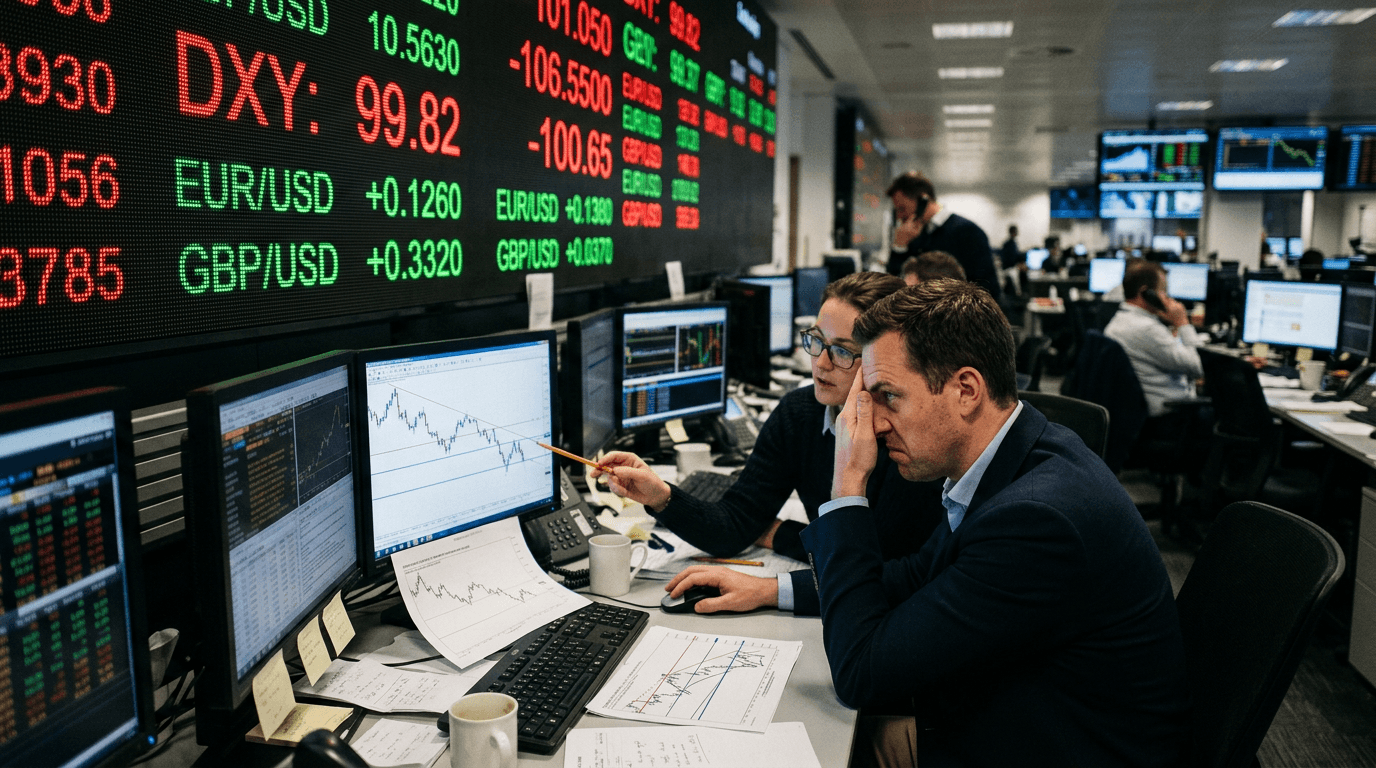
The breach of the US Dollar Index below the critical 100 mark serves as a pivotal moment in the foreign exchange landscape, marking a significant transformation in dollar sentiment unseen since July 2023. This shift, influenced by a blend of policy unpredictability, geopolitical unrest, and relative economic frailties abroad, has prompted a notable reevaluation among global investors, raising substantial inquiries about the future resilience of the dollar.
The Perfect Storm: Factors Behind The Dollar's Decline
The recent downturn of the dollar did not occur in isolation. It was the result of multiple converging factors creating a perfect storm for dollar weakness. The Trump administration's confrontational approach toward key trading partners, coupled with heightened scrutiny of Federal Reserve Chair Jerome Powell, introduced an unexpected layer of policy uncertainty that markets struggled to assimilate. This led to European funds actively divesting from dollar-denominated assets in a process termed "dedollarization," which accelerated outflows from dollar assets at a rate few could accommodate.
Additionally, geopolitical tensions between the US and Iran disrupted energy markets, causing oil prices to surge due to fears over disruptions in the Strait of Hormuz. This energy shock reverberated through global markets, altering expectations around interest rate policies and bolstering the argument for potential Federal Reserve rate cuts. Labor market data in the US also presented troubling signs, with a sharp rise in job cut announcements and businesses citing weaker consumer demand, reinforcing a dovish outlook.
The technical situation deteriorated swiftly, with the DXY declining nearly 2.5 percent in a single week as traders unwound positions ahead of Federal Open Market Committee meetings. The combination of seasonal patterns favoring dollar weakness before FOMC decisions and actual fundamental weakening resulted in a one-way decline that tested key support levels unseen in nearly three years.
Key Technical Levels And Market Implications
For traders and risk managers, comprehending the technical landscape is crucial in this volatile environment. The DXY currently resides in the 96.50 to 97.00 support range, a critical level that many analysts identify as the lows of 2025. A decisive breach below 97.00 could lead to testing even lower support near 96.20, aligning with the September FOMC lows. Conversely, a consolidation range between 96.80 and 97.30 seems likely until the next FOMC announcement, after which direction may become more pronounced.
On the upside, resistance zones exist at 98.80 to 99.00, followed by the January highs near 99.40 to 99.50. A move above 100.376 would signify a return to November highs. Notably, the 200-day moving average has become a vital reference point, as the dollar's strength or weakness relative to this long-term indicator distinguishes between temporary corrections and sustained trend changes.
The currency implications stretch far beyond technical charts. The EUR/USD pair has already approached the 1.15 level, indicating dollar weakness and relative euro stability despite Europe's heavy reliance on energy imports. Other major pairs like USD/JPY, GBP/USD, and commodity-linked pairs have also undergone significant repricing, presenting both challenges and opportunities across the forex spectrum.
The Broader Economic Context
What makes this dollar decline particularly noteworthy is that it reflects relative economic weakness rather than absolute US strength. The downward revision to late-2025 growth forecasts suggests the global slowdown is becoming more apparent, particularly in Europe and Japan. The dollar's recent resilience, such as it was, stemmed not from robust American economic performance but from other economies appearing even more fragile and the Federal Reserve having limited room to cut rates compared to global counterparts.
This dynamic creates an intriguing paradox. Investors are not necessarily betting on a stronger US economy, but instead positioning defensively in the relative strength of dollar assets. However, ongoing inflation threats and concerns about stagflation risk—combined with policy uncertainty—have eroded even this relative advantage. Markets had previously anticipated a 25 basis point Fed rate cut, but geopolitical tensions and inflation readings have introduced complexity to the policy outlook.
What Traders Should Watch Going Forward
The immediate focus remains on FOMC outcomes and whether the Federal Reserve revises its guidance on rate cuts. A supportive stance toward lower rates would likely prolong dollar weakness, while hawkish surprises could trigger sharp reversals given the extreme positioning. Energy prices warrant close monitoring as well, particularly developments concerning Iran and broader geopolitical tensions that could prompt further oil spikes and additional pressure on the dollar.
European economic data will also be of significant importance, as EUR strength depends partly on whether Europe can stabilize growth despite energy headwinds. Finally, tracking Treasury yield movements and real interest rate differentials will remain critical, as these fundamentals typically drive sustained foreign exchange movements. The 200-day moving average on the DXY serves as a key pivot point to determine whether weakness represents a technical bounce or a structural shift.
The US Dollar Index's fall below 100 for the first time since July 2023 marks an inflection point that reflects genuine shifts in monetary policy expectations, geopolitical risk, and relative economic momentum across major economies. For traders, the key is distinguishing between mean reversion moves and sustained trends while maintaining awareness of the technical support and resistance levels that define the market landscape.