
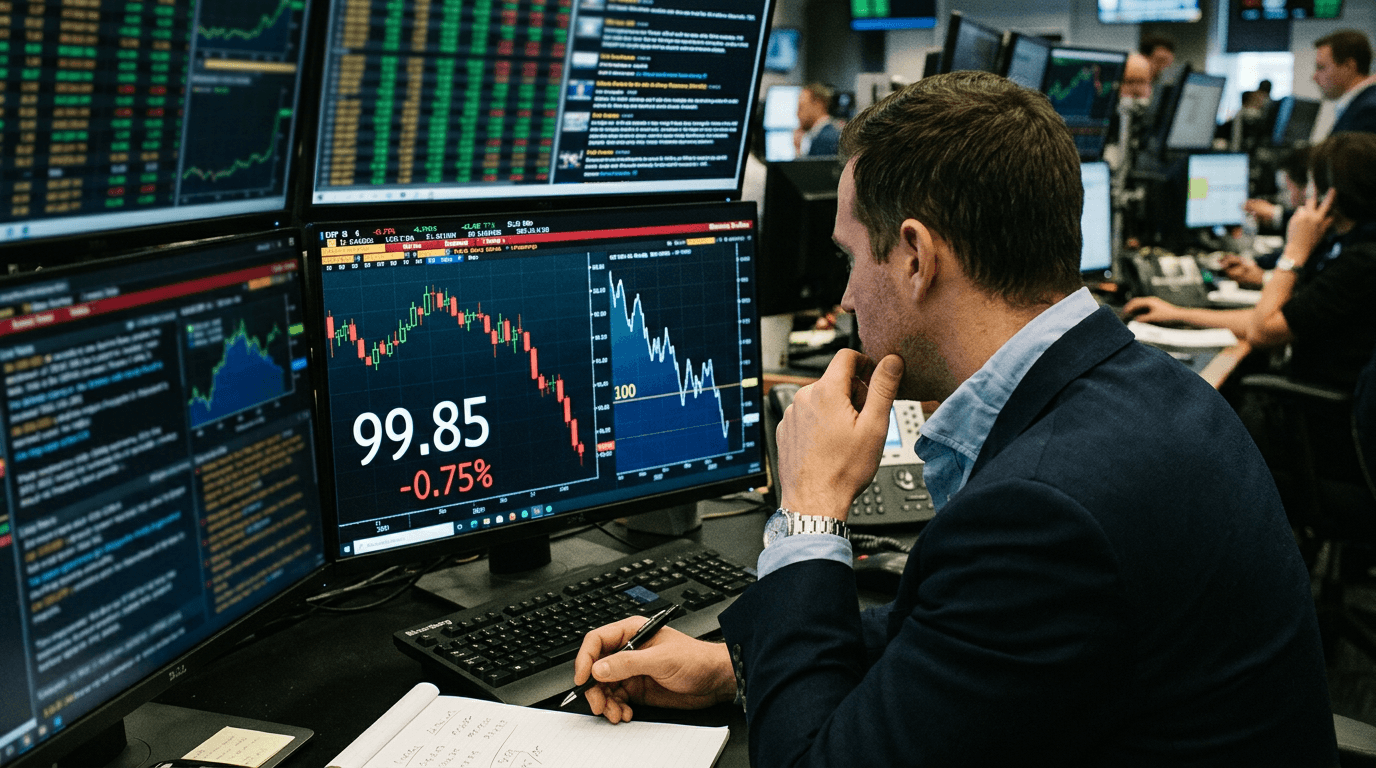
The US Dollar Index has reached a crucial psychological threshold that has caught the attention of traders worldwide. For the first time since July 2023, the DXY has dipped below the 100 mark, marking a significant shift in currency markets and signaling deeper concerns about the American economy's health. This drop from a January high of 110 illustrates a striking 7% decline in the dollar's value since President Trump's inauguration, challenging Wall Street's expectations of a stronger dollar under his leadership. The breach of the 100 level is more than a mere numerical milestone—it's a fundamental shift in how investors perceive the US currency and the economic strategies influencing its decline.
What Caused The Dollar's Weakness
The primary factor behind the dollar's decline is the escalating trade tension between the United States and China, coupled with uncertainty surrounding Trump's tariff policies. Contrary to predictions of a strengthening currency, the administration's protectionist policies have had the opposite effect. The dollar index has fallen from its January peak of 110 to a low of 99.74, with ongoing tariff discussions casting a shadow of unpredictability over global markets. This unexpected turn of events has left many analysts surprised, as investors traditionally flock to the dollar during uncertain times, viewing it as the ultimate safe-haven currency.
Compounding the issue are rising concerns about an impending US recession, spurred by Trump's aggressive tariff measures. The disruption to global supply chains and the threat of retaliatory actions from trading partners have unsettled investors, prompting them to reevaluate the robustness of the American economy. Market participants are now questioning whether the short-term impact of tariffs will justify any long-term economic benefits, a sentiment that is directly mirrored in the dollar's weakening.
The Shift In Safe-haven Preferences
One of the most telling indicators of market stress is the movement of investor funds. Historically, the US dollar has served as the ultimate safe haven during volatile periods. However, this dynamic has undergone a dramatic shift. As investors flee the dollar in search of safer alternatives, the Japanese Yen and Swiss Franc have emerged as the new preferred safe-haven currencies. This change in global capital flows suggests a loss of confidence in the dollar's traditional protective attributes.
This shift is rooted in a deliberate policy choice by the Trump administration. Weakening the dollar is an intentional strategy aimed at refocusing the economic spotlight from Wall Street to Main Street. By devaluing the dollar, US exports become more competitive globally, potentially attracting foreign investment into manufacturing and boosting domestic production and job creation. While this strategy may benefit the real economy in the long term, it introduces short-term volatility and uncertainty, prompting investors to seek refuge in other assets.
Implications For Forex Traders
For forex traders, the repercussions of a weaker dollar are substantial. As the DXY dips below 100, currency pairs like EUR/USD and GBP/USD gain significant strength. A weaker dollar means fewer euros or pounds are needed to purchase the same amount of dollars, making these pairs more appealing to traders. The Euro and Japanese Yen are expected to strengthen further, with analysts at private equity firm KKR predicting a continued weakening of the dollar while other major currencies appreciate.
This scenario presents both opportunities and risks for traders involved in these pairs. Those with long positions in EUR/USD or GBP/USD stand to benefit from the trend, while dollar bulls face challenges. The key lies in understanding that this weakness is structural, driven by policy choices rather than temporary market fluctuations, suggesting that the trend could persist for an extended period.
Market Uncertainty And Volatility Ahead
Trump's recent vacillations on trade policy have heightened overall market uncertainty. Announcements regarding reciprocal tariffs and threats toward China introduce layers of complexity that make forecasting difficult for traders and investors alike. This uncertainty has led many market participants to adopt a risk-off approach, divesting dollars and seeking alternative safe-haven currencies or gold.
Looking ahead, Trading Economics global macro models predict the dollar could trade around 100.13 by the end of this quarter, with a projection of 97.93 in 12 months, indicating further potential weakness. However, recent data shows the dollar has rebounded to around 100.48 as of March 30, 2026, suggesting some stabilization, possibly driven by Middle East tensions maintaining some safe-haven demand.
Practical Takeaways For Traders
For active traders, several critical lessons emerge from the dollar's dip below 100. First, policy uncertainty is a catalyst for currency weakness that should not be underestimated. Second, traditional safe-haven relationships can shift swiftly when confidence in an economy falters. Third, this environment favors trading pairs where the dollar is the weaker element, particularly EUR/USD and GBP/USD. Finally, position sizing becomes crucial when fundamental trends are shifting as dramatically as we're witnessing with the DXY.
The dollar's fall below 100 is not merely a technical breakdown—it reflects genuine concerns about trade policy, recession risks, and a fundamental reassessment of American economic strength. Traders who grasp these underlying drivers will be better equipped to navigate the volatility ahead.