
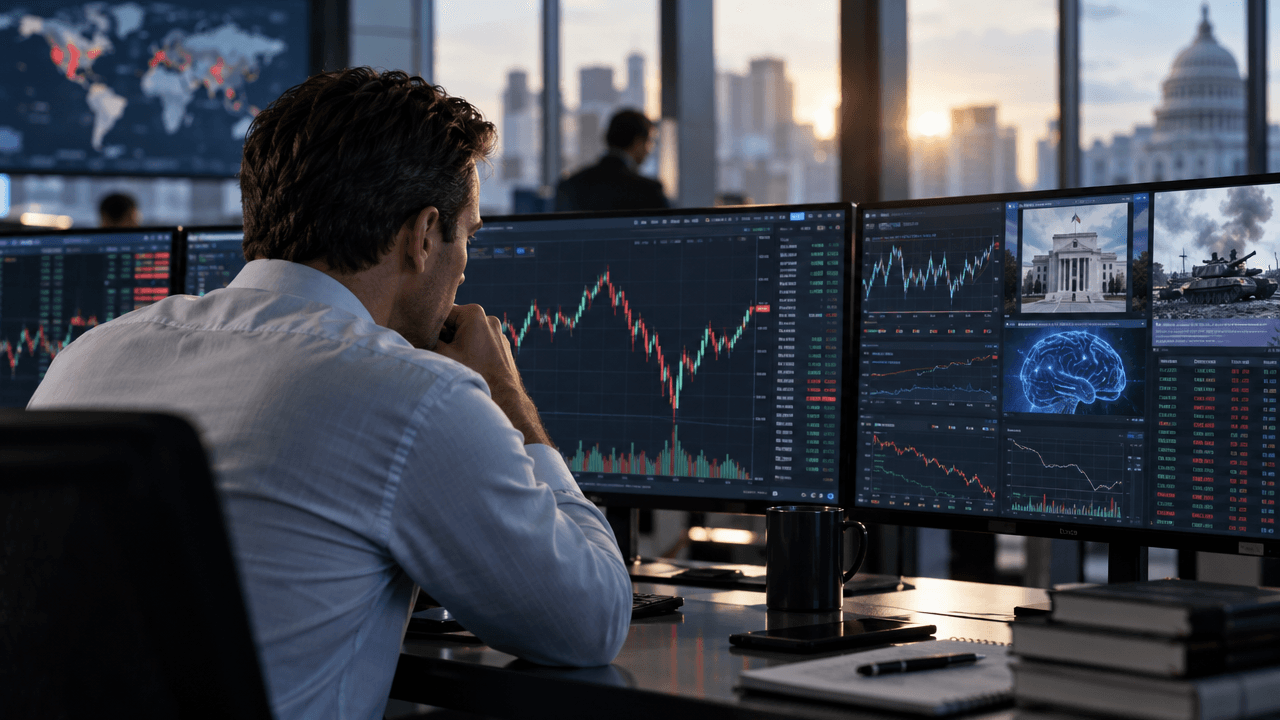
U.S. equity-index futures are entering a more fragile phase as traders reassess interest rates, inflation, artificial-intelligence valuations, and the possibility that geopolitical uncertainty could amplify already-large market swings. The latest move is not simply a technology-sector pullback. It reflects a broader repricing of risk, with futures increasingly sensitive to every inflation release, Federal Reserve signal, earnings update, and headline affecting the AI investment cycle.
November has been unusually active by recent standards. The S&P 500 has averaged daily moves of approximately 1.6%, while the Nasdaq 100 has averaged about 2.4%. Both figures represent the largest average daily changes for the indexes since the tariff-related turmoil of April 2025. [1] For traders, that means a position that appears modest in normal conditions can produce significantly larger gains or losses within hours.
Why Futures Are Moving So Sharply
Equity-index futures are forward-looking instruments. They react before the cash market opens and often provide the first indication of how investors are interpreting overnight developments. When uncertainty is elevated, futures can move rapidly as traders adjust exposure, hedge portfolios, or respond to changes in bond yields.
The key pressure point is the relationship between inflation and monetary policy. Hotter-than-expected October inflation data strengthened expectations that the Federal Reserve could raise interest rates again at its December meeting. Treasury yields rose sharply, while technology shares came under pressure because higher discount rates reduce the present value of future corporate earnings. [9]
That relationship is especially important for growth stocks. Many AI and software companies are valued on expectations of strong revenue and profit growth years into the future. When interest rates rise, those expected future cash flows become less valuable in today’s terms. The result can be an outsized decline in high-growth shares even when their current earnings remain solid.
Ai Optimism Meets Ai Skepticism
The artificial-intelligence trade has been one of the most powerful forces behind the equity rally, but it has also become a major source of volatility. Investors are no longer asking only whether AI will transform the economy. They are asking how quickly companies will earn returns on enormous spending commitments involving chips, data centers, energy, and cloud infrastructure.
Concerns about a slower AI data-center buildout contributed to heavy selling across technology stocks. Political developments also raised questions about whether changes in regulation or public policy could slow construction and investment in key markets. [3] The pressure spread beyond individual companies, affecting chipmakers, cloud providers, software firms, and other businesses linked to the AI ecosystem.
Recent price action illustrates how quickly sentiment can reverse. On one session, the Nasdaq Composite rose 1.60% and the S&P 500 gained 1.31% as technology stocks rebounded. [10] On another, the Nasdaq fell 0.7% after inflation data increased expectations for additional rate hikes. [7] Such reversals indicate that traders are competing over valuation, policy, and growth expectations rather than following a single clear market trend.
What This Means For Traders
The first practical lesson is to reduce assumptions about “normal” volatility. A strategy that worked when the S&P 500 moved less than 1% on most days may behave very differently when average daily movement approaches 1.6%. Position sizing should reflect the distance between the entry price and the planned stop, not simply the amount a trader would like to risk.
For example, a trader risking $500 on a position should calculate the number of shares or contracts only after determining the stop distance. If expected volatility requires a stop twice as wide as usual, the position should generally be smaller. This approach keeps dollar risk consistent while allowing the trade enough room to avoid being stopped out by ordinary market noise.
Second, traders should distinguish between overnight and intraday risk. Futures can gap higher or lower after inflation data, central-bank comments, earnings announcements, or geopolitical headlines. A stop order cannot guarantee an exact exit price during a fast overnight move. Traders using simulated accounts can study this risk without putting capital in danger by comparing planned entries with actual opening prices.
Third, avoid treating an index move as a complete market explanation. The S&P 500 may appear stable while its largest technology constituents experience significant selling. Conversely, a strong rebound in a handful of mega-cap stocks can lift the index even when market breadth is weak. Monitoring sector performance, bond yields, volatility measures, and market breadth gives a more complete picture than watching the headline index alone.
A Simfi Playbook For Renewed Volatility
Simulated finance provides a useful environment for testing decisions under these conditions. Traders can create separate scenarios for a hot inflation report, a dovish Federal Reserve surprise, an AI earnings disappointment, and a geopolitical risk event. The objective is not to predict every outcome. It is to evaluate whether the trading plan remains disciplined when the market moves quickly.
A practical framework includes four steps. First, define the catalyst and the time window in which it matters. Second, establish the maximum acceptable loss before entering. Third, identify invalidation levels based on price structure rather than emotion. Fourth, record whether the trade followed the plan, regardless of its result.
It is also useful to compare a single-stock position with an index position. An individual AI stock may carry company-specific earnings and valuation risk, while an index future spreads exposure across multiple companies. Neither is automatically safer, particularly during broad risk-off sessions, but the comparison helps traders understand concentration risk.
Conclusion
Renewed volatility in U.S. equity-index futures reflects a market caught between strong long-term growth narratives and immediate policy, valuation, and geopolitical risks. The S&P 500’s roughly 1.6% average daily move and the Nasdaq 100’s approximately 2.4% average show why traditional position sizes and loose assumptions can quickly become costly. [1]
The most durable response is not to guess the next headline. It is to manage exposure, respect the influence of interest rates, question overly optimistic AI assumptions, and prepare for multiple scenarios. In a SimFi environment, traders can build that discipline through deliberate testing, detailed journaling, and consistent risk controls before applying the lessons to more consequential markets.