
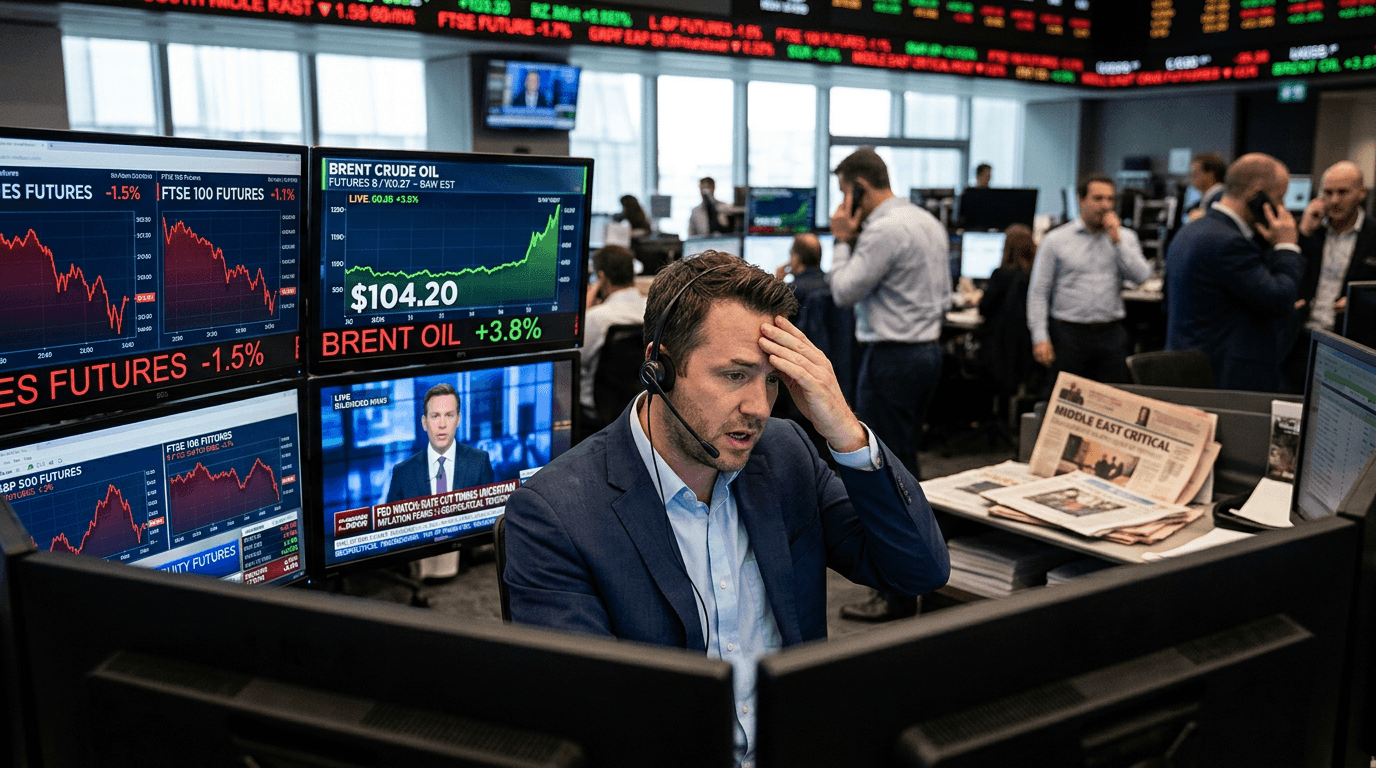
Geopolitical tensions in the Middle East sent U.S. equity futures plunging this week, with major indices testing critical support levels as investors grapple with the potential for sustained disruption to global energy supplies. The sharp sell-off reflects a fundamental concern haunting market participants: escalating conflict in one of the world's most volatile regions could trigger an inflationary spiral just as the Federal Reserve faces mounting pressure over interest rate policy.[1][2]
The Market Reaction
On Tuesday, March 3, the broad market decline was immediate and substantial. The Dow Jones Industrial Average fell 403.51 points, or 0.83%, with intraday losses reaching as steep as 2.6% during the worst of the trading session. The S&P 500 dropped 0.94% while the Nasdaq Composite fell 1.02%, signaling broad-based weakness across growth and value stocks alike.[1] What makes this pullback particularly noteworthy is not just the magnitude of the decline, but the underlying driver: a rational market reassessment of risk stemming from geopolitical events rather than corporate earnings misses or economic data disappointments.
The sell-off reflects what seasoned traders recognize as a classic risk-off dynamic. When geopolitical uncertainty spikes, investors systematically move out of equities and into perceived safe havens. The trigger this time was Iran's expansion of strikes across the Middle East, combined with threats to restrict vital shipping lanes and warnings that crude prices could reach $200 per barrel.[2] For market participants already concerned about elevated valuations and inflation pressures, this represented a legitimate trigger for profit-taking and defensive repositioning.
OIL PRICES BREACH THE PSYCHOLOGICAL $100 BARRIER
The most visceral market impact came from energy markets. Oil prices spiked above $100 per barrel for the first time in this latest escalation cycle, with Brent crude climbing more than 4% to $81 per barrel on Tuesday and West Texas Intermediate crude jumping over 4% to $74 per barrel.[1] By Thursday, March 12, crude had pressed even higher, briefly breaching $100 before pulling back slightly as markets absorbed the full scope of the conflict's energy implications.[2]
This oil spike matters enormously for equity investors. Rising energy costs feed directly into production and transportation expenses across virtually every sector of the economy. More critically, higher oil prices create inflationary pressure that complicates the calculus for policymakers. As one market analyst noted, investors fear that if oil prices remain elevated above $100 per barrel, the inflationary consequences could force the Federal Reserve to maintain higher interest rates for longer than previously anticipated.[1]
The root cause is stark: the Strait of Hormuz, through which approximately 20% of the world's oil transits daily, faces potential disruption due to Iranian threats to attack vessels attempting to pass through.[1][3] Additionally, several Middle Eastern oil and gas producers have already halted production, while ports including the critical Jebel Ali facility in Dubai suspended operations following drone strikes.[3] This is not theoretical supply disruption—it is happening in real time.
Federal Reserve Policy Under Pressure
The intersection of geopolitical risk and monetary policy has created a genuine dilemma for the Fed. Investors had previously anticipated a 25-basis-point interest rate cut in July, but Middle East tensions have pushed expectations for rate cuts to September.[1] This delay matters significantly for equity valuations, particularly growth stocks that depend on lower discount rates for their valuations.
The paradox facing Fed policymakers is unforgiving: inflation pressures from rising oil prices argue against rate cuts, while geopolitical uncertainty and potential economic slowdown argue in favor of cutting rates to support growth. As one trader colorfully summarized the situation, the Federal Reserve is facing genuine constraints from multiple directions simultaneously.[2] Tariff-driven inflation is already sticky, with year-over-year inflation reaching 3.1% in February, and now energy price shocks threaten to push inflation even higher.[2]
Key Support Levels And Trader Considerations
For technical-minded traders, the S&P 500 is testing critical support around 6,737, with potential for breakdown to 6,500 if geopolitical tensions worsen.[3] Individual stocks have shown extreme volatility, with 20-25% of names swinging 2-3% or more on single trading sessions.[2] This divergence between broad index stability and individual stock volatility suggests market concentration and rotation rather than comprehensive capitulation.
Market participants should monitor three critical variables: first, the trajectory of crude oil prices and any statements from OPEC producers; second, Iranian rhetoric regarding Strait of Hormuz closure; and third, Fed communications regarding inflation and rate policy. President Trump's announcement of support for maritime trade guarantees and potential Navy escort services temporarily moderated oil prices, but the fundamental supply risk remains.[1]
The bottom line is straightforward: geopolitical risk has returned to the forefront of market consciousness, and until Middle East tensions materially de-escalate, equity investors should expect continued volatility with a bias toward defensive positioning in sectors less exposed to energy costs and interest rate sensitivity.
---