
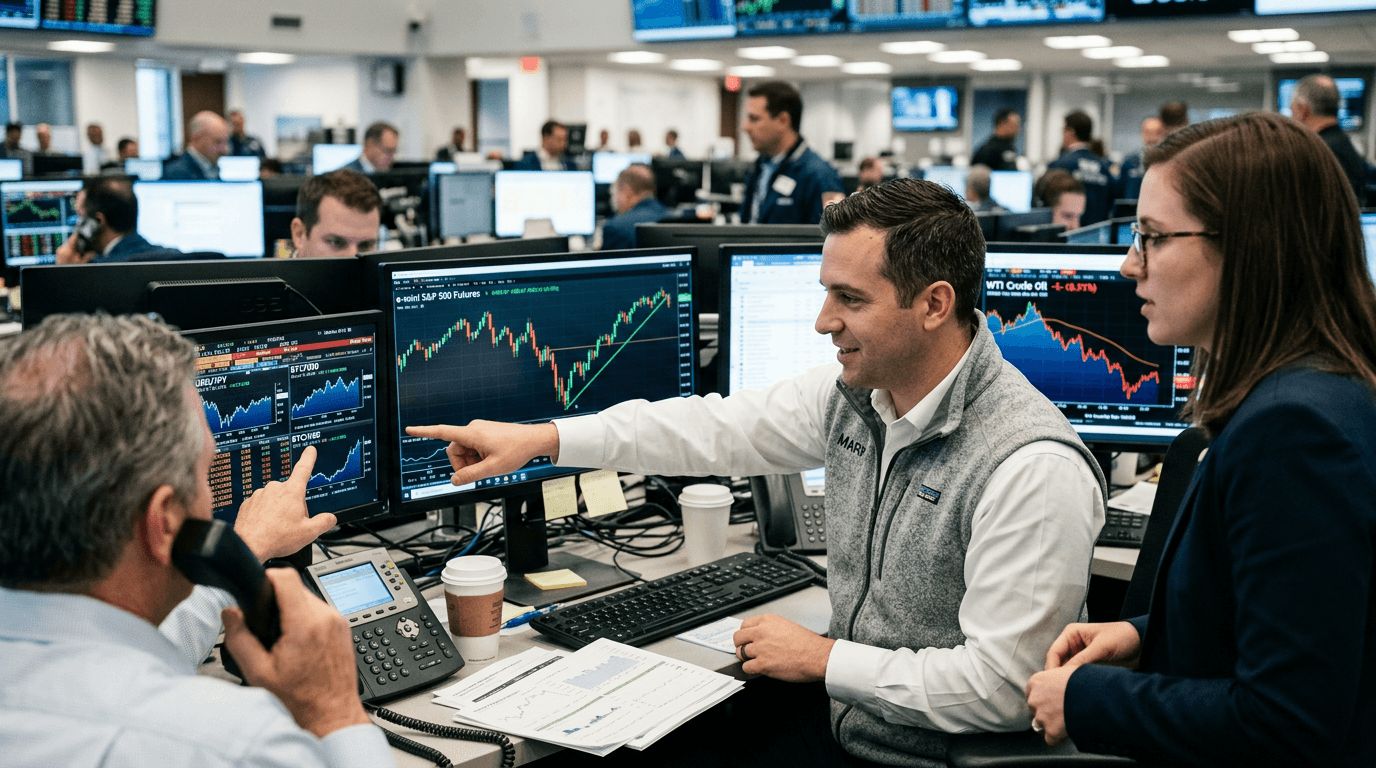
U.S. equity index futures staged a rebound as oil prices backed off earlier highs, signaling that traders are reassessing the geopolitical shock from renewed U.S.–Iran strikes and dialing down immediate worst‑case fears.[7][10] The move higher in S&P 500, Nasdaq 100, and Dow futures suggests that, for now, markets view the latest escalation as sharp but contained, rather than a catalyst for a sustained risk‑off trend.[4][7]
Markets Snap Back As Oil Pulls Back
In the first wave of headlines, the natural reaction is a flight to safety: oil spikes, equities drop, and volatility jumps as traders rush to price in the risk of broader conflict in the Gulf.[7][10] That pattern has been visible in previous U.S.–Iran flare‑ups, where concerns about supply disruptions in the Strait of Hormuz drove energy prices higher and weighed on risk assets.[7][10]
Once more information emerges, markets often “right‑size” the shock. When it becomes clearer that strikes are targeted and that neither side is pushing immediately toward full‑scale war, oil has a tendency to retrace a chunk of its move as physical supply fears ease.[10] In similar episodes, U.S. stock index futures have recovered from early losses to trade modestly higher, with S&P 500 and Nasdaq 100 contracts often up around 0.4–0.6% after the dust settles.[4][7]
The current rebound follows that playbook: as crude prices retreat from their intraday highs, equity futures are finding support and moving back into positive territory, especially in growth and tech‑heavy indices like the Nasdaq 100.[7][8] This reflects investors shifting focus from “tail‑risk war scenario” back toward earnings, interest rates, and sector‑specific catalysts that tend to dominate in the absence of a clear escalation path.[4][9]
Why Oil And Equities Move Together In Geopolitical Shocks
Understanding why oil and equities often move in opposite directions around Middle East headlines is critical for anyone trading index futures, energy contracts, or related derivatives. A spike in crude prices effectively acts like a tax on the global economy: higher input costs for companies, higher fuel prices for consumers, and a potential drag on growth and margins.[10]
When oil rises sharply, equity investors worry about two things at once—profit squeeze for energy‑intensive sectors and the risk that central banks might have to stay hawkish longer if higher energy feeds into inflation.[10] That combination tends to pressure broad indices such as the S&P 500 and Dow while pushing money into traditional havens like Treasuries and the dollar.[4]
Conversely, when oil backs off from conflict‑driven highs, it relieves some of that macro pressure. In previous episodes, Brent futures have quickly fallen back toward pre‑conflict levels, easing concerns about lasting damage to growth.[10] This has often coincided with rebounds in equity futures and renewed buying in cyclical and growth names that had been hit during the initial risk‑off move.[7][10]
For active traders, the key takeaway is that the direction and persistence of the oil move matter more than the initial headline. A one‑day price spike that reverses is a very different macro signal than a sustained break higher in crude that persists for weeks.
What Futures Prices Are Signaling About Risk Sentiment
Index futures are essentially the market’s real‑time sentiment gauge, reacting faster than the underlying cash market when news breaks overnight or outside regular trading hours.[4] When S&P 500 and Nasdaq 100 futures bounce back after a geopolitical jolt, it signals that institutional and systematic traders are not repositioning for a prolonged crisis—at least not yet.[4][7]
Recent patterns show that technology and semiconductor shares have repeatedly led rebounds after geopolitical and macro setbacks, reflecting their central role in the current market cycle.[3][7][8] Futures linked to tech‑heavy indices often outperform during relief rallies as traders rotate back into high‑beta growth exposures once the immediate macro fear subsides.[3][8][9]
The rebound in U.S. futures also needs to be read alongside volatility metrics and sector futures. If equity futures push higher while volatility futures (like VIX contracts) drift lower, it confirms a shift back toward risk‑on positioning. If, instead, equities bounce but volatility stays elevated, it suggests lingering caution and a higher probability of renewed swings.
For traders using simulated environments, watching how index futures respond over the first 24–48 hours after a shock is a powerful way to learn how institutional flows evolve from panic to repricing to normalization.
Ripple Effects In Fx, Rates, And Crypto
Geopolitical shocks in the Middle East rarely stay confined to oil and equities. The initial response typically sees the dollar and other safe‑haven currencies catch a bid as investors de‑risk and seek liquidity.[4][7] If oil remains elevated, energy‑importing currencies can come under pressure, while exporters may benefit from improved terms of trade.
As oil retreats and equity futures rebound, some of those safe‑haven flows reverse. The dollar can ease off its highs, and higher‑beta FX—such as commodity‑linked or emerging‑market currencies—may stabilize or bounce as risk appetite recovers.[4] In rates markets, a sharp but short‑lived flight to Treasuries can quickly fade, with yields retracing higher once fears of sustained escalation diminish.[4][10]
Crypto markets increasingly trade as a high‑beta extension of risk sentiment. During episodes when stock index futures slide on geopolitical news, major cryptocurrencies often sell off as well; when futures rebound and volatility cools, crypto frequently participates in the relief rally. The correlation is far from perfect, but it has been strong enough that many traders now monitor S&P 500 futures as a key input for short‑term crypto positioning.
How Simulated Traders Can Practice Geopolitical Shocks
For many traders, geopolitical events are mentally hard to trade because they are rare, noisy, and emotionally charged. This is where a simulated finance (SimFi) environment can add real educational value: you can replay variants of the same macro shock without putting capital at risk.
A practical framework to practice in simulation might include:
• Scenario 1: Initial shock Model the first 1–2 hours after a headline: oil spikes, equity futures drop, safe‑haven FX strengthens. Focus on execution discipline—position sizing, stop placement, and avoiding over‑trading the first headline.
• Scenario 2: Information drip Simulate the next phase, where officials release statements, analysts assess damage, and markets start to differentiate between a one‑off strike and a broader escalation. Here, practice adjusting positions as probabilities change, not as emotions swing.
• Scenario 3: Relief and rotation Build scenarios where oil retraces and stock index futures turn higher, similar to prior rebounds in U.S. futures once geopolitical tensions looked contained.[4][7][10] Practice rotating from defensive to growth exposures, tightening risk as volatility normalizes, and identifying which sectors historically lead in such recoveries (for example, chipmakers and large‑cap growth stocks in recent cycles).[3][7][8]
By tracking how futures, oil, FX, and crypto move in sequence—and rehearsing that sequence in a simulated environment—you develop a playbook that can be deployed more calmly when the next real‑world shock hits. Over time, what feels like chaos starts to look more like a pattern of cause and effect that you can analyze and trade with a structured process rather than instinct.