
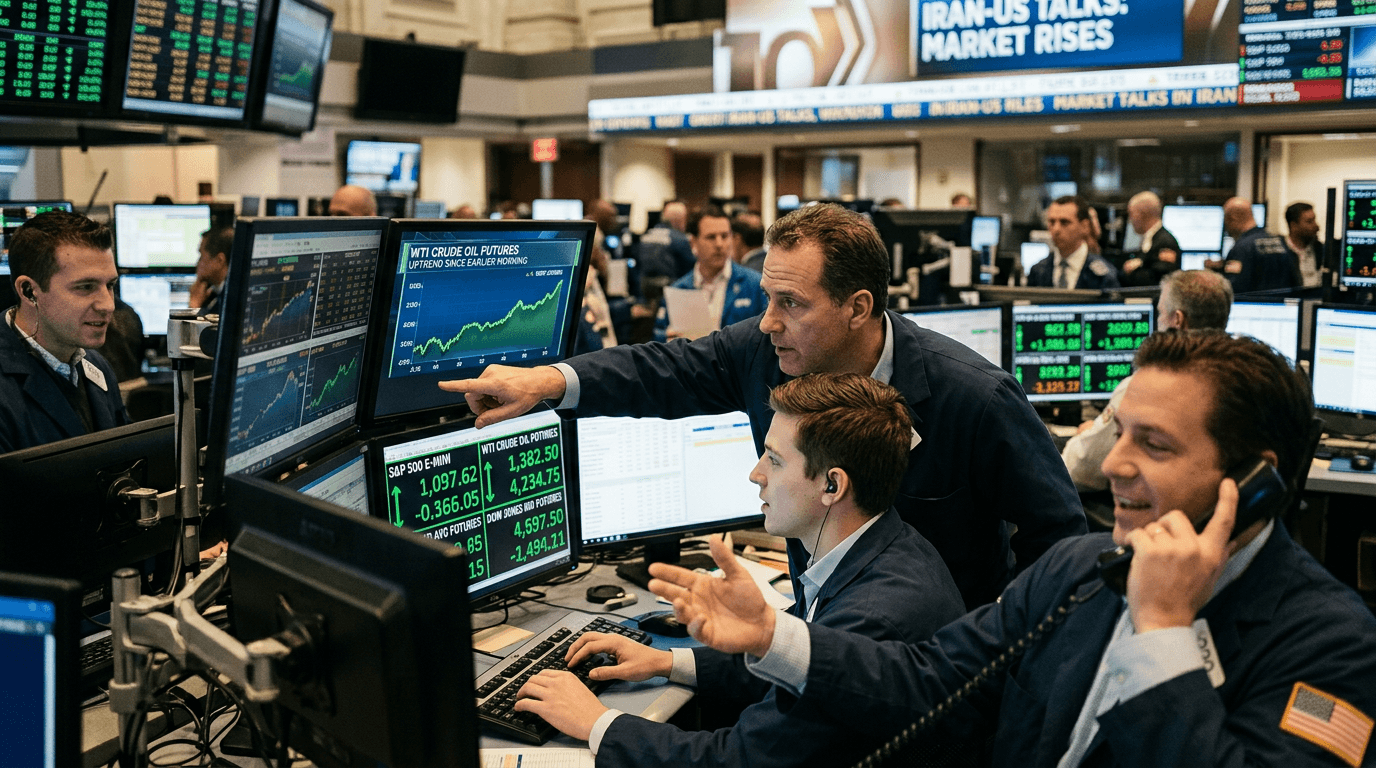
US stock-index futures opened slightly higher as traders welcomed reports of a temporary halt in attacks between the US and Iran following clashes in the Persian Gulf.[6] The move has eased immediate fears of a broader conflict, leading to modest gains in risk assets like equity futures and oil, while trimming demand for traditional safe havens.[6] For traders, it is a textbook example of how quickly geopolitical headlines can reshape market sentiment.
Market Overview: Futures Lift As Tensions Ease
The key driver behind the early move higher is the perception that the worst-case geopolitical scenarios are less likely in the near term.[6] When reports suggest that Washington and Tehran are stepping back from further strikes, even temporarily, markets tend to reprice the odds of escalation, shifting from “risk-off” to a more cautious “risk-on” stance.
US stock-index futures, including contracts linked to the S&P 500, Dow Jones Industrial Average, and Nasdaq-100, are among the first instruments to reflect changing expectations for the upcoming cash session.[4][9] A modest uptick in these futures suggests investors are willing to add exposure to equities again, but the “edge higher” language also signals that confidence is far from all-in. Traders are still highly sensitive to any new headlines that could reverse the narrative.
How Geopolitics Moves Futures
Futures markets are often used as a real-time barometer of sentiment before the stock market’s opening bell.[3][4] Because they trade virtually around the clock, equity index futures incorporate global developments—economic data, central bank commentary, and geopolitical events—before cash markets can react.[3][9] That makes them particularly informative on days when political or military news breaks outside regular US trading hours.
Geopolitical risk typically feeds markets through two key channels:
1. Growth expectations: A major conflict in a strategic region can threaten global trade, corporate profits, and consumer confidence. If investors fear a material hit to growth, stock futures usually fall as participants hedge equity exposure or reduce risk.
2. Risk appetite: Even before real economic effects appear, markets react to uncertainty itself. Heightened tensions can push investors into safe-haven assets such as US Treasuries, the US dollar, and gold, while weighing on stocks, high-yield credit, and risk-sensitive currencies.
Today’s modest rise in US stock futures, together with a softening bid for safe havens, signals a shift away from the most pessimistic scenarios that dominated after initial reports of strikes and counterstrikes.[6] It does not mean the risk has disappeared; it means traders now put lower odds on an immediate, uncontrolled escalation.
Ripple Effects Across Oil, Bonds, And Fx
Energy markets are particularly sensitive to developments involving Iran and the broader Persian Gulf region. Reports of a temporary halt to attacks have not erased the risk premium entirely, but they have kept oil prices supported rather than sending them sharply lower.[6] The market appears to be balancing two forces: relief that tensions may cool and a recognition that the underlying geopolitical fault lines remain unresolved.
In fixed income, easing worst-case fears tends to reduce demand for Treasuries as a safe haven, nudging yields higher and prices lower. While the move may be modest, it reflects a classic “unwind” of defensive positioning: investors who rushed into government bonds on initial escalation may now begin to rotate back toward risk assets.
Foreign exchange markets often respond in parallel. When risk appetite improves, so-called “risk-sensitive” currency pairs—such as higher-yielding or emerging-market currencies against the dollar—can find support. At the same time, traditional safe-haven currencies like the US dollar and Japanese yen may lose some momentum as traders step back from defensive trades. This cross-asset reaction helps confirm whether the move in futures is isolated or part of a broader sentiment shift.
What Traders Can Learn From This Episode
For both new and experienced traders, this episode underlines several important lessons:
1. Headlines can flip sentiment fast Geopolitical stories rarely evolve linearly. Initial reports of strikes can trigger sharp risk-off moves, followed by rapid reversals when ceasefire rumors or de-escalation headlines appear. Traders need playbooks for both scenarios rather than reacting emotionally to each update.
2. Futures are an early signal, not a final verdict Futures prices provide valuable clues about how the cash market might open, but they are not guarantees.[3] Liquidity is thinner in overnight sessions, and price moves can be reversed once regular trading begins and more participants step in. Use futures as a guide, not an absolute forecast.
3. Correlations intensify in stress Episodes of geopolitical stress often strengthen cross-asset correlations: stocks, oil, bonds, and FX can move in more tightly linked patterns. Traders who understand these relationships—such as how oil and energy equities react to Middle East risk, or how Treasuries respond to safe-haven demand—can better interpret intraday price action.
4. Scenario planning matters more than prediction Rather than trying to forecast the exact path of US–Iran relations, traders can structure their approach around scenarios: escalation, de-escalation, or stalemate. For each scenario, define likely reactions in key markets (equities, rates, commodities, FX) and a corresponding risk-management plan. This reduces the temptation to trade impulsively on every headline.
5. Practice in a low-stakes environment Because geopolitical episodes can trigger fast, volatile moves, they are ideal case studies for simulated or paper trading. By testing strategies—such as hedging equity exposure with index futures or using options to express views on volatility—in a simulated environment, traders can refine decision-making without putting real capital at risk.
Key Takeaways For The Week Ahead
First, the modest rise in US stock-index futures indicates relief, not euphoria. Markets are acknowledging a reduction in immediate tail risks while still pricing in lingering uncertainty.[6] Traders should watch whether that cautious optimism survives the next round of headlines and official statements.
Second, oil’s reaction is crucial. Persistent strength in crude would signal that markets still see a meaningful risk premium tied to Middle East tensions, while a quick pullback would suggest confidence that supply disruptions are unlikely.[6] Energy equities and related sectors may offer additional clues.
Third, cross-asset confirmation matters. If equities firm while safe havens like Treasuries and the dollar fade, that alignment supports a genuine improvement in risk sentiment. If the signals diverge—for example, stocks rise but bond yields continue to fall—traders should be wary of reading too much into futures alone.
Finally, this episode underscores an enduring reality: geopolitical risks can’t be timed, but they can be prepared for. Building robust risk management, understanding how futures and related instruments respond to shocks, and practicing response plans in a simulated setting can make the difference between reactive trading and disciplined execution the next time markets are jolted by unexpected news.