
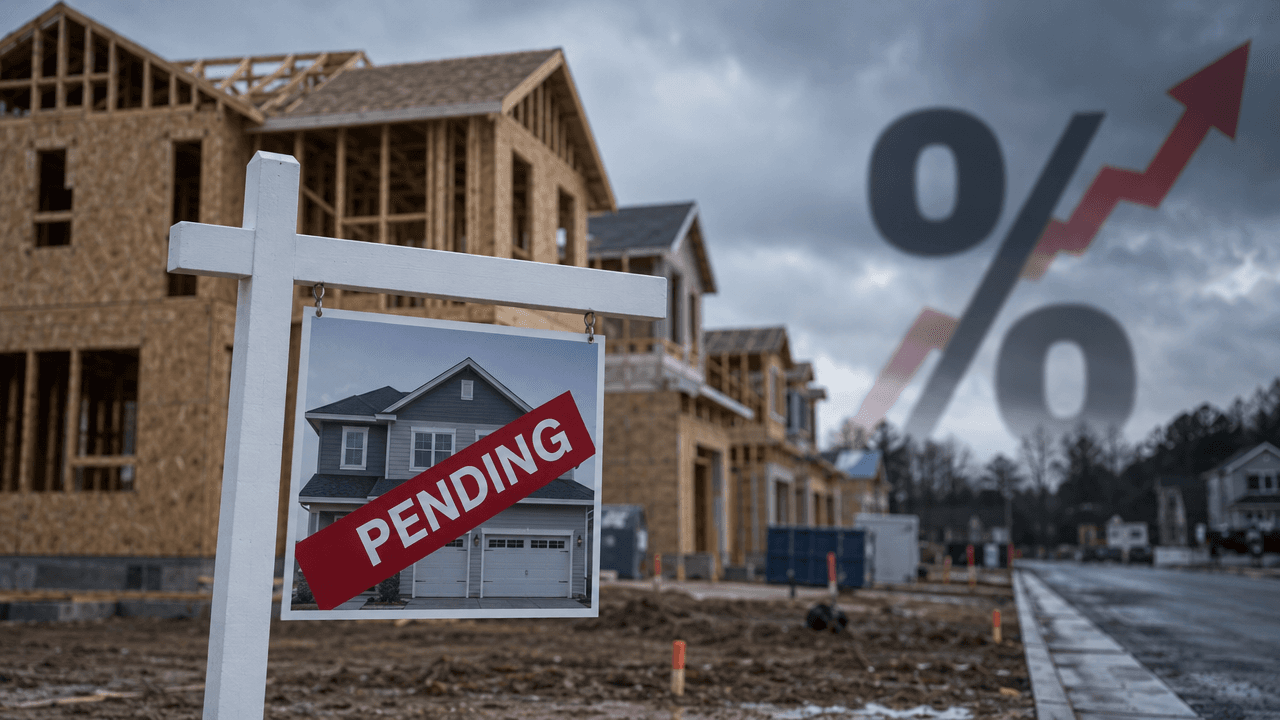
U.S. housing data delivered a clear warning about the economy’s momentum in September. Housing starts fell to a seasonally adjusted annual rate of 1.221 million, well below the roughly 1.305 million consensus forecast. At the same time, pending home sales plunged 7.3% in one month to a record-low index reading of 66.0. [1][2]
The housing market is not the entire economy, but it is one of the most interest-rate-sensitive sectors. When construction slows and fewer buyers sign contracts, the effects can spread across employment, household spending, building materials, financial markets, and business confidence. The latest figures therefore raise fresh concerns that higher borrowing costs are restraining activity more broadly.
What The Data Shows
Housing starts declined 5.2% from August, marking another setback for residential construction. Single-family starts fell 4.6% to an annualized 859,000, while multifamily starts dropped 7.2% to 349,000. The weakness was especially pronounced in the West and Midwest, although activity in the South increased. [15]
The headline decline matters because housing starts represent actual construction activity. Builders that begin fewer projects are signaling caution about future demand, financing conditions, labor costs, and inventory levels. A sustained slowdown can also reduce demand for construction workers, appliances, furniture, transportation, and other goods connected to homebuilding.
Building permits provided a limited counterpoint. Permits declined only slightly to an annualized 1.4 million, a result that was modestly above some market expectations. Because permits generally precede construction, this reading suggests that builders have not abandoned future projects entirely. However, single-family permits weakened, and the gap between permits and starts may indicate that some approved projects are being delayed rather than immediately built. [5][8]
The pipeline also shows signs of caution. The number of permitted single-family homes that had not yet started construction remained near a four-and-a-half-year high at 151,000 units. Meanwhile, housing completions fell to an annualized 840,000, the lowest level since May 2020. [1]
The Demand Side Looks Even Weaker
The pending home sales report was more concerning than the construction figures. Pending sales measure signed contracts for existing homes and are often viewed as an early indicator of completed home sales in the following months. In September, the index dropped 7.3% from August and stood 11.3% below its level a year earlier. Its reading of 66.0 was the lowest since the series began in 2001. [2][9]
That decline was far more severe than the expected decrease of approximately 0.3% to 0.5%. A move of this size suggests that potential buyers are not merely taking a little longer to make decisions. Many may be postponing purchases altogether because monthly mortgage payments remain too high relative to household income.
Housing affordability is being pressured from several directions. Elevated mortgage rates increase financing costs, while high home prices limit the number of properties buyers can afford. Even when wages rise, the combination of price and interest-rate pressures can keep households out of the market. Existing homeowners with low-rate mortgages may also be reluctant to sell, reducing available supply and making the market less fluid.
Why This Matters For Economic Growth
Residential investment is a direct component of gross domestic product, so weaker construction can subtract from economic growth. The broader effects may be more important. A home purchase typically generates spending on renovations, furnishings, electronics, insurance, moving services, and professional fees. When transactions fall, those related industries feel the slowdown.
The labor market can also be affected. Homebuilding supports contractors, suppliers, architects, engineers, real-estate professionals, and local businesses. A prolonged decline in activity could lead companies to delay hiring or reduce hours, particularly in regions where construction has been a major source of employment.
Still, one month of disappointing data does not prove that the U.S. economy is entering a recession. Housing is volatile, and weather, regional conditions, project timing, and revisions can influence monthly figures. The permit data also suggests that some future construction demand remains in the pipeline.
What Traders Should Watch Next
Market participants should focus on whether weakness continues across several months. A single disappointing report may produce a temporary move in Treasury yields, mortgage-sensitive equities, homebuilders, and the U.S. dollar. Persistent weakness would carry greater significance because it could alter expectations for consumer spending and future monetary policy.
The next important indicators include mortgage-rate trends, new and existing home sales, housing inventories, building permits, and consumer confidence. Traders should also watch whether weaker housing data begins appearing alongside softer employment or retail-sales figures. A synchronized slowdown would provide stronger evidence that economic momentum is fading.
For SimFi traders, the practical lesson is to avoid treating housing data as an isolated trade signal. Instead, compare the release with market expectations and with the direction of related assets. A weaker-than-expected housing report may support rate-cut expectations, but if inflation remains elevated, bond-market reactions could be limited or short-lived. Risk management matters because markets frequently price in part of the news before the data is released.
The Key Takeaway
September’s housing figures point to a U.S. economy losing some momentum under the weight of expensive financing and strained affordability. Housing starts missed forecasts, pending sales collapsed to a record low, and the modestly better-than-expected permit figure offered only a partial offset.
The most important question is whether this is a temporary pause or the beginning of a broader housing downturn. Until mortgage costs ease or household purchasing power improves, residential activity is likely to remain a significant pressure point for the U.S. growth outlook. For traders, the data reinforces the importance of tracking both the headline numbers and the transmission channels connecting housing to employment, consumption, inflation, and interest-rate expectations.