
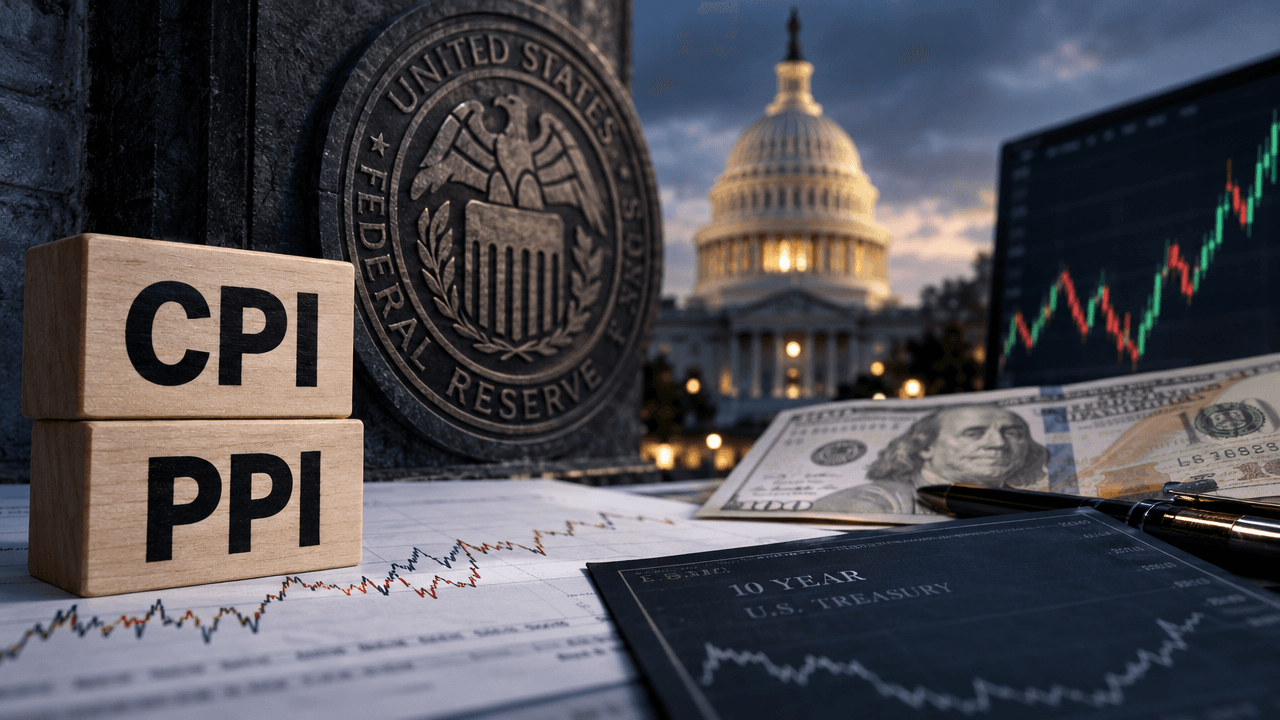
Inflation is moving to the center of the market’s attention. With October U.S. Consumer Price Index data due Tuesday, November 10, followed by Producer Price Index data on Friday, November 13, traders are preparing for a week that could reshape expectations for the Federal Reserve’s December policy decision. The CPI release is scheduled for 8:30 a.m. Eastern Time, while the PPI report follows at the same time on Friday. [3][1]
Current money-market pricing places the probability of another 25-basis-point Federal Reserve rate increase in December near 75%. That expectation leaves the U.S. dollar, Treasury futures, equity indexes, and other risk-sensitive markets unusually exposed to even modest surprises in the inflation data.
Why This Week Matters
The Federal Reserve’s policy decisions depend heavily on whether inflation is moving sustainably toward its objective. A hotter-than-expected report could suggest that price pressures remain persistent, making another rate increase more likely. A softer report could reduce pressure on policymakers and encourage traders to price a more cautious path.
The distinction between headline and core inflation will be especially important. Headline CPI includes volatile food and energy prices, which can produce sharp monthly swings. Core CPI excludes those categories and is often viewed as a clearer measure of underlying price momentum.
Markets will also examine the monthly changes rather than focusing only on the annual rate. A seemingly moderate year-over-year reading can still concern policymakers if recent monthly increases show acceleration. Conversely, a higher annual rate may attract less attention if the latest monthly data confirms a sustained cooling trend.
For traders, the critical question is not simply whether prices rose. It is whether the report changes the expected path of interest rates.
Reading Cpi And Ppi Together
CPI measures the prices paid by consumers for a broad basket of goods and services. It includes categories such as shelter, transportation, medical care, food, and household goods. Because consumer prices directly affect household purchasing power and inflation expectations, CPI is typically the more immediate market catalyst.
PPI measures prices received by domestic producers for their output. It can provide clues about costs moving through the supply chain before they appear in consumer prices. However, producer prices do not automatically translate into higher CPI. Businesses may absorb rising costs, improve efficiency, change suppliers, or accept narrower profit margins.
The most useful analysis combines both reports. A hot CPI accompanied by firm PPI would reinforce the case for persistent inflation. A soft CPI followed by subdued PPI could support the view that price pressures are easing. Conflicting results may produce short-term volatility as traders determine which signal is more reliable.
Investors should also watch services inflation, shelter costs, transportation prices, and measures of underlying producer prices. These components can matter more for monetary policy than one volatile commodity category.
Market Reactions To Watch
Treasury futures are likely to respond first. A stronger inflation reading generally pushes yields higher because traders anticipate tighter monetary policy. Since bond prices and yields move in opposite directions, Treasury futures could decline if the data points toward a December hike.
The dollar may also strengthen on a hotter report. Higher expected U.S. interest rates can make dollar-denominated assets more attractive, particularly against currencies whose central banks are expected to remain more accommodative. A weaker inflation report could have the opposite effect, especially if it causes traders to reduce December hike expectations.
Equity markets face a more complicated reaction. Initially, investors may welcome cooler inflation because it reduces interest-rate pressure. However, a weak inflation report could also raise concerns about slowing economic activity if it coincides with soft demand. A hotter report may support sectors linked to pricing power but pressure growth-oriented stocks whose valuations depend heavily on future earnings.
Gold, commodities, and cryptocurrency markets can also react through changes in real yields and the dollar. Higher yields and a stronger dollar often create headwinds for assets that do not generate interest income.
A Practical Trading Framework
The first step is to identify the consensus forecast and compare the actual figures with expectations. Markets trade the surprise, not the number in isolation. An inflation reading that appears high historically may still produce a muted reaction if it matches what traders already anticipated.
Next, assess the composition of the release. A small headline miss may matter less if core services inflation accelerates. Similarly, a headline beat driven entirely by energy prices may have a less lasting impact if underlying measures remain controlled.
Timing and risk management are equally important. Economic releases can produce rapid price gaps, wider spreads, and temporary reversals. Traders using simulated finance accounts should test how their strategies behave during high-volatility events without confusing a successful short-term reaction with a repeatable edge.
Useful questions include: Did the data change December rate expectations? Did Treasury yields confirm the initial move? Is the dollar’s reaction broad-based? Are equity markets responding to rates, growth concerns, or both?
The Bigger Picture
This week’s inflation data will not determine the Federal Reserve’s entire policy path by itself. Policymakers will also consider employment, consumer spending, financial conditions, and forward-looking risks. Still, with December hike expectations already elevated, the threshold for a meaningful market reaction is likely to be low.
A hotter-than-expected CPI and PPI combination could push rate expectations higher and reinforce strength in the dollar while weighing on Treasuries and rate-sensitive equities. A cooler sequence could produce relief across bonds and growth assets, although traders may then focus on whether weaker inflation reflects improving supply conditions or deteriorating demand.
The key lesson is to avoid treating one data point as a complete market thesis. Inflation reports are most valuable when interpreted alongside expectations, market positioning, and the Federal Reserve’s broader reaction function. For traders, preparation matters more than prediction: know the release time, define risk before volatility rises, and evaluate the details behind the headline.