
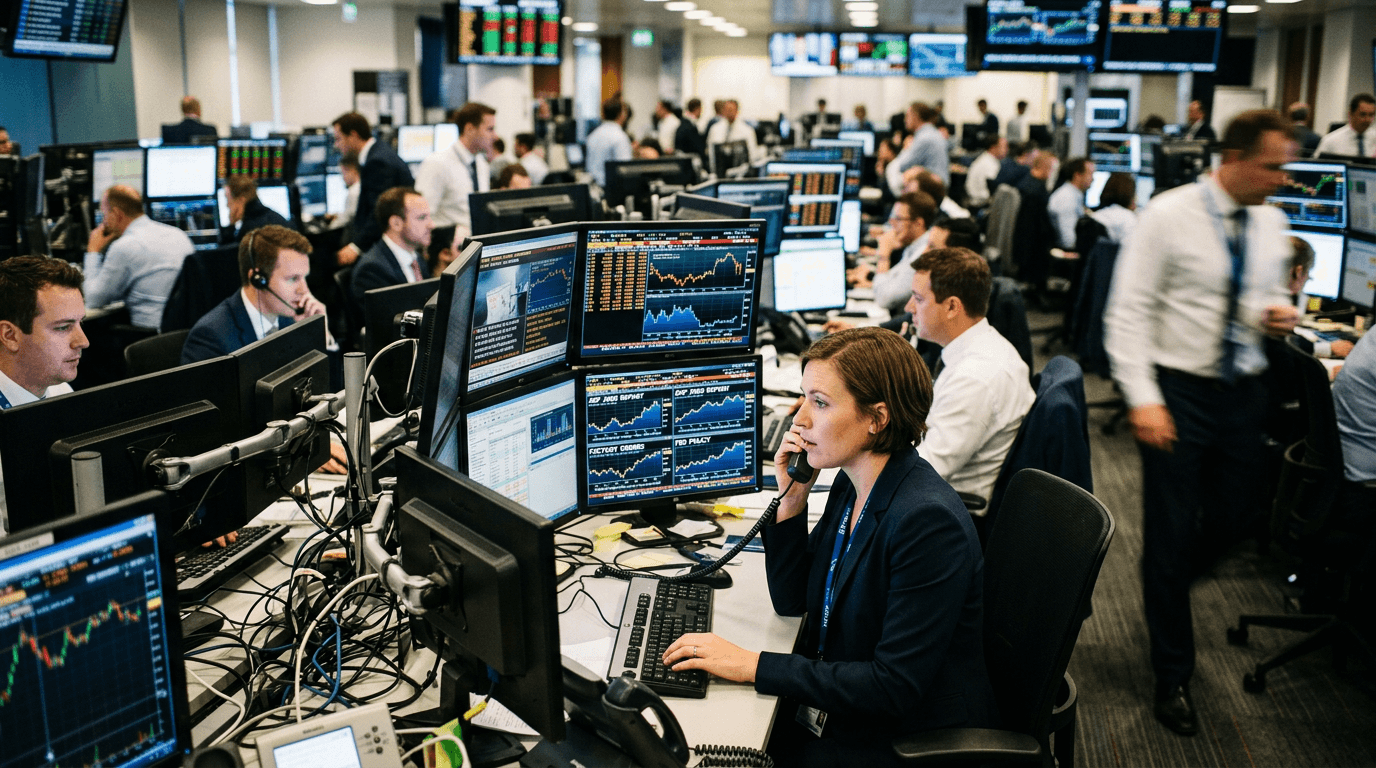
Markets are entering today’s US data releases with a cautious tone, as traders weigh the latest ADP employment figures against upcoming factory orders and the Federal Reserve’s Beige Book. Equity index futures are slightly lower and volatility is elevated, reflecting the market’s sensitivity to any signal that the labor market or manufacturing cycle might be shifting.
Labor Market In The Spotlight
The ADP National Employment Report is one of the earliest major reads on US private-sector hiring each month, and it often sets the tone for expectations heading into the official nonfarm payrolls release. The report tracks changes in non-farm private employment using payroll data from hundreds of thousands of US businesses[1]. It is designed as a high-frequency measure of the labor market, providing monthly updates based on anonymized payroll data covering more than 26 million workers[7].
For the August reference period, released on September 2, ADP nonfarm employment change is reported at roughly 47,000 jobs, modestly above the consensus forecast near 44,000[1]. That figure is well below the long-run average of around 143,000 monthly gains seen since 2010, highlighting a slower pace of hiring compared with the post-pandemic recovery phase[13]. For traders, this combination—positive but subdued job growth—suggests an economy still expanding, but with less momentum than in prior years.
It is important to remember that ADP and the official nonfarm payrolls report often diverge in month-to-month changes, but they tend to capture similar underlying trends in labor demand over time[7][13]. When ADP prints close to expectations and shows only modest job growth, markets usually shift their focus to the broader data mix: wage trends, participation rates, and sector-specific employment, which will come later from other releases.
What Adp Data Signals For Growth And Fed Policy
The ADP figures sit alongside qualitative evidence from the Federal Reserve’s Beige Book, which provides anecdotal reports from businesses across all 12 Federal Reserve districts[12]. Recent Beige Book contributions have described employment rising modestly, with contacts expecting a similar pace of hiring over the next year[6]. Overall, the labor market is characterized as stable, with some difficulty still reported in finding skilled workers, particularly in manufacturing and specialized trades[6][15].
At the same time, several districts have noted improved labor availability and increased use of temporary or contract workers as firms remain cautious about committing to permanent hires[15]. AI-driven productivity gains have allowed some firms to delay or reduce hiring, especially for certain roles, even as activity remains steady[15]. Wage growth has generally been described as modest to moderate, with wage competition no longer as intense as in the immediate post-pandemic period[6][15].
For monetary policy expectations, this combination of modest job gains and stable, but not overheated, wage growth points toward a Federal Reserve that remains data-dependent but not under urgent pressure to tighten aggressively. If labor demand continues to cool gradually while wages grow at a moderate pace, markets may increasingly price a slower path for rate changes, shifting attention to inflation and productivity data as the next key drivers.
Factory Orders: Reading The Manufacturing Cycle
Alongside labor data, today’s factory orders report offers a window into the health of the US manufacturing and investment cycle. Factory orders measure the change in the total value of new purchase orders placed with manufacturers, including both durable and nondurable goods[11]. Because it captures future production commitments, the series is closely watched as a leading indicator for manufacturing output and corporate capital expenditure.
Recent data show a mixed but generally cooling pattern. After a strong surge in orders earlier in the year, including a 5.3% monthly jump in April, orders unexpectedly declined by 1.1% in May and 0.3% in June, even though they remained well above their early-2024 lows[8]. More recent figures indicate a rebound in July, with factory orders rising around 0.7% month-on-month and beating expectations for a small decline[2][11]. This suggests that while the sector has lost some momentum, it is not yet in outright contraction.
For traders, the interplay between factory orders and labor data is key. Softening orders can translate into slower hiring, shorter shifts, or delayed investment decisions in manufacturing-heavy regions. Conversely, a rebound in orders can signal renewed demand that may support employment in industrial sectors in the coming months. Today’s release will help clarify whether the recent bounce is the start of a new upswing or simply noise within a broader slowdown.
Beige Book: Anecdotal Color Behind The Data
The Beige Book, published eight times per year, aggregates anecdotal information on current economic conditions, including consumer spending, labor markets, pricing, and business investment[12]. It does not provide hard numbers, but its qualitative color often influences how traders interpret the official data.
Recent reports point to a regional economy growing modestly, with employment levels steady to slightly higher across most districts[15]. Firms describe labor demand as stable, turnover and layoffs as low, and hiring focused largely on replacement rather than aggressive expansion[15]. Some contacts report ongoing challenges in recruiting for skilled trades and certain sectors, even as availability improves for other roles[6][15].
Price trends in these reports show moderate increases, with wage growth also modest and concentrated in specific areas such as healthcare and skilled trades[6][15]. Importantly, some districts note that productivity improvements, including AI adoption, are allowing businesses to manage workloads without increasing headcount as rapidly as in prior cycles[15]. These anecdotes help traders understand how companies are adjusting to slower growth, potentially dampening future labor and inflation pressures.
Implications For Traders And Simulated Finance Strategies
For active traders and those using simulated finance platforms like E8 Markets, today’s data mix is a textbook opportunity to practice event-driven strategies without bearing real-world risk. ADP, factory orders, and the Beige Book together provide a multi-dimensional view of growth, labor tightness, and corporate sentiment, all of which feed into rates, equities, and FX pricing.
One practical approach is to construct scenarios around the labor data. In a “strong labor” scenario—ADP well above expectations, upbeat Beige Book language, and firm factory orders—traders might explore strategies that favor higher yields, a firmer US dollar, and sector rotation toward cyclicals. In a “soft labor” scenario—ADP below expectations, cautious Beige Book tone, and weak factory orders—defensive equities, lower yields, and potential pressure on the dollar become more relevant.
On a SimFi platform, traders can design and test these scenarios using index futures, sector ETFs, or FX pairs that are historically sensitive to US labor and manufacturing surprises. They can experiment with position sizing, stop-loss placement, and volatility adjustments ahead of data releases, then review how simulated P&L responds when actual numbers hit the tape. This kind of structured practice builds discipline and helps traders refine their reaction function to macro events.
Conclusion
As markets digest the latest ADP employment report, factory orders, and Beige Book insights, the picture that emerges is one of an economy still growing but at a more measured pace. Labor demand appears stable, with modest job gains and wage growth, while manufacturing shows signs of cooling offset by pockets of resilience[1][2][6][8][11][15]. For traders, these are not “shock” data points, but they are important inputs into the ongoing debate over the trajectory of US growth and Federal Reserve policy. Using both live markets and simulated environments to navigate days like today can help turn routine data releases into valuable learning opportunities and more robust trading frameworks.