
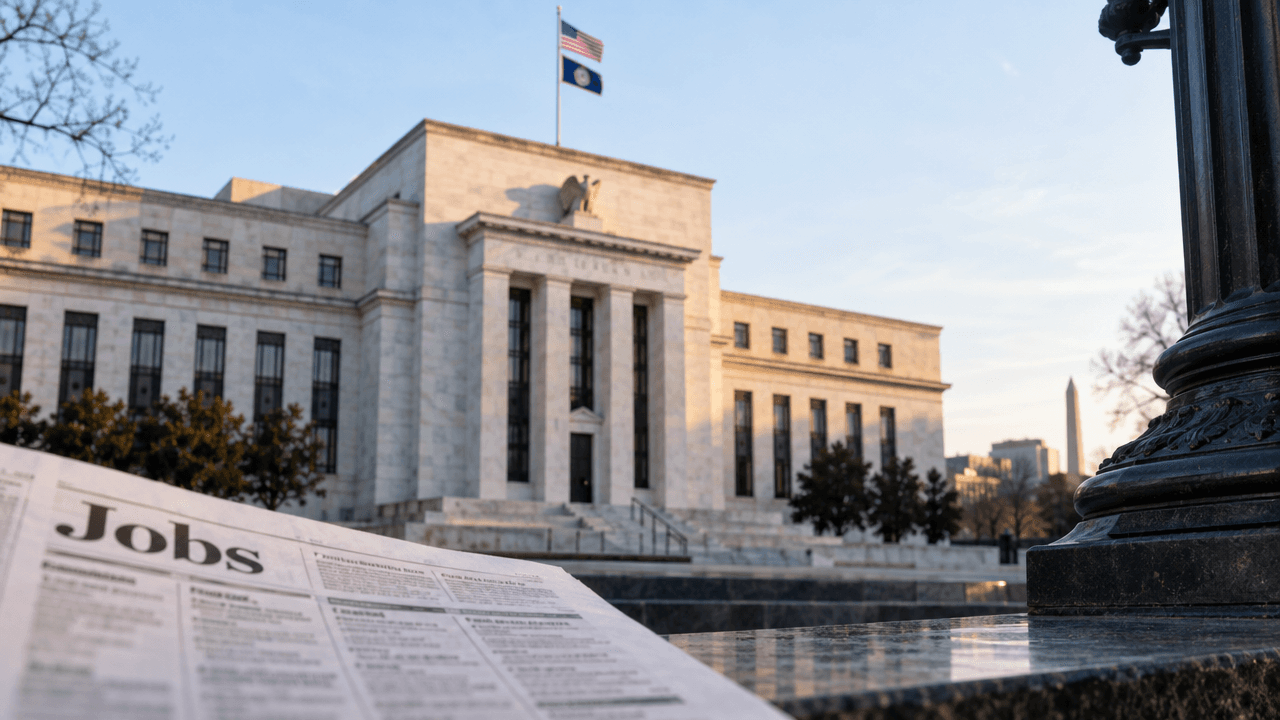
U.S. jobless claims have delivered a clear message ahead of the Federal Reserve’s October meeting: employers are still holding on to workers, and the labor market has not yet shown the kind of deterioration that would demand an urgent policy response.
Initial unemployment claims fell to 194,000 in the week ending October 17, down from the previous week’s revised 200,000 and below the 200,000 expected by economists. The four-week moving average also declined to 197,750, helping confirm that the result was not simply a one-week fluctuation. [5]
Labor Market Strength Remains The Central Signal
Weekly jobless claims measure the number of people filing for unemployment benefits for the first time. While the data can be volatile, persistently low readings generally indicate that layoffs remain limited.
The latest figure is especially notable because claims have remained below 230,000 throughout 2026, according to reports citing Labor Department data. The latest release also marked the sixth consecutive week in which claims were at or below 200,000. [1][4]
That stability suggests businesses are continuing to protect existing staff, even if hiring has slowed from stronger periods. For workers, low layoffs support household income and consumer spending. For companies, however, a reluctance to reduce headcount can also reflect difficulty finding qualified replacements or uncertainty about how quickly demand may recover.
The labor market is therefore firm, but “firm” does not necessarily mean booming. It means the economy continues to absorb pressure without producing a rapid increase in unemployment claims.
Why The Fed Is Likely To Hold Rates
Markets broadly expect the Federal Reserve to leave its federal funds target range unchanged at 3.75% to 4.00% when policymakers conclude their October 28 meeting. A recent Fed preview also described an expectation that the policy statement would remain largely unchanged. [14]
The claims report supports that cautious approach. A central bank considering rate cuts generally wants evidence that economic activity is cooling and that labor-market conditions are weakening enough to reduce inflation pressure. Low claims provide the opposite signal: workers are still employed, layoffs remain contained, and income growth may continue supporting demand.
At the same time, one labor-market indicator cannot determine monetary policy by itself. Federal Reserve officials also examine inflation, wage growth, consumer spending, business investment, financial conditions, and broader employment trends. Initial claims are useful because they arrive weekly, but they do not fully capture slower hiring, reduced working hours, or people who have stopped searching for work.
This distinction matters for traders. A strong claims report can reduce expectations for near-term easing without necessarily creating expectations for an immediate rate increase.
December Expectations Move Into Focus
With an October hold largely priced into markets, attention is shifting toward the Fed’s December decision. Rate futures data showed a roughly 92% probability of the target range remaining at 3.75% to 4.00% after the October meeting, compared with an 8% probability of a move to 4.00% to 4.25% as of October 22. [15]
That pricing shows that traders are not treating an October hike as the base case. Instead, they are evaluating whether persistent labor-market strength could give policymakers a reason to consider higher rates later.
A potential December hike would likely require more than a single strong claims report. Markets would probably look for a combination of stubborn inflation, resilient consumer demand, strong employment data, and evidence that financial conditions are becoming too supportive of further price pressures.
For traders, the important lesson is that expectations can change before the Fed actually changes rates. A sequence of firm economic reports may push Treasury yields higher, support the dollar, and pressure rate-sensitive assets even while the official policy rate remains unchanged.
Market Implications For Traders
The immediate market reaction to low jobless claims depends on what investors have already priced in. If traders expect weak labor data, a strong report can produce a sharper move in yields and currencies. If strength is already anticipated, the reaction may be modest.
U.S. Treasury yields are particularly sensitive to shifting rate expectations. Strong labor data can lift shorter-term yields because investors reduce expectations for rate cuts or increase the probability of a future hike. The U.S. dollar may also benefit from higher expected returns on dollar-denominated assets.
Equity markets can react in two directions. A stable labor market is positive for corporate revenues and consumer spending, but higher interest-rate expectations can reduce the valuation of growth companies and other assets whose prices depend heavily on future cash flows. The result may be rotation rather than a simple market-wide rally or decline.
In a SimFi environment, traders can use this event to practice scenario planning. One scenario could involve claims staying near current levels, reinforcing expectations for an October hold. Another could involve weaker employment data, increasing the likelihood of future easing. A third could combine strong labor data with hotter inflation, raising the risk of a December hike.
Practical Takeaways
First, distinguish between an October decision and the broader policy path. A rate hold does not guarantee that future meetings will produce the same outcome.
Second, focus on trends rather than one headline number. The four-week average of 197,750 provides a smoother view of labor conditions than any single weekly release. [5]
Third, watch how markets respond, not only what the data says. If yields rise sharply after strong labor reports, rate expectations may be becoming the dominant market theme.
Finally, manage risk around the Fed meeting. Volatility can increase in Treasury, currency, equity-index, and commodity markets as traders adjust positions. Simulated trading offers a useful way to test entry plans, stop-loss placement, position sizing, and alternative outcomes without exposing real capital.
Conclusion
The latest jobless-claims data reinforces the view that the U.S. labor market remains durable heading into the Federal Reserve’s October 28 meeting. With claims at 194,000 and the four-week average below 200,000, there is little evidence of a sudden layoffs-driven downturn. [5]
That strength supports expectations for an October rate hold while keeping the possibility of a December hike on the market’s radar. The key question is no longer simply whether the labor market is strong, but whether it remains strong enough, alongside other economic data, to keep inflation risks elevated. For traders, that makes the next round of employment and inflation reports crucial to understanding the Fed’s next move.