
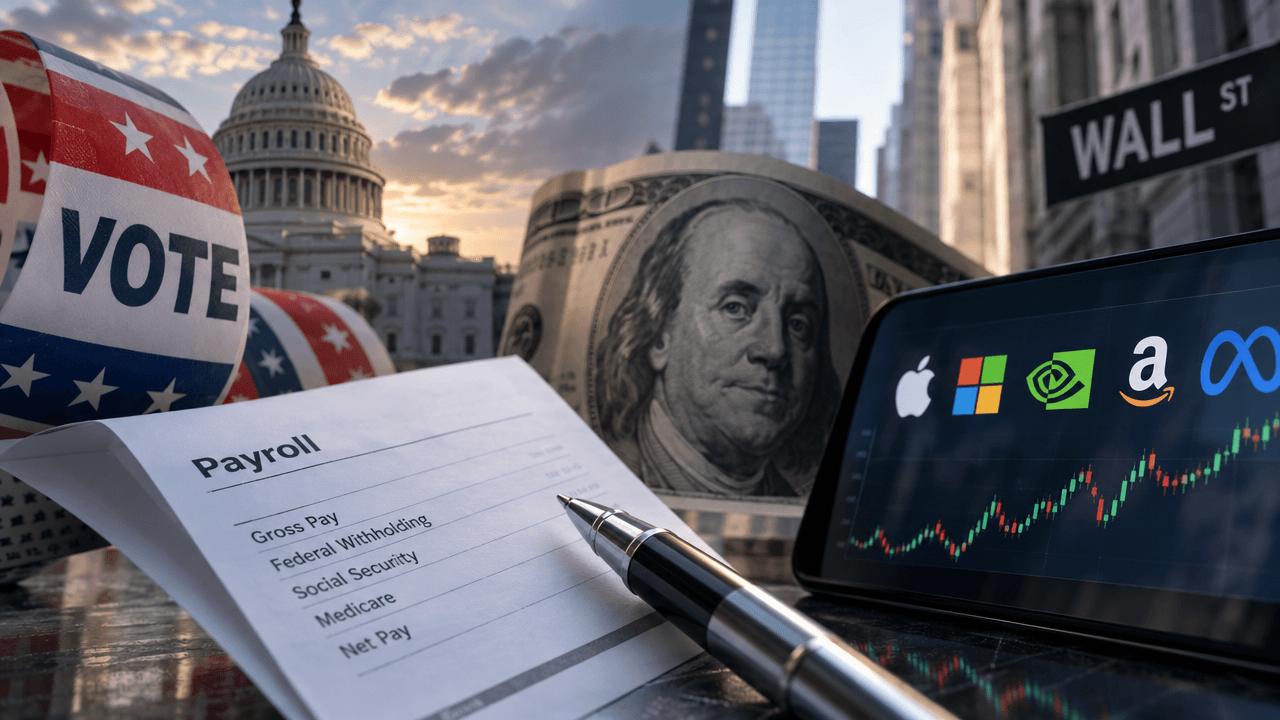
Financial markets are entering one of the most information-heavy weeks of the year. Investors are preparing for the U.S. midterm elections on Tuesday, a major technology earnings cycle, and Friday’s October employment report. Together, these events could reshape expectations for interest rates, move the dollar, and determine whether equity markets extend their recent rebound or resume October’s technology-led sell-off. [2][4]
The market’s challenge is that each event affects a different part of the investment outlook. The election may influence fiscal policy, regulation, trade, energy, and technology spending. The jobs report will provide fresh evidence about economic growth and inflationary pressure. Meanwhile, earnings from companies such as Apple, AMD, Palantir, Qualcomm, and other technology leaders will test whether the enormous investment in artificial intelligence is translating into sustainable profits. [3][12]
The Midterm Elections And Market Uncertainty
The U.S. midterm elections are scheduled for Tuesday, November 3, and investors will be watching the balance of power in Congress. Although elections do not automatically produce an immediate change in economic conditions, they can alter expectations for taxes, government spending, business regulation, infrastructure policy, and technology oversight.
A divided government may reduce the probability of major legislation while creating a more predictable policy environment in some areas. A decisive result, by contrast, could increase expectations for changes in fiscal policy or regulatory priorities. Markets may initially respond to the result itself, but the longer-term reaction will depend on whether investors believe the outcome improves or weakens economic growth.
Technology policy is particularly important this year. Data centers, semiconductor supply chains, artificial intelligence regulation, and energy consumption are increasingly connected to the political debate. Any indication that lawmakers intend to restrict or support the expansion of AI infrastructure could affect chipmakers, cloud providers, utilities, and companies building data-center capacity.
Investors should also expect volatility around headlines and exit polls. Early market moves may not represent a durable trend, especially if the result is contested or if control of Congress remains uncertain.
The Jobs Report Takes Center Stage
Friday’s October employment report is likely to be the week’s most important economic release. Economists surveyed by Dow Jones expect employers to have added approximately 55,000 jobs, following a gain of just 29,000 in September. The unemployment rate rose to 4.2% in September from 4.1% in August, highlighting a labor market that appears to be cooling. [6][7]
The report matters because the Federal Reserve needs to balance two competing risks. If hiring remains weak, policymakers may become more concerned about slowing economic activity. That could support expectations for lower interest rates or a slower pace of future increases. If payroll growth rebounds sharply and wage gains remain firm, markets could instead anticipate that interest rates will stay higher for longer.
The headline payroll number will not tell the whole story. Traders will also examine the unemployment rate, average hourly earnings, labor-force participation, revisions to previous months, and private-sector hiring. A weak payroll number paired with strong wage growth could produce a very different market reaction from a weak report accompanied by cooling wages.
Other labor indicators will help shape expectations before Friday. September job openings are due Tuesday, ADP private payrolls on Wednesday, and weekly jobless claims on Thursday. These releases may influence positioning, but the nonfarm payrolls report is expected to remain the main test of the labor market’s resilience. [10]
Why Rates And The Dollar Matter
Employment data can quickly affect Treasury yields, the U.S. dollar, and equity valuations. When investors expect stronger growth or persistent inflation, bond yields generally rise as markets price in tighter monetary policy. Higher yields can support the dollar but place pressure on long-duration assets, including growth stocks and technology companies.
A softer jobs report could have the opposite effect. Falling yields may make future corporate earnings more valuable in present-day terms, potentially helping technology and other growth sectors. However, an excessively weak report could raise concerns about recession risk, limiting the benefit of lower rates.
The dollar may also react to the election. Fiscal expectations, trade policy, geopolitical risks, and the perceived stability of U.S. institutions can all influence currency markets. Traders should avoid assuming that a weaker dollar or higher stocks will automatically follow one political outcome. The reaction will depend on how the result changes expectations for growth, inflation, and policy.
Technology Earnings Add Another Layer
The technology sector enters the week under pressure after a difficult October. The PHLX Semiconductor Index fell 15% last month amid concerns about spending, credit conditions, and the profitability of the AI investment cycle. [1]
Apple’s earnings are scheduled for Monday after the market close, followed by AMD on Tuesday. Palantir, Qualcomm, Arm, AppLovin, and other companies are also reporting during the week. Investors will focus not only on revenue and earnings but also on guidance, capital expenditure, cloud demand, chip orders, and evidence that AI-related spending is creating measurable returns. [12]
Strong earnings may help stabilize sentiment, but even positive results could be met with caution if valuations are already high. Conversely, a disappointing outlook from a major technology company could pressure the broader market because large technology stocks represent a significant share of major equity indexes.
Practical Takeaways For Traders
First, distinguish between event risk and trend risk. A sharp move after the election or jobs report may be temporary if it is driven by positioning rather than a lasting change in fundamentals.
Second, monitor cross-market confirmation. A durable equity rally supported by falling yields, stable credit markets, and orderly currency trading may be more convincing than a stock move occurring in isolation.
Third, define risk before the data arrives. Wider spreads, rapid price swings, and overnight gaps can make familiar strategies behave differently. Simulated trading provides a useful way to test position sizing, stop placement, and reactions to multiple scenarios without putting capital at risk.
Finally, avoid trading every headline. The strongest approach may be to identify key levels, prepare bullish and bearish scenarios, and wait for the market to reveal whether it accepts or rejects the new information.
Conclusion
The week ahead combines political uncertainty, labor-market evidence, monetary-policy expectations, and high-profile technology earnings. That combination makes the U.S. midterms and October jobs data potentially market-moving well beyond Friday’s closing bell.
For investors and traders, the central question is not simply whether stocks rise or fall. It is whether the election, employment report, and earnings results collectively point toward stronger growth, persistent inflation, or a more pronounced economic slowdown. Staying flexible, tracking the interaction between asset classes, and managing risk carefully will matter more than trying to predict every headline.