
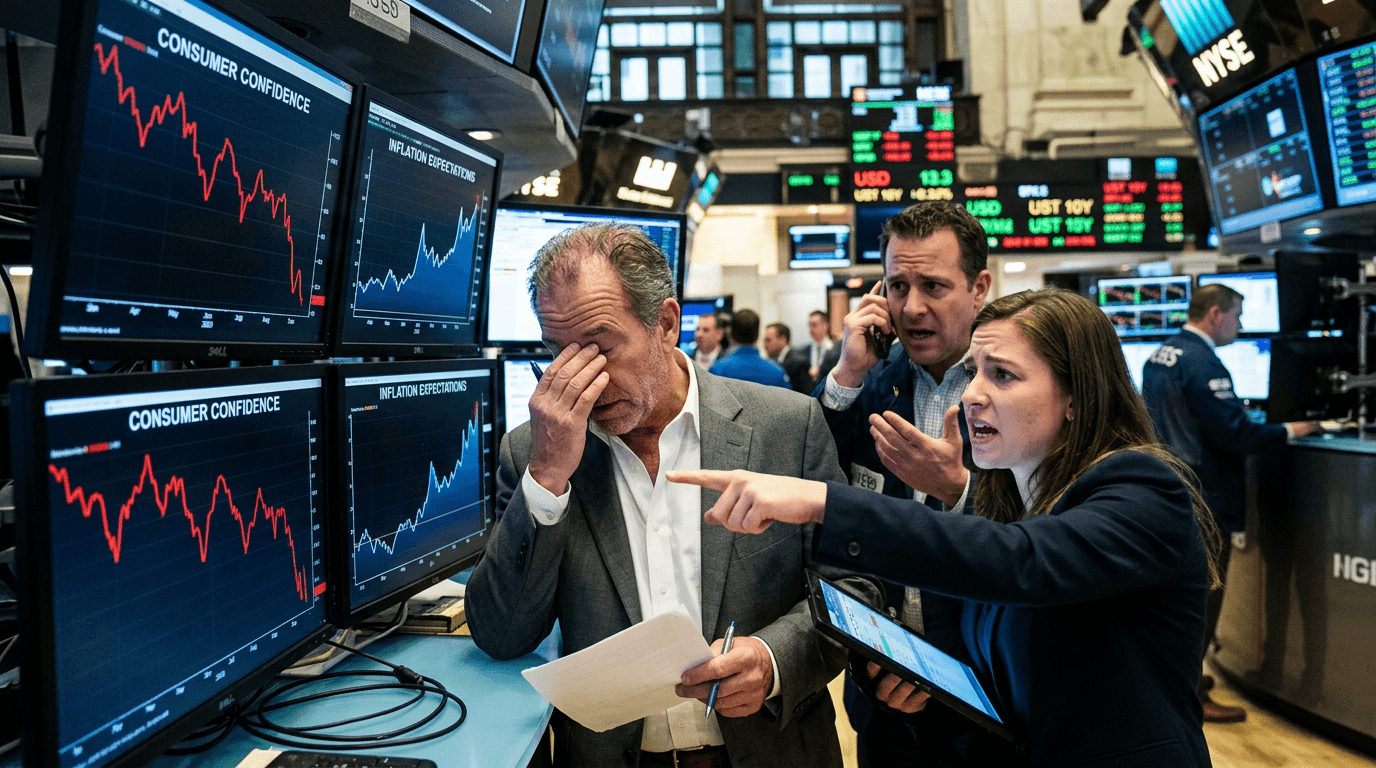
The latest US consumer sentiment data delivered a jarring mix: households feel markedly worse about the economy, yet they expect inflation to run even hotter over the next year. The University of Michigan’s preliminary sentiment index dropped sharply to 50.8 from 57.0, far below expectations, while 1‑year inflation expectations jumped to 6.7% versus 5.0% expected. That combination—weak confidence but rising price fears—injects fresh uncertainty into the outlook for the dollar, Treasury yields, and the Federal Reserve’s next moves.
What The Data Is Really Telling Us
On its own, a steep fall in consumer sentiment usually signals growing concern about jobs, incomes, and future spending. Recent surveys and analysis highlight how inflation, geopolitical tensions, and policy uncertainty have been key drivers of pessimism among US households.[4][5][7][9] When confidence falls this far, consumers often cut back on discretionary purchases, delay big-ticket items, and become more sensitive to negative headlines.[9]
At the same time, short‑term inflation expectations have been running unusually high across major consumer surveys. Research from the Federal Reserve Bank of Minneapolis notes that all three major consumer surveys put one‑year inflation expectations above 3%, with some readings considerably higher.[1] Households’ worries about prices are “widespread and seen across income and age groups,” underscoring how broad-based the concern has become.[1]
The surprise in the latest numbers is the combination: sentiment plunging to levels associated with previous downturns, while inflation expectations spike rather than soften. Historically, weaker growth outlooks tend to cool inflation expectations as people anticipate slower demand. The fact that expectations jumped instead suggests households fear a period of high prices even as the economy feels fragile.
Why The Fed Cares So Much About Inflation Expectations
For the Federal Reserve, inflation expectations are not just a side note—they are central to how it sets policy. If households and businesses start to believe inflation will remain high, they may negotiate higher wages, raise prices more aggressively, and front‑load purchases, all of which can make inflation more persistent.
Research from the Federal Reserve Bank of New York shows that one‑year-ahead consumer inflation expectations are highly responsive to incoming inflation news, both before and after the pandemic.[2] However, three‑year-ahead expectations have become less responsive, suggesting that while people react strongly to near‑term price shocks, they are somewhat less convinced that high inflation will last indefinitely.[2] That nuance matters: the Fed is more tolerant of temporary spikes than of a structural shift higher.
The latest jump in 1‑year expectations to 6.7% complicates the Fed’s balancing act. On one side, collapsing sentiment points to rising recession risk if consumers retrench. On the other, elevated short‑term inflation expectations argue against cutting rates too quickly or signaling an early pivot, for fear of re‑accelerating price pressures. This tension between growth and inflation is exactly what creates macro uncertainty for both the dollar and yields.
Market Reaction: Why Dollar And Yields Turned Choppy
Markets hate mixed messages, and this data delivered a textbook case. Lower consumer sentiment normally leans dovish for policy expectations: traders price in slower growth, lower future rates, and potentially a weaker dollar. In contrast, higher inflation expectations tend to push nominal yields higher and can support the currency if traders anticipate a more hawkish Fed stance.
Similar episodes of elevated inflation expectations amid policy uncertainty have led to choppy price action across asset classes in recent years.[6] In this latest move, rate futures markets had to reassess the path of Fed policy: is the central bank closer to cutting to support growth, or closer to holding—or even hiking—because inflation risks are not fully subdued?
For the Treasury market, the data pulls in opposite directions. Weak sentiment is normally bullish for Treasuries (yields down, prices up), especially at the longer end, because it implies softer demand and lower long‑run growth. But higher inflation expectations put pressure on real yields and inflation compensation, especially in the front to intermediate maturities. The result is a tug‑of‑war along the curve, with intraday swings as traders digest the implications.
In FX, the dollar’s reaction is equally nuanced. A softer growth outlook can weigh on the dollar against higher‑beta currencies, but the prospect of the Fed staying restrictive for longer to contain inflation expectations can limit downside or even provide support versus lower‑yielding peers. That is why the initial response in dollar pairs was choppy rather than one‑directional.
Trading Implications: How To Navigate This Kind Of Print
For traders, especially those honing their skills in a simulated environment, this kind of data release is a valuable stress test of macro frameworks. Instead of searching for a simple “good news/bad news” label, it makes sense to break down the print into its growth and inflation components and map each to potential market reactions.
A few practical angles
– Growth lens: A sentiment index near 50 historically lines up with periods of heightened recession risk. That typically supports defensive positioning (quality assets, longer duration) and pressures cyclical sectors and currencies.
– Inflation lens: A jump in 1‑year expectations tells you that the inflation narrative is not “defeated” in the minds of consumers. That can keep front‑end yields and breakeven inflation supported, and makes it harder for central banks to pivot dovish.
– Policy lens: Rate futures will often “vote” in real time on which force dominates. If the market prices fewer cuts or a longer period on hold after the data, the inflation signal is winning. If cuts are brought forward, the growth signal is dominating.
Simulated trading platforms are particularly useful here: you can test different scenarios—such as “Fed prioritizes inflation” versus “Fed prioritizes growth”—and see how dollar pairs, equity indices, and bond yields would behave under each, without risking real capital.
What To Watch Next
This data print does not exist in isolation. It is one piece in a broader macro puzzle that includes upcoming inflation releases, labor market data, and other confidence surveys. Analysts have already noted that US consumer sentiment had been weakening on concerns about inflation and job security, leading households to pull back on discretionary spending.[9] This latest drop reinforces that trend but adds sharper inflation anxiety into the mix.
Key follow‑ups for traders to monitor:
– Official inflation data: If CPI and PCE readings confirm the jump in inflation expectations, the case for a more hawkish Fed reaction strengthens. If they remain benign, markets may see the sentiment survey as an overreaction.
– Labor market indicators: Softer job gains or rising unemployment would tilt the balance toward growth fears and potentially steepen the yield curve if the market anticipates eventual easing.
– Other expectations measures: Market‑based gauges like breakeven inflation and inflation swaps, along with other survey-based measures, will show whether the rise in expectations is broadening or remains contained to one data point.[6][1]
Looking Ahead
The uncomfortable mix of weakening sentiment and rising inflation expectations is exactly the kind of macro backdrop that keeps volatility elevated in the dollar, yields, and risk assets. It challenges simple narratives and demands that traders weigh both sides of the Fed’s dual mandate—maximum employment and price stability—at the same time.
For investors and active traders alike, the key is flexibility. Rather than anchoring to a single macro story, it pays to think in probabilities: how likely is a slower‑growth, still‑sticky‑inflation environment, and how would that reshape the path of rates and the relative appeal of the dollar? Using scenario analysis, robust risk management, and, where available, simulated trading to rehearse reactions, market participants can turn this uncertainty into a structured decision-making process.