
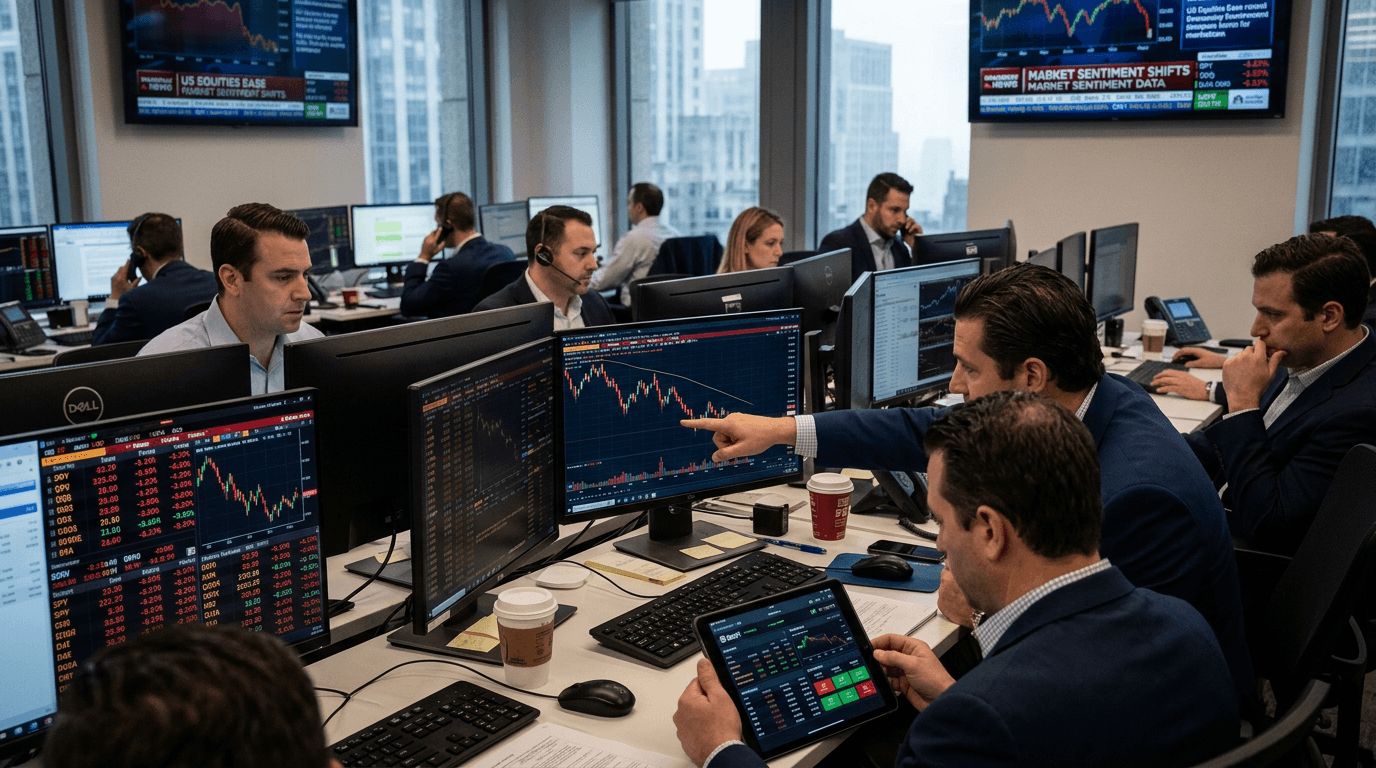
After several sessions of steady gains, U.S. equities are finally exhaling, with the S&P 500 and Nasdaq giving back a portion of their recent advance as investors trim risk into the weekend and key data releases.[1][12] The move is modest in size, but the tone has shifted: index futures are starting to price more caution, suggesting a risk-off tilt rather than outright panic.[5][12] For active traders and SimFi participants, this kind of environment is where understanding sentiment, positioning, and the mechanics of futures really matters.
Market Cooling After A Strong Run
The latest pullback comes on the heels of a powerful run that saw major U.S. indices set or challenge record highs, supported by resilient earnings and easing inflation pressures.[1][4] When markets grind higher for several weeks, even a small round of profit-taking can look dramatic on an intraday chart, but in context it often represents a “reset” rather than a reversal.
Recent sessions have seen the S&P 500 slip a few tenths of a percent, with the Nasdaq declining slightly more as growth and tech leaders pause after outsized gains.[1][12] At the same time, earlier strength in so-called “old economy” sectors like industrials and energy has sometimes helped cushion the overall indices, leaving the tape mixed rather than decisively bearish.[2]
This kind of pattern—indexes drifting lower but not collapsing—often signals that positioning had become crowded on the long side and that investors are tactically de-risking rather than abandoning equities altogether.[4][15] In other words, the market is cooling off, not necessarily breaking down.
UNDERSTANDING A "RISK-OFF" TILT IN INDEX FUTURES
The phrase “risk-off tilt” in index futures is easy to misread as an alarm bell, but the nuance matters. A full-blown risk-off move typically involves sharp declines in equity futures, a rush into safe havens like Treasuries and the U.S. dollar, and an uptick in volatility indices. In contrast, what we are seeing now is more muted: S&P 500 and Nasdaq futures are showing either small declines or mixed performance, sometimes flat with a slight negative bias.[5][12]
In practice, that tells you three key things:
1) Positioning is being pared back, not liquidated. Futures pricing implies investors are trimming exposure—perhaps taking off leveraged long positions—rather than aggressively shorting indices.[5][12]
2) Volatility expectations remain contained. If this were a true risk-off episode, implied volatility would usually spike, and futures discounts versus fair value would widen substantially. Current moves look more like recalibration than stress.
3) The market is data-dependent, not fear-driven. Futures are reacting to a mix of upcoming catalysts—economic releases, central-bank communication, and geopolitical headlines—rather than a single shock event.[4][5]
For SimFi traders at platforms like E8 Markets, this is a prime scenario to study how futures curves shift around macro events and how small changes in sentiment translate into pricing.
What's Driving The Pullback Now
Several drivers sit behind the current soft tone in U.S. equities and index futures:
Geopolitical uncertainty Flare-ups in geopolitical tensions tend to nudge global portfolios into a more cautious stance, especially after strong equity performance.[4] Even without a single “headline event,” a period of elevated geopolitical noise can motivate traders to take some chips off the table.
Upcoming economic releases Key data prints—such as inflation readings, retail sales, and employment reports—are approaching, and these will shape expectations for the Federal Reserve’s next moves.[1][5] Ahead of such releases, short-term players often reduce exposure because the risk-reward of holding large positions through potentially market-moving data can be unattractive.
Rally fatigue and valuation questions After months of gains and a relatively shallow pullback profile, the S&P 500 has become more sensitive to any sign that earnings growth or macro momentum could slow.[4][15] Analysts have highlighted that an “overdue” pullback can serve as a test of whether dip-buyers are still willing to step in at higher valuation levels.[15]
Sector rotation Recent sessions show that not all parts of the market are retreating simultaneously. While growth and tech have eased, other sectors with more cyclical or value characteristics have sometimes held up better.[2][11] That rotation pattern speaks to a more nuanced repricing of risk across the index rather than simple selling of everything.
Implications And Playbook For Simulated Traders
For traders operating in a simulated environment, the current backdrop is an ideal case study in risk management and behavioral dynamics. A few practical angles to focus on:
1) Study how futures lead cash markets Index futures often move ahead of the cash open, reflecting overnight developments and global sentiment.[9][12] SimFi traders can practice mapping pre-market futures moves to the subsequent cash session: Does a 0.3% drop in futures translate into similar weakness at the open, or do dip-buyers quickly absorb it?
2) Practice scenario planning around data releases In a risk-off tilt driven by anticipation of economic data, scenario planning is critical. Use simulations to define three paths—bullish surprise, in-line, and bearish surprise—and pre-plan trade entries, exits, and position sizing for each scenario. Then compare your plan to the actual market reaction when the data hits.
3) Focus on relative strength and sector rotation Even in mild pullbacks, some sectors quietly outperform. In simulation, track which industries show resilience when the broad market is under pressure. Test strategies that go long relative winners and short relative laggards to see how dispersion behaves during a cautious tape.
4) Refine your risk-off playbook A modest risk-off tilt is a good time to stress-test your personal risk rules. In simulation, define maximum drawdown limits, daily loss caps, and rules for reducing leverage after a string of losing trades. Use the current pullback as the backdrop to see how these rules would have altered your P&L trajectory.
5) Analyze order execution and slippage During quieter but directional sessions, liquidity conditions can change at the margin. SimFi environments allow you to practice scaling in and out of index futures proxies, testing whether smaller, staggered orders achieve better average prices than single, large orders.
Conclusion: Using Small Pullbacks As Learning Moments
The current softening in U.S. equities—paired with a cautious, but not panicked, tone in index futures—looks more like a healthy reset after strong gains than the start of a full-scale risk-off episode.[1][4][12] For investors and traders, the key is recognizing that sentiment has shifted from “fear of missing out” to “respect for upcoming risks,” particularly around geopolitics and economic data.[4][5]
In a SimFi context, this environment is rich with lessons: how futures embed expectations, how risk is trimmed ahead of catalysts, and how sector leadership behaves when the market tilts risk-off but stays structurally bullish. By using simulated trading to rehearse playbooks for these conditions, traders can build the discipline and pattern recognition needed to navigate the next, potentially sharper, swing in risk sentiment with greater confidence.