
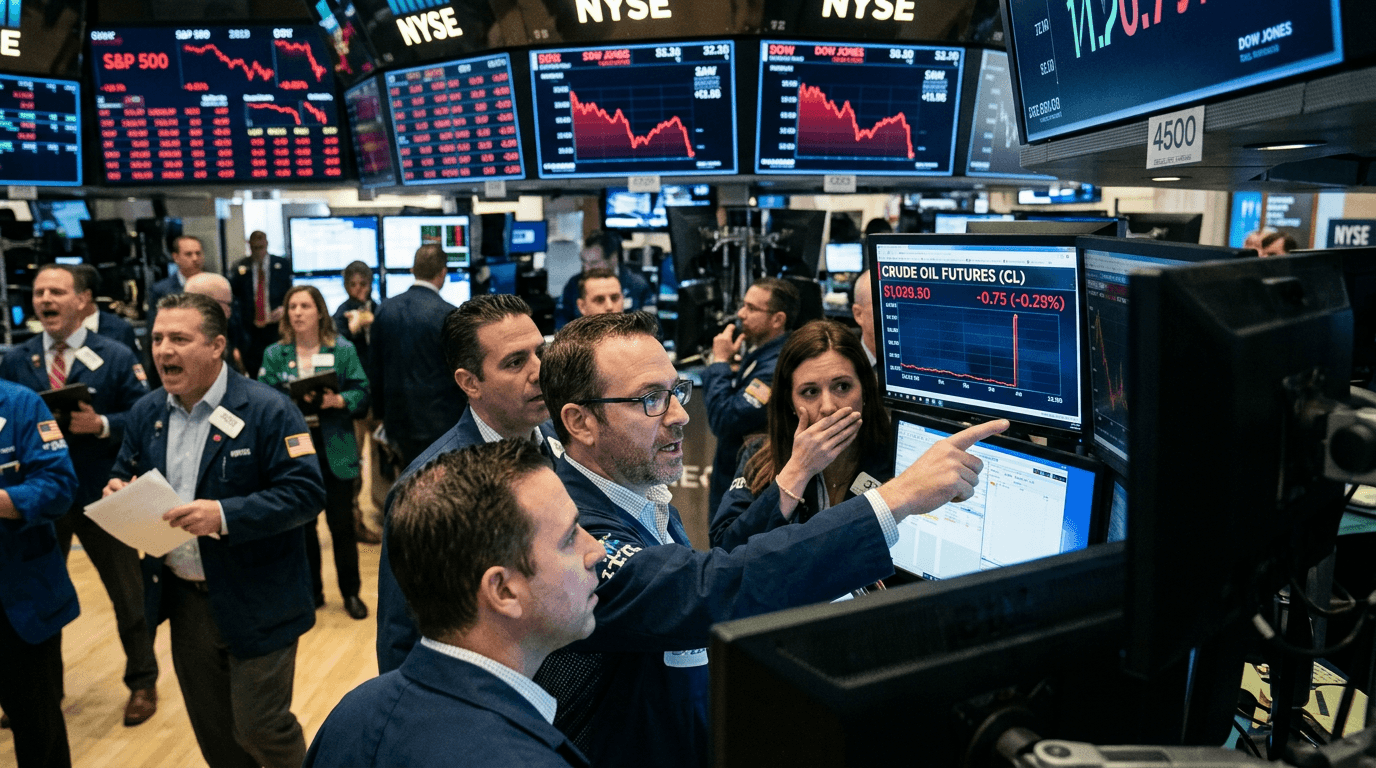
U.S. equities were hit with a sharp risk-off move as crude oil spiked as much as 9% on renewed Middle East war fears, underscoring how quickly geopolitics can ripple across markets. Stock indices that had been grinding higher on stable economic data suddenly repriced for a world of higher energy costs, stickier inflation, and greater uncertainty.
Markets Reprice Geopolitical Risk
The immediate catalyst was an escalation in tensions in the Middle East, with investors focusing on the risk of supply disruptions and potential conflict spillovers into key shipping lanes. That was enough to send crude sharply higher in a single session, with U.S. benchmark oil briefly punching through levels not seen in months and volatility exploding across energy markets.
Equity futures and cash markets responded in classic fashion. The S&P 500 and Nasdaq slid as traders de-risked, with cyclical and rate-sensitive names under particular pressure. High-valuation growth stocks, small caps, travel, and transportation shares all saw outsized losses, reflecting concerns about both funding costs and future demand.
Not all parts of the market moved lower. Energy stocks and some defense names rallied as higher crude prices boosted earnings expectations for producers and refiners, and geopolitical uncertainty lifted demand for military and security-related assets. Still, those gains were not nearly enough to offset broader equity weakness.
Beyond equities, the move echoed through other risk assets. Credit spreads widened as investors demanded more compensation for holding corporate debt. Some haven assets, such as gold and the U.S. dollar, attracted renewed interest. Implied volatility rose, with options pricing in a wider range of potential outcomes for indices and key commodities.
Why Oil Spikes Hit Growth, Profits, And Sentiment
When oil jumps on war fears, it acts like a tax on the global economy. Unlike a demand-driven rise in prices, where strong growth pushes energy higher, a geopolitically driven spike means companies and consumers pay more without getting a corresponding boost in income or output.
For households, higher fuel and heating costs reduce disposable income. That can translate into less spending on discretionary goods and services, hurting sectors such as retail, travel, restaurants, and entertainment. For businesses, elevated energy and transport costs squeeze profit margins, especially for firms with limited pricing power.
That earnings squeeze is one reason equity markets tend to sell off when oil moves sharply higher. Even if the overall level of economic activity does not immediately collapse, investors must revalue future cash flows under a scenario of lower margins and potentially slower top-line growth.
Sector performance reflects this dynamic. Historically, when oil spikes on geopolitical shocks:
- Energy, some commodities, and defense often outperform.
- Airlines, logistics, cruise lines, and auto makers tend to underperform.
- Rate-sensitive sectors such as real estate and high-growth tech can struggle if higher inflation expectations push yields up.
The additional challenge is uncertainty. Markets are not just reacting to today’s oil price but to the width of the potential outcome distribution over the coming months. If traders cannot confidently estimate how long the disruption will last or how far the conflict might spread, risk premiums must rise to compensate.
The Inflation And Fed Policy Angle
The oil surge comes at a delicate moment for inflation dynamics. After moderating from their post-pandemic peaks, price pressures had recently shown signs of re-accelerating, with energy a key contributor. A renewed spike in crude directly lifts headline inflation through gasoline, heating, and transportation costs. Over time, it can also bleed into core inflation as businesses pass higher input costs along the supply chain.
For the Federal Reserve, this complicates an already challenging balancing act. Prior to the latest geopolitical shock, markets were pricing a path of gradual rate cuts on the assumption that inflation would drift back toward the 2% target while growth cooled but remained positive. A sustained oil rally forces traders to reconsider that narrative.
If inflation expectations, as measured by breakeven rates in the Treasury market, start to climb materially, the Fed may feel compelled to keep policy tighter for longer, even if growth shows signs of fatigue. That prospect alone can be enough to push equities lower and unsettle risk assets: higher-for-longer policy rates raise discount rates on future earnings and make safe assets more competitive relative to stocks.
At the same time, if the oil shock meaningfully dents growth, the Fed could eventually face a trade-off between supporting the economy and fighting inflation. Markets are already trying to anticipate which side of that trade-off will dominate, leading to swings in rate expectations, yield curves, and equity valuations.
Key Indicators Traders Should Watch
In an environment where headlines can change by the hour, focusing on a few key indicators can provide more signal than noise:
Oil curve, not just spot price Look beyond the front-month crude contract. A sharply backwardated curve—where near-term prices trade well above longer-dated contracts—signals acute short-term supply stress. If the curve begins to flatten or move into contango, it may suggest that fears of prolonged disruption are fading.
Inflation expectations Track breakeven inflation rates derived from Treasury Inflation-Protected Securities (TIPS). A persistent move higher would indicate markets see the oil spike feeding into broader price levels, increasing the risk of a more hawkish Fed response.
Rate-cut probabilities Watch Fed funds futures and OIS markets for changes in expected policy paths. A reduction in the number or pace of anticipated cuts, or pricing of renewed hikes, will directly influence equity valuations, especially in growth and long-duration sectors.
Credit and funding stresses Monitor credit spreads, particularly in high-yield and leveraged loans. Oil- and war-driven risk-off moves that spill into credit can amplify equity downside and raise the risk of broader financial tightening.
Geopolitical and shipping developments Follow updates around key chokepoints such as the Strait of Hormuz and regional shipping lanes. Concrete signs of secure passage, insurance normalization, or diplomatic progress can rapidly compress the risk premium embedded in crude.
A Practical Playbook For Active And Simulated Traders
For both live and simulated traders, the goal is not to predict every geopolitical twist but to manage risk and adapt to shifting regimes.
Clarify your time horizon Short-term traders may lean into volatility with tight risk controls, trading intraday reactions in indices, energy, and related sectors. Longer-term participants might focus more on trend shifts, sector rotation, and whether the shock is likely to be transitory or persistent.
Adjust position sizing and leverage Volatility cuts both ways. With intraday ranges widening, using the same position size or leverage as in calmer periods can quickly overwhelm risk limits. Reducing size, widening stops thoughtfully, or hedging with options can help prevent a single headline from derailing your strategy.
Revisit correlations Correlation structures often change in geopolitical shocks. Assets that used to move together may decouple, and traditional hedges might become less effective. Systematic traders should re-test assumptions and, where possible, simulate portfolio performance under past oil shock scenarios.
Look for relative, not just directional, opportunities In addition to simple bullish or bearish bets, consider relative-value ideas: energy versus broader indices, regional equity performance, or sector pairs (for example, energy producers versus energy-intensive consumers). These can express views on how the shock is distributed across the economy rather than just its overall sign.
Use simulated environments to prepare Simulated finance platforms provide a risk-free way to test playbooks for high-volatility, geopolitically driven markets. Traders can practice responding to gap opens, rapid sentiment reversals, and regime changes in correlations without putting real capital at risk. The experience can be invaluable when similar conditions appear in live markets.
Conclusion
The slide in U.S. stocks alongside a sharp spike in oil is a reminder that geopolitics can still dominate markets, even in a data-driven, algorithmic trading world. Higher crude prices tighten financial conditions, threaten margins, and complicate central bank policy, forcing a broad repricing of risk.
For traders and investors, success in this environment depends less on predicting the exact course of events and more on staying disciplined, monitoring key indicators, and adapting quickly as new information arrives. By combining robust risk management with a clear framework for interpreting oil, inflation, and policy signals, market participants can navigate the volatility—and potentially uncover opportunities—amid the uncertainty.