
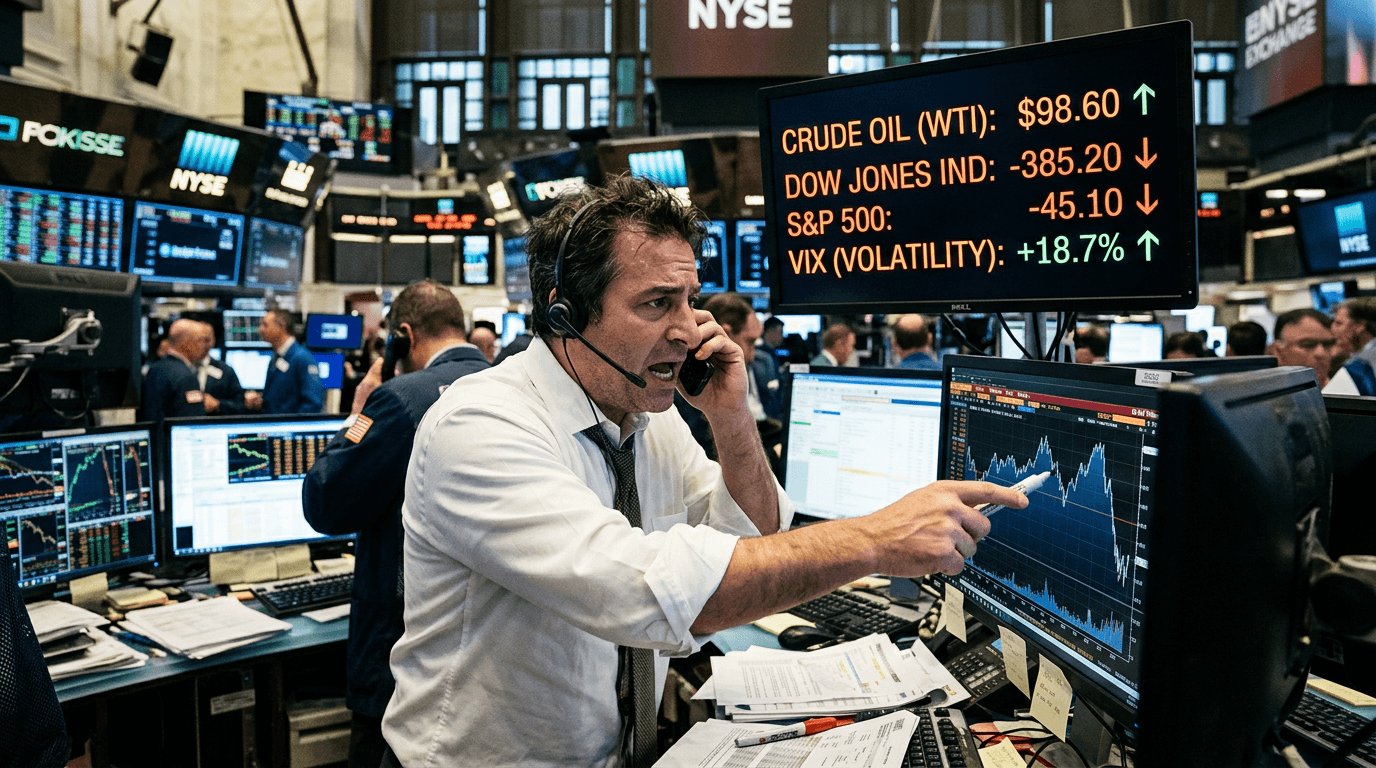
Oil’s latest surge is rippling through global markets, and U.S. equities are feeling the pressure. Benchmarks have slipped in broad-based selling as crude prices lurch toward the $100-a-barrel mark amid renewed Middle East tensions and attacks on shipping. Equity index futures point to more volatility ahead as traders rapidly reprice the outlook for inflation, growth, and central bank policy. At the same time, currencies tied to commodities and safe havens are moving in ways that signal a classic “oil shock” risk-off environment.
Why An Oil Shock Hits Stocks So Quickly
An abrupt move higher in oil behaves like a tax on the global economy. For households, more expensive fuel and energy bills squeeze discretionary spending. For companies, higher input and transport costs compress margins unless they can pass those costs on to customers. That combination threatens both revenues and profits, which is why equity markets typically react quickly to sharp oil moves.
Historically, oil shocks driven by geopolitical disruptions—wars, embargoes, or chokepoint threats—tend to be particularly destabilizing. The issue is not just higher prices but higher uncertainty. When shipping routes like the Strait of Hormuz are at risk, markets must price in the chance of further supply disruptions and even more extreme scenarios, such as oil moving well above $100. That “tail risk” pushes investors to demand a higher risk premium for owning equities.
This time, the move in crude has arrived after a long stretch of already elevated inflation and restrictive monetary policy. That makes markets especially sensitive. A spike in energy prices today lands on economies that have less room for policy support and on central banks that are wary of rekindling inflation just as it begins to recede.
INFLATION, FED EXPECTATIONS, AND THE “HIGHER FOR LONGER” NARRATIVE
Oil is a key driver of headline inflation, and markets know central banks watch it closely. Even if underlying core inflation is easing, a renewed energy shock can slow or stall progress toward inflation targets. That’s the concern now: traders are recalibrating expectations from “imminent rate cuts” to “cuts might be later, smaller, or both.”
The U.S. dollar’s recent resilience, even in the face of softer economic data, is part of this story. When inflation risks rise and uncertainty spikes, investors tend to favor the dollar both for its safe-haven status and because the Federal Reserve may keep rates higher for longer than other major central banks. The result is upward pressure on U.S. yields and the dollar, conditions that typically weigh on global risk assets, especially emerging markets and highly valued growth stocks.
What is different in the current episode is that markets seem more focused on inflation risk than on slowing growth. Weak data alone has not been enough to push the dollar or yields meaningfully lower. Instead, traders are watching energy prices, geopolitical headlines, and inflation expectations to gauge whether the Fed can safely pivot toward easier policy. As long as oil remains elevated and volatile, the bar for rate cuts may stay high.
Key takeaway: An oil shock that lifts inflation expectations—even modestly—tends to tighten financial conditions through higher yields, a stronger dollar, and weaker equities.
Winners And Losers Across Sectors And Asset Classes
Not all parts of the market react the same way to an oil shock. Energy producers are the most obvious beneficiaries; higher crude prices support stronger cash flows, better earnings visibility, and improved balance sheets. In recent sessions, energy stocks have significantly outperformed the broader market, helping cushion index-level declines.
On the other side, energy-intensive and consumer-facing sectors are more vulnerable. Airlines, shipping, logistics, autos, and consumer discretionary names face a double hit from higher costs and potentially weaker demand. Small caps, which tend to have less pricing power and more domestic exposure, can underperform when higher fuel prices threaten household budgets and margins simultaneously.
In fixed income, rising energy prices can push nominal yields higher as investors price in more persistent inflation, especially on the front and intermediate parts of the curve. Longer-dated bonds are caught between higher inflation risk and concerns about slower growth, which can flatten or even invert yield curves further.
Currency markets are also reshuffling. Oil exporters and commodity-linked currencies—such as the Canadian dollar, Norwegian krone, and to some extent the Australian dollar—may find support, while big oil importers face headwinds. At the same time, classic safe havens like the U.S. dollar and, in some scenarios, the Swiss franc often benefit from risk-off flows. For emerging markets that rely on imported energy and external financing, this combination of higher oil and stronger USD can be particularly challenging.
Key takeaway: Oil shocks create sharp relative moves—energy vs. energy users, exporters vs. importers, and safe havens vs. higher-beta assets.
What Futures And Volatility Are Signaling
Equity index futures have been quick to reflect the new risk regime. Overnight gaps and intraday swings have become more pronounced as macro headlines drive price action. Implied volatility in major U.S. indices has ticked higher, and volatility skew—particularly demand for downside protection via puts—has steepened, signaling increased appetite for hedging.
In commodities, crude oil futures curves offer important clues. A move into backwardation (near-term contracts priced above later months) can signal immediate supply concerns and strong demand for prompt barrel delivery. The steeper the backwardation, the more the market is pricing near-term risk over long-term fundamentals.
For active traders, the correlation structure is changing as well. When an oil shock dominates the narrative, cross-asset correlations often rise: equities, high-yield credit, and cyclical FX tend to move together, while safe havens move inversely. Index futures, options on volatility products, and energy futures become the primary tools for expressing macro views and managing portfolio risk in real time.
Key takeaway: Elevated futures volatility and changing term structures highlight that markets are shifting from a calm, data-driven regime to a headline-sensitive, risk-premium-driven regime.
How Traders Can Navigate An Oil-driven Risk-off Move
For traders and investors—whether in live markets or simulated environments—this type of oil-driven shock is both a risk and an opportunity. The priority is risk management. That means reviewing position sizing, leverage, and stop-loss levels with an eye toward higher intraday volatility and potential weekend gaps around geopolitical developments.
Scenario analysis becomes essential. Consider multiple paths for oil: a quick reversal if tensions ease, a range-bound plateau near current levels, or an extended move higher if disruptions worsen. For each scenario, map out potential implications for inflation, Fed policy expectations, the dollar, and key sectors. Then align your trading plan with those conditional views, rather than making binary bets on single outcomes.
Diversification within equity exposure can help. Balancing growth and value, adding some energy or value tilt, and avoiding excessive concentration in the most rate- and energy-sensitive names can reduce portfolio vulnerability. In FX and indices, be aware that high correlations during stress can limit the protection value of what looked like uncorrelated positions in quieter regimes.
For those using Simulated Finance platforms, this environment is an ideal laboratory. You can test strategies across past oil shock periods, model how changes in volatility and correlation impact P&L, and practice execution under fast-moving conditions without real capital at risk. The lessons from simulated trading in these regimes—around discipline, position sizing, and reaction to news flow—translate directly to live markets.
Key takeaway: Focus on resilience over prediction. Structure your risk so you can stay in the game through a volatile, headline-driven phase.
Conclusion
The latest oil shock is a reminder that geopolitics can quickly overshadow fundamentals and reprice risk across assets. Higher crude prices are reviving inflation worries, delaying expectations for easier monetary policy, and shifting flows toward the dollar and energy-related assets. U.S. stocks and futures are adjusting not just to higher costs, but to a new layer of uncertainty about the economic and policy outlook.
Whether this episode becomes a temporary scare or the start of a more prolonged regime of higher inflation and volatility will depend on the path of the conflict, supply disruptions, and policy responses. For traders, the challenge is to respect the risks without overreacting, using robust risk management and thoughtful scenario planning to navigate markets where oil once again sits at the center of the narrative.