
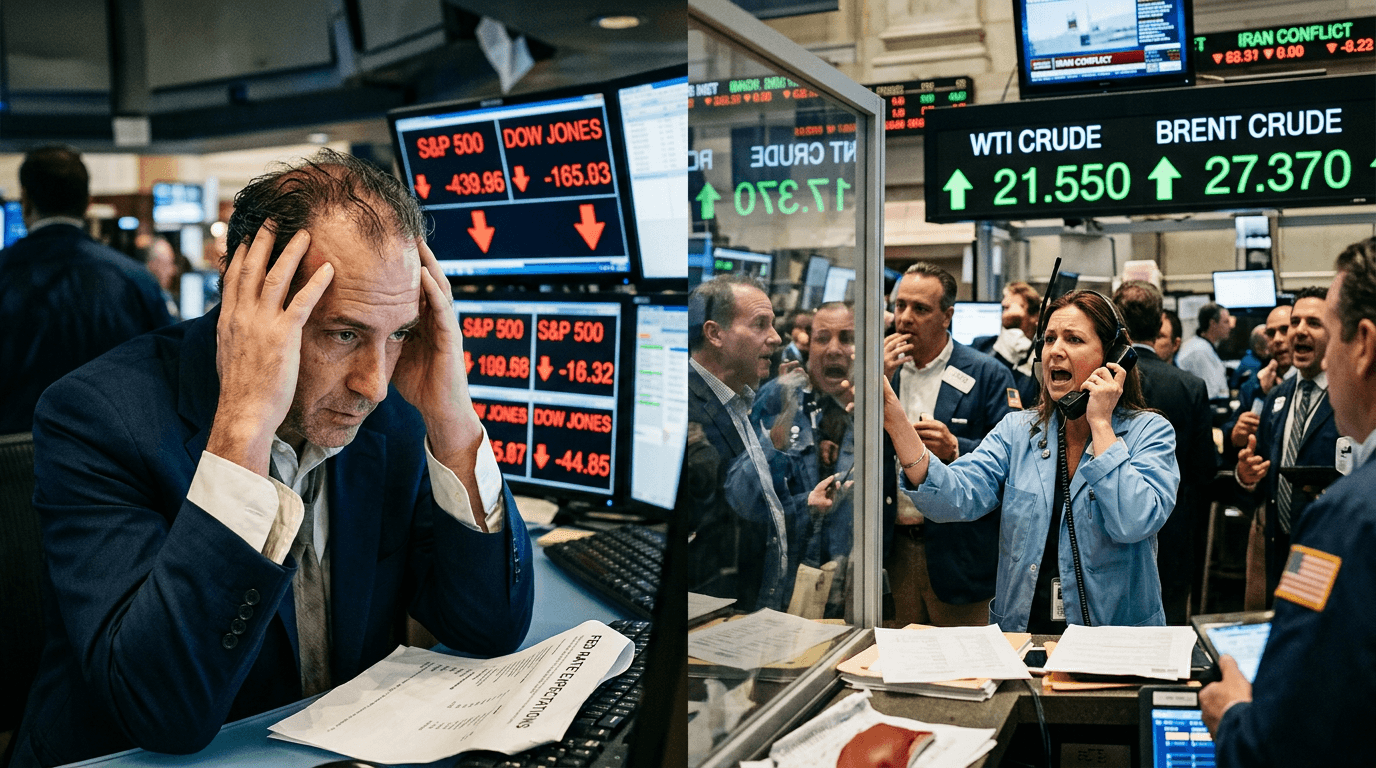
US stocks and oil prices are once again moving in opposite directions as renewed war fears in the Middle East drive investors into a risk-off stance. Crude has surged on concerns about supply disruptions tied to the Iran conflict, while US equities have retreated as traders reassess the outlook for inflation, interest rates, and global growth. The result is a familiar but challenging mix: higher energy prices, more volatility, and a market forced to quickly reprice risk.
Market Snapshot
Equity indices have pulled back after a period of relative calm, with broad benchmarks such as the S&P 500 and Nasdaq slipping as headlines around the Iran conflict intensified. At the same time, US crude has spiked sharply, with prices jumping from the low-$70s and briefly punching through levels not seen since mid-2024.
This divergence reflects a classic pattern: when geopolitical risk threatens energy supply, oil goes up and risk assets tend to go down. The equity selloff remains modest compared with past crises, but it is meaningful because it comes alongside a shift in interest-rate expectations. Traders who once anticipated a steady path of Federal Reserve rate cuts are now questioning whether persistent energy-driven inflation will delay or dilute that easing cycle.
Oil, War Risk And The Strait Of Hormuz
At the center of the latest move is the Strait of Hormuz, a narrow waterway between Iran and the Arabian Peninsula that is one of the world’s most critical energy chokepoints. Roughly one-fifth of global petroleum trade typically passes through this corridor. When conflict threatens that flow, the market quickly adds a risk premium to oil prices.
Recent reports of missile and drone threats, reduced tanker traffic, and direct attacks in the region have amplified those concerns. Even if physical supply has not yet fallen dramatically, traders are pricing the possibility that it could. Futures markets are forward-looking: prices jump not only on actual outages, but on the probability of future disruption.
The mechanics are straightforward
If tankers avoid the strait, shipping distances and insurance costs rise.
If buyers fear sanctions or military escalation, they scramble for alternative supplies.
If producers or infrastructure are hit, spare capacity elsewhere has to fill the gap, often at higher marginal cost.
Each of these channels adds upward pressure to spot oil prices and can steepen the backwardation in the futures curve, where near-term contracts trade above those further out.
From Crude To Cpi: Why Equities Care
Higher oil prices matter for stocks because energy is embedded everywhere in the economy. When crude spikes:
Input costs rise for manufacturers, transportation firms, airlines, and logistics providers.
Fuel and utility bills eat into household budgets, leaving less discretionary income for other spending.
Business confidence can weaken as margins get squeezed and demand growth becomes more uncertain.
All of this feeds into inflation data. Even if central banks often “look through” temporary energy spikes, a sustained period of higher oil raises headline inflation and can nudge core measures up as companies pass on higher costs. That is exactly what makes equity investors nervous now: energy-driven inflation can complicate the Federal Reserve’s path.
Until recently, markets were pricing multiple rate cuts over the coming year. With crude jumping and war risk elevated, traders have started to reduce those expectations. Fewer or slower cuts mean higher yields for longer, which matters for equity valuations. When the discount rate used to value future cash flows increases, the present value of those cash flows generally falls, especially for long-duration assets like high-growth tech stocks.
That helps explain recent sector moves
Energy stocks often outperform, supported by rising commodity prices and expanding cash flows.
Industrials, airlines, and consumer discretionary names can lag as investors price higher costs and softer demand.
Defensives such as utilities, staples, and some healthcare names may hold up better as investors seek earnings stability.
What History Tells Us About Geopolitical Shocks
While the latest headlines are unsettling, historical data offers an important counterbalance to fear. Analysis over the past several decades shows that equity markets often recover from geopolitical shocks faster than many expect.
Looking at wars, terror attacks, and energy crises over the last 75 years, major US equity indices have, on average, delivered positive returns 12 months after such events. One large bank’s research recently put that average around the mid–single digits to high–single digits, despite significant short-term volatility around the initial shock.
There are structural reasons why the US market has been more resilient to oil shocks than in past eras:
The US is now a net energy exporter and the world’s largest oil producer, which provides a partial hedge for the domestic economy.
Oil consumption per unit of economic output has fallen dramatically since 1980 as the economy has become more efficient and more service-oriented.
Energy’s share of the average US consumer’s budget is roughly one-third of what it was during the late-1970s oil crises.
These shifts do not eliminate the impact of an oil spike, but they help explain why recent conflicts have produced less severe and shorter-lived damage to US equities than similar events did decades ago. Still, if high prices persist and conflict widens, the risks to growth and earnings become more substantial.
Key Metrics To Track In The Weeks Ahead
For traders and investors trying to navigate this environment, focusing on a few key indicators can provide more clarity than chasing every headline:
First, watch the oil curve, not just the spot price. A sharply backwardated curve signals immediate supply stress; if that flattens, it can indicate easing fears.
Second, monitor inflation expectations through breakeven rates in the Treasury market. A sustained rise suggests markets see the oil shock feeding through to broader prices.
Third, keep an eye on rate-cut pricing in futures markets. Changes in the number and timing of expected cuts can be just as important for equities as the oil move itself.
Fourth, track credit spreads and volatility indices. Widening spreads and a rising volatility gauge often mark a deeper risk-off turn, while stabilization there can signal that markets are digesting the shock.
Finally, follow shipping and defense-related news around the Strait of Hormuz and surrounding regions. Concrete signs of secure passage, insurance normalization, or diplomatic progress can deflate the risk premium in crude.
Practical Takeaways For Traders
For active traders and those practicing in simulated environments, the latest swings offer several clear lessons:
Avoid reactionary position changes based purely on headlines. Geopolitical news can be emotionally charged, but the market impact often fades faster than the story.
Reassess sector exposures. Consider whether your portfolio is unintentionally overexposed to oil-sensitive industries or underexposed to potential beneficiaries such as energy producers or certain defense names.
Stress test your strategy. Build scenarios that assume higher-for-longer oil prices, slower rate cuts, or temporary recessions in energy-importing regions. Evaluate how your approach performs under each path.
Tighten risk management. In periods of elevated volatility, position sizing, stop-loss discipline, and diversification become more important than short-term return targets.
Use volatility as a teacher. Simulated trading environments can be particularly valuable here, allowing you to practice navigating gaps, news shocks, and fast-moving markets without real capital at risk.
Conclusion
The renewed war fears in the Middle East are a potent reminder that markets still react quickly to geopolitical shocks, especially when energy supply is on the line. Oil’s surge and the pullback in US stocks are reshaping expectations for inflation, interest rates, and sector performance, even as underlying economic fundamentals remain relatively stable.
For traders, the challenge is to separate signal from noise: recognize that higher energy prices can meaningfully alter the macro backdrop, while also understanding that history suggests many such shocks prove temporary. By focusing on key indicators, revisiting risk assumptions, and testing strategies across different scenarios, market participants can turn a period of uncertainty into an opportunity to sharpen their edge rather than succumb to fear.