
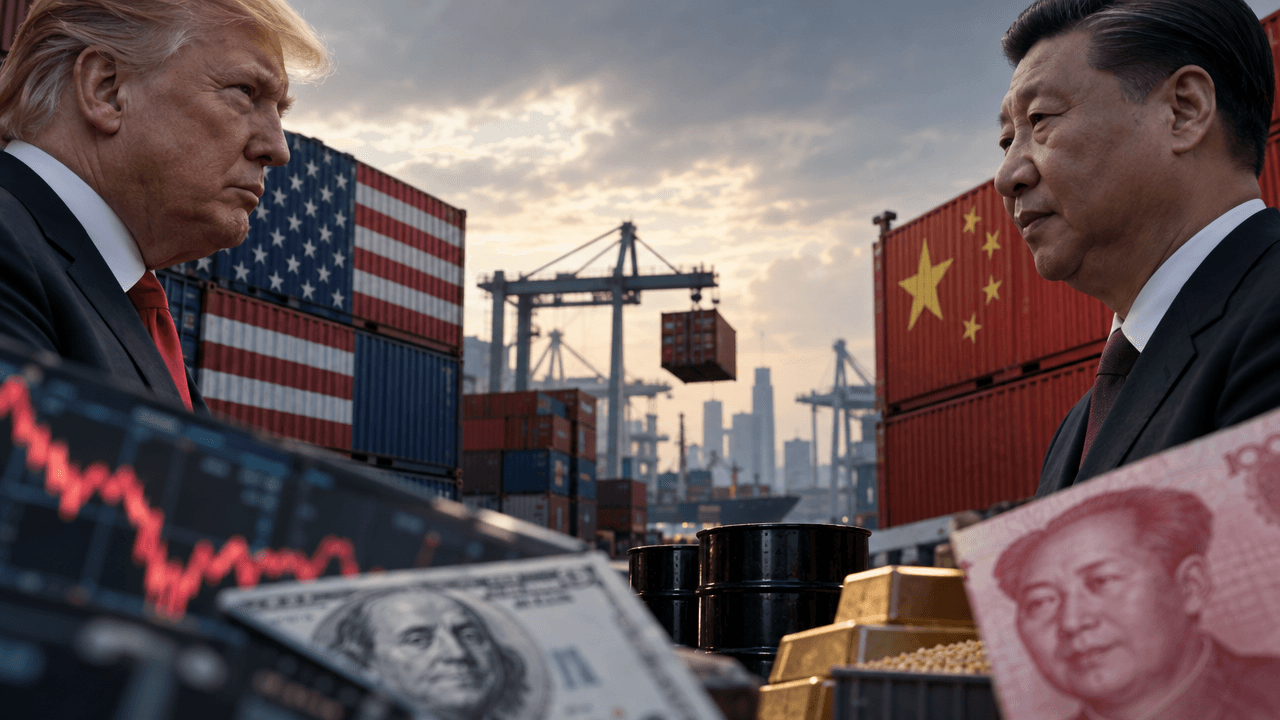
A new escalation in U.S.-China trade tensions is putting financial markets back into risk-sensitive mode. Washington is reported to be preparing an additional 20% tariff on Chinese imports, with the possibility of a higher rate if negotiations deteriorate. Beijing has warned that it will take necessary defensive measures, raising the prospect of retaliation and another round of uncertainty for investors. [1][3]
Markets react not only to the immediate cost of tariffs, but also to what they imply about global growth, inflation, supply chains and future policy. When trade tensions rise, investors typically reassess assets tied to economic expansion and move toward markets perceived as more defensive. That process can create sharp moves across equities, currencies, commodities and interest rates.
Why Tariff Escalation Matters
Tariffs function like a tax on imported goods. A 20% duty on Chinese products could increase costs for American companies that rely on Chinese electronics, machinery, chemicals, apparel and household goods. Businesses must then decide whether to absorb the expense, pass it on to customers, change suppliers or reduce production.
Each option carries market consequences. If companies absorb the cost, profit margins may narrow. If they raise prices, consumers may reduce spending and inflation could become more persistent. If they shift supply chains, capital spending may increase in the short term, while production becomes less efficient during the transition.
The uncertainty can be as disruptive as the tariff itself. Companies may delay investment, hiring and long-term purchasing decisions while waiting to see whether the measures become permanent, expand to other products or trigger negotiations. Reports indicate that the proposed duties could rise to 40% if Washington determines that China is not engaging adequately, adding another layer of policy risk. [3][15]
Equities Face Earnings And Growth Pressure
Equity markets are especially sensitive to tariff headlines because investors must quickly revise earnings expectations. Exporters with significant exposure to China may face weaker demand, while manufacturers dependent on Chinese components could experience higher costs.
Industries such as semiconductors, automobiles, industrial machinery and consumer electronics are particularly exposed to changes in cross-border trade. Companies may have some ability to redirect production or raise prices, but those solutions are rarely immediate or cost-free. The result can be lower earnings visibility and wider valuation swings.
Broader indexes may also weaken if investors interpret escalating tariffs as a threat to global economic growth. Trade restrictions can reduce business activity across multiple economies at once, especially when affected countries respond with their own barriers. Recent market analysis has identified tariff uncertainty and technology-sector weakness as factors contributing to heightened volatility. [2]
For traders, the key issue is not simply whether stocks fall on the first headline. It is whether the policy develops into a prolonged cycle of tariffs, retaliation and counter-retaliation. A temporary announcement may produce a short-lived shock, while a sustained trade conflict can influence earnings, economic data and central-bank policy for months.
Currencies And Commodities Signal Changing Risk Appetite
Currencies often provide an immediate measure of how markets are interpreting trade developments. In a risk-off environment, the U.S. dollar may attract demand because of its liquidity and traditional safe-haven status. At the same time, currencies closely linked to Chinese demand and global manufacturing may come under pressure.
The Chinese yuan, Australian dollar, South Korean won, Taiwanese dollar and other pro-cyclical currencies can be vulnerable when investors anticipate weaker Chinese imports, reduced industrial activity or disruptions to regional supply chains. The Mexican peso and other emerging-market currencies may also experience volatility if investors reduce exposure to riskier assets.
Commodity markets can move in both directions. Industrial metals such as copper may weaken if traders expect slower construction and manufacturing activity. Energy prices may also face pressure if the dispute increases concerns about global demand. However, commodities connected to supply restrictions or strategic materials could rise if retaliation threatens access to critical inputs.
China has previously used regulatory and supply-chain measures as part of its response to trade pressure. Recent reporting has highlighted the potential for countermeasures involving tariffs, restrictions on U.S. companies and critical minerals. [4] That possibility means commodity traders must monitor both demand expectations and supply risks.
What Traders Should Watch Next
The first priority is separating confirmed policy from preliminary proposals. A reported tariff plan can change during negotiations, public consultations or implementation. Traders should monitor official announcements, effective dates, product exemptions and any language describing future increases.
The second priority is watching the response from Beijing. Retaliatory tariffs on U.S. agricultural products, energy or manufactured goods would affect different sectors than the original U.S. measures. Restrictions on critical materials or pressure on American companies operating in China could create additional volatility even without a broad tariff response.
The third priority is tracking market confirmation. If equities weaken while the dollar strengthens and China-sensitive currencies decline, markets are likely pricing a broader risk-off scenario. If these moves reverse quickly, investors may be treating the announcement as a negotiating tactic rather than the beginning of a lasting trade conflict.
Simulated Finance traders can use this environment to practice scenario planning without committing real capital. One exercise is to build three cases: de-escalation, implementation of the proposed 20% tariff and a severe escalation toward 40% or retaliatory measures. For each case, define expected reactions in equities, the dollar, yuan-linked currencies, industrial metals and oil.
The objective is not to predict every headline. It is to understand how different instruments respond to the same event and to establish risk limits before volatility accelerates.
Conclusion
U.S. tariff escalation is keeping markets risk-sensitive because it combines immediate cost pressures with uncertainty about global growth and future policy. A proposed 20% tariff on Chinese imports may affect corporate margins, consumer prices, currency flows and commodity demand, while China’s threatened response raises the possibility of a wider confrontation. [6][9]
For traders, discipline matters more than speed. Monitor confirmed developments, identify the assets most exposed to China and global trade, and prepare multiple scenarios rather than relying on a single forecast. Until the policy path becomes clearer, elevated volatility is likely to remain a central feature of the market environment.