
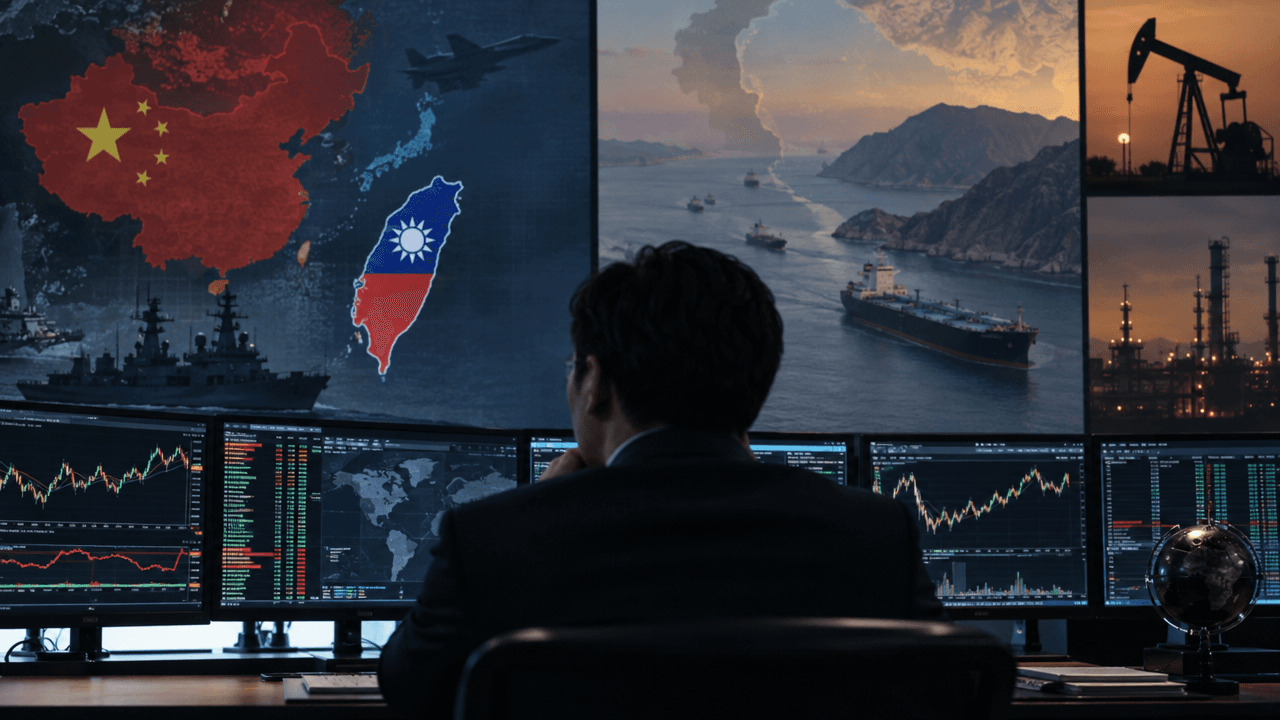
With U.S. cash markets closed for the weekend, price discovery shifts from live screens to scenario planning, as traders and risk managers focus on how geopolitical headlines could translate into gaps at the next open. In quiet tape conditions like this, the absence of real-time equity flows can make perceived risk feel larger than it is, but it also creates space to think more strategically about what truly matters for Monday’s opening auction and beyond.
Markets Pause, Risks Do Not
When the main U.S. exchanges are shut, liquidity migrates to a handful of global venues, OTC markets, and crypto, but most traditional risk metrics stay frozen until futures and cash markets reopen. That pause changes the psychology of risk: traders stop reacting tick-by-tick and start asking “What could this look like on the next open?”
Right now, the focus is clustering around three themes: China–Taiwan tensions, developments around Iran and the Strait of Hormuz, and the path of yields, the dollar, and Bitcoin into the new week. This is not a random list; it reflects where macro, trade flows, and sentiment intersect. Taiwan sits at the heart of global semiconductor supply chains, the Strait of Hormuz remains one of the world’s most critical energy chokepoints, and dollar and rate moves drive valuation, funding, and risk-parity behavior across assets.
For traders, the key takeaway is that weekend risk is less about predicting every headline and more about mapping which channels each shock could travel through: supply chains, energy prices, funding markets, and risk sentiment. In a SimFi environment, this is precisely the kind of structured thinking you can practice without capital at risk.
CHINA–TAIWAN TENSIONS AND TECH SUPPLY CHAINS
China’s long-run objective of “reunification” with Taiwan has moved from rhetoric into an increasingly muscular grey-zone campaign, including air-defense zone incursions, expanded coast guard operations, and more frequent exercises in and around the Taiwan Strait[2][7][12]. These operations are designed to apply sustained pressure while stopping short of outright conflict, but they raise the probability of miscalculation.
Recent reporting points to China using research vessels to map Taiwan’s seabed and monitor undersea cable routes, a move interpreted by some analysts as preparation for potential future action that could target communications infrastructure[3]. At the same time, Taiwan has launched large-scale military exercises, mobilizing reservists and testing new communications concepts inspired by U.S. doctrine, explicitly framed as preparation for a possible invasion scenario[7]. All of this adds to the sense that the status quo is becoming more fragile.
From a markets perspective, the linchpin is Taiwan’s role in advanced chip manufacturing. Conflict, even limited, would disrupt semiconductor exports, with knock-on effects for global tech hardware, cloud infrastructure, AI build-outs, and any industry that relies on sophisticated electronics[2]. For U.S. indices, that translates into potential pressure on mega-cap tech, hardware, and anything tightly linked to the electronics cycle.
Practical takeaway: In simulations, traders can model scenarios where a Taiwan-related shock drives underperformance in semiconductor and hardware proxies, strengthens safe-haven assets, and potentially supports defense-related names. The goal is not to forecast war, but to understand how the tech-heavy structure of modern indices amplifies any disruption to Taiwan’s output.
Strait Of Hormuz: Energy And Shipping At Stake
The Strait of Hormuz has become another flashpoint, with Iran and the United States locked in a high-stakes standoff over control of the waterway. Security developments earlier this year saw Iran declare the Strait closed in the wake of U.S.-Israeli attacks, leaving hundreds of vessels effectively trapped and prompting the creation of a new “Persian Gulf Strait Authority” to manage passage permits[5]. In response, Washington has warned about sanctions risks for entities paying Iran for transit guarantees[5].
Diplomatic efforts to reopen Hormuz remain stalled. Reports describe U.S.-Iran talks at the UN that failed to bridge differences, with Tehran insisting on an end to the U.S. blockade of its ports while oil continues to move through a dangerous, heavily militarized corridor[6][8]. Iranian officials and parliamentary leaders have repeatedly stated that the Strait will not reopen fully until Washington meets a long list of conditions, including lifting sanctions, compensating war damage, and withdrawing military assets from the area[9][14]. Meanwhile, Oman-mediated diplomacy has been delayed, and attacks on shipping and Saudi energy infrastructure have heightened pressure on regional oil routes[11].
The operational impact is visible in shipping data: thousands of vessels are reported stranded in the Gulf, while mine-clearing operations may take months before the strait can be considered safe for normal commercial passage[15]. Trade routes have shifted, with a growing share of liquids transit using alternative channels or “dark” transits that avoid Iranian oversight[13].
For energy markets, this kind of disruption usually translates into higher risk premia in oil and refined product prices, steeper front-end curves, and episodic volatility as headlines swing between escalation and partial relief. For equities, sustained pressure in oil can weigh on energy-intensive sectors while supporting select producers. For credit and FX, any sustained risk-off move linked to Hormuz can feed into tighter financial conditions.
Practical takeaway: Simulated traders can explore scenarios where Hormuz stress drives an oil spike, tests risk appetite in high-beta sectors, and triggers rotations into energy, defense, and selected commodities, while also modeling how a sudden easing of tensions could unwind those moves.
Watchlist: Yields, Dollar And Bitcoin
Away from pure geopolitics, the next U.S. open will also be shaped by how yields, the dollar, and Bitcoin trade through the weekend. Rising yields tighten financial conditions and compress valuation multiples, especially for long-duration assets like high-growth tech. A stronger dollar can weigh on commodities, emerging markets, and U.S. multinationals’ foreign earnings, while a weaker dollar tends to do the opposite.
Bitcoin often trades as a real-time barometer of speculative risk sentiment. In some episodes, crypto has behaved like a high-beta “liquidity proxy,” selling off alongside equities during risk-off shocks; in others, it has attracted flows as a hedge against currency debasement or political uncertainty. Weekend moves in Bitcoin can therefore serve as an early signal of how retail and speculative capital is digesting geopolitical headlines before traditional markets reopen.
Practical takeaway: Treat yields, the dollar, and Bitcoin as cross-asset indicators rather than isolated trades. In a SimFi setting, traders can test relationships such as “higher yields + stronger dollar + weaker Bitcoin” as a risk-off configuration versus “stable yields + softer dollar + firmer Bitcoin” as a more constructive backdrop.
Practical Playbook For Simulated Traders
With U.S. markets closed, there is no need to guess every headline; the edge lies in building robust playbooks. A structured approach to weekend geopolitical risk might include:
1. Mapping channels: Identify how each risk—China–Taiwan, Hormuz, rates/FX/crypto—translates into specific sectors, factors, and asset classes. 2. Defining scenarios: Build base, upside, and downside cases for Monday’s open, including gap-risk in index proxies, oil, and key FX pairs. 3. Stress-testing: Use simulated portfolios to test how concentrated exposures (e.g., semiconductor-heavy, energy-light) behave under each scenario. 4. Planning responses: Decide in advance how you would adjust positions on different types of gaps—small, manageable moves versus large, illiquid jumps.
The goal is not prediction perfection, but preparedness. By practicing this discipline in a simulation environment, traders can refine their reaction function to geopolitical shocks without bearing real P&L volatility. When markets do reopen, those who have already mapped the landscape of risks and channels will be better positioned to interpret price action calmly, rather than chasing headlines in real time.