
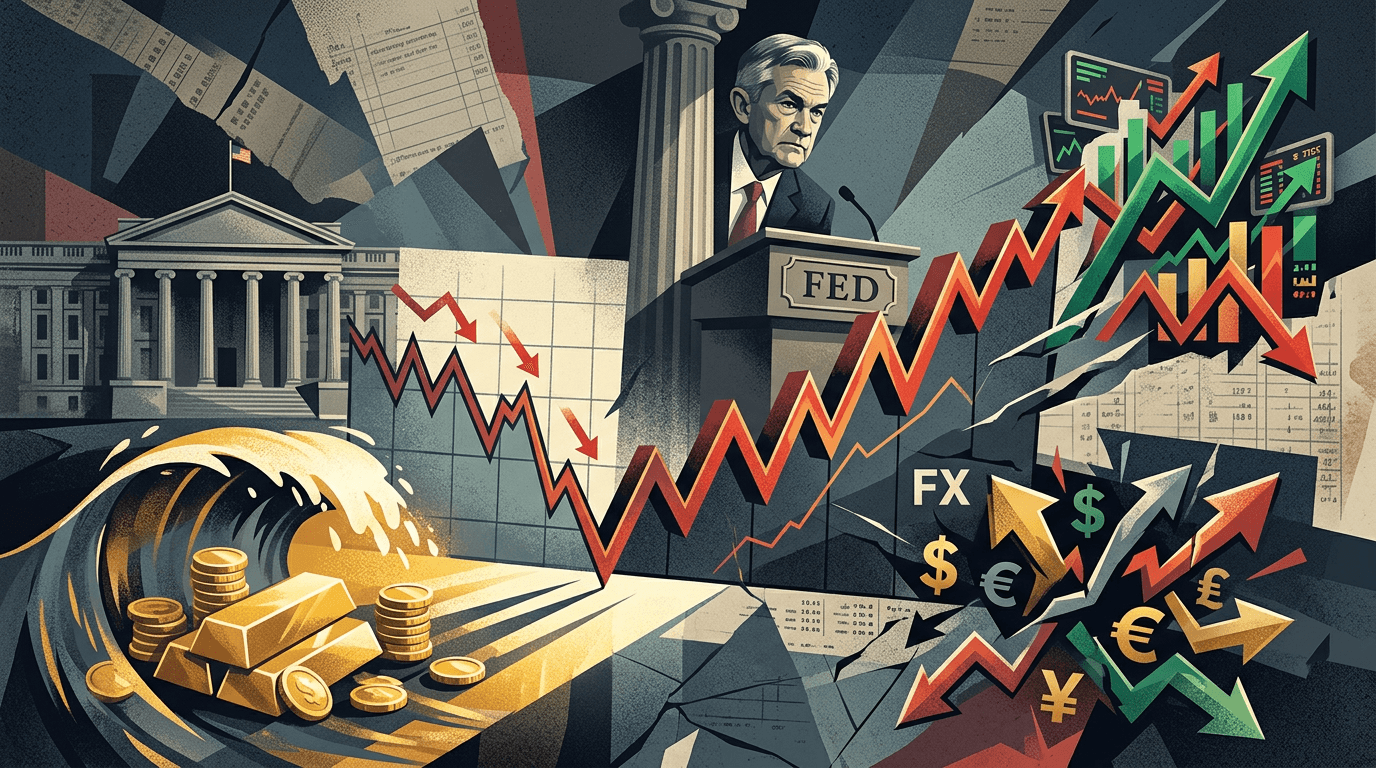
Treasury markets are once again caught between softer economic data and a Federal Reserve that remains fixated on inflation. After a weaker US payrolls report, government bond yields initially moved lower, only to climb back intraday as traders positioned for a potentially hawkish tone in upcoming Fed minutes. This kind of whipsaw price action is a textbook example of how quickly narratives can shift from “growth is slowing” to “inflation is still too high,” and why active traders need a framework for interpreting both data and central bank communication.[5][7]
Market Snapshot: Yields Whipsaw On Data And Fed Expectations
The first reaction to soft payrolls was straightforward: weaker job growth typically means slower economic momentum, lower inflation pressures, and a higher probability that the Fed will eventually reduce interest rates.[5][6] That combination generally pushes Treasury prices up and yields down as investors seek safety and bet on an easier policy path.[5]
But that initial move did not last. As the session unfolded, yields began to edge higher again, not because the data suddenly changed, but because attention shifted to the tone of upcoming Fed minutes and public comments. Markets have learned that even modest economic softness may not be enough to outweigh the central bank’s concern about inflation persistence, especially when inflation has remained above target for an extended period.[4] The result was a tug-of-war in the rates curve: data pointing one way, Fed expectations pulling the other.
For traders, this kind of intraday reversal is a reminder that the “first move” after a data release is often just the starting point, not the final answer.
Why Soft Payrolls Pull Yields Lower
To understand the initial drop in yields, it helps to revisit why payrolls matter so much. Nonfarm payrolls are one of the most closely watched indicators of US labor market health and overall economic momentum.[7] When job growth comes in weaker than expected, investors infer that households may spend less, corporate earnings may soften, and inflation pressures could ease in the months ahead.[5][7]
In that environment, several things typically happen:
Investors reassess the future path of Fed policy, lowering the probability of rate hikes or bringing forward expectations for cuts.[5][6]
Demand for longer-dated Treasuries rises as investors seek safe, liquid assets that benefit from lower policy rates.[5]
Higher demand for bonds pushes prices up; because yields move inversely to prices, yields fall.[6]
In past episodes of weak labor data, this pattern has played out consistently: yields have declined while implied volatility spikes as investors rotate from risk assets into safe havens.[5][6] For active traders, soft payrolls often serve as a catalyst for relative value trades along the curve—such as long 10-year vs short 2-year—based on how much easing they expect the Fed to deliver.
Why Yields Rebound On Hawkish Fed Expectations
The more nuanced part of this story is why yields rebounded intraday despite the softer data. Here, Fed communication is key. When inflation is running above target, policymakers frequently emphasize “inflation persistence” and the risk of cutting rates prematurely.[4] That narrative can dominate the market’s reaction even to weak data, especially if:
Previous reports have shown robust job growth or resilient wage gains.[4][7]
Fed officials have recently signaled concern that inflation could reaccelerate.[4]
Market pricing for rate cuts has drifted ahead of what the Fed views as appropriate.[4]
In those situations, traders may view upcoming Fed minutes as an opportunity for policymakers to push back against dovish expectations—by highlighting upside inflation risks, emphasizing data dependence, or placing a higher bar on future easing. Anticipating that tone, investors may demand a higher term premium to hold longer-dated Treasuries, lifting yields even when growth data is softer.
This dynamic is not contradictory: yields can fall on the data surprise, then rise as the market re-prices the Fed reaction function. For traders, the lesson is that economic releases and Fed communications must be interpreted as a sequence, not in isolation.
Ripple Effects: Fx, Equity Futures, And Gold
Moves in the US rates curve rarely stay confined to the bond market. When yields swing intraday, the effects ripple across FX, equity index futures, and commodities like gold.
In FX, the US dollar often strengthens when yields rise, particularly at the front end of the curve, as higher rate expectations improve the relative attractiveness of USD-denominated assets.[3][4] Conversely, when yields fall on weaker data, the dollar can lose ground against major counterparts as carry and growth expectations shift.
Equity index futures tend to react to yields through the lens of discount rates and growth. Higher yields can weigh on valuations, especially for growth and tech sectors that are more sensitive to changes in financing costs and discount factors.[3][4] Lower yields, driven by expectations of future easing, typically support risk assets—but if they are associated with fears of a sharper slowdown, the equity reaction can be mixed.[5]
Gold sits in between these narratives. As a non-yielding asset, gold often benefits when real yields fall and investors hedge against macro uncertainty.[5] However, if the Fed’s hawkish tone convinces markets that policy will stay restrictive longer, higher real yields can cap gold’s upside, even in the face of softer data.
For traders, monitoring how these cross-asset moves line up—or diverge—helps confirm whether the dominant narrative is “weak growth,” “sticky inflation,” or a complex combination of both.
Practical Lessons For Simulated Traders
For traders operating in a simulated environment, this episode offers several practical lessons that translate directly into strategy development and risk management:
Separate data surprise from narrative evolution. The initial payrolls reaction reflects the surprise versus expectations; the subsequent yield rebound reflects how markets anticipate the Fed will respond. Treat these as distinct phases in your scenario analysis.[7]
Use the curve, not just the headline yield. A soft jobs print might flatten or steepen the curve depending on how markets redistribute expectations for short-term vs long-term rates. Simulated trades that compare 2-year, 10-year, and 30-year yields can help you see which part of the curve is most sensitive to each narrative.[3][4]
Map rate moves into FX and indices systematically. Build rule-of-thumb scenarios: for example, “10 bp drop in 10-year yields with dovish repricing” vs “10 bp rise on hawkish Fed minutes,” then examine typical responses in USD pairs, S&P/Nasdaq futures, and gold.[3][4][5]
Drill intraday reaction patterns. SimFi platforms are ideal for practicing reactions to data releases and minutes in real time—testing orders, stop placement, and position sizing without financial risk. Focus on how quickly you adjust when the market shifts from data-driven to policy-driven trading.
Conclusion: Navigating Data Vs Fed Narrative
The pullback and subsequent intraday rebound in US yields after soft payrolls encapsulate the modern macro trading environment: data remains crucial, but central bank communication can override the first impulse. Softer jobs numbers pointed toward slower growth and lower yields, yet anticipation of a hawkish Fed tone—rooted in concerns about inflation persistence—pulled yields higher and re-shaped cross-asset pricing.[4][5][7]
For traders, the key is not to choose between “data” and “Fed,” but to understand how they interact over hours and days. In a simulated setting, this is a prime opportunity to refine playbooks for labor releases, minutes, and speeches—developing the discipline to respond to evolving narratives rather than anchoring to the initial move. That skillset is increasingly essential in a market where the balance between growth fears and inflation vigilance can shift in a single trading session.