
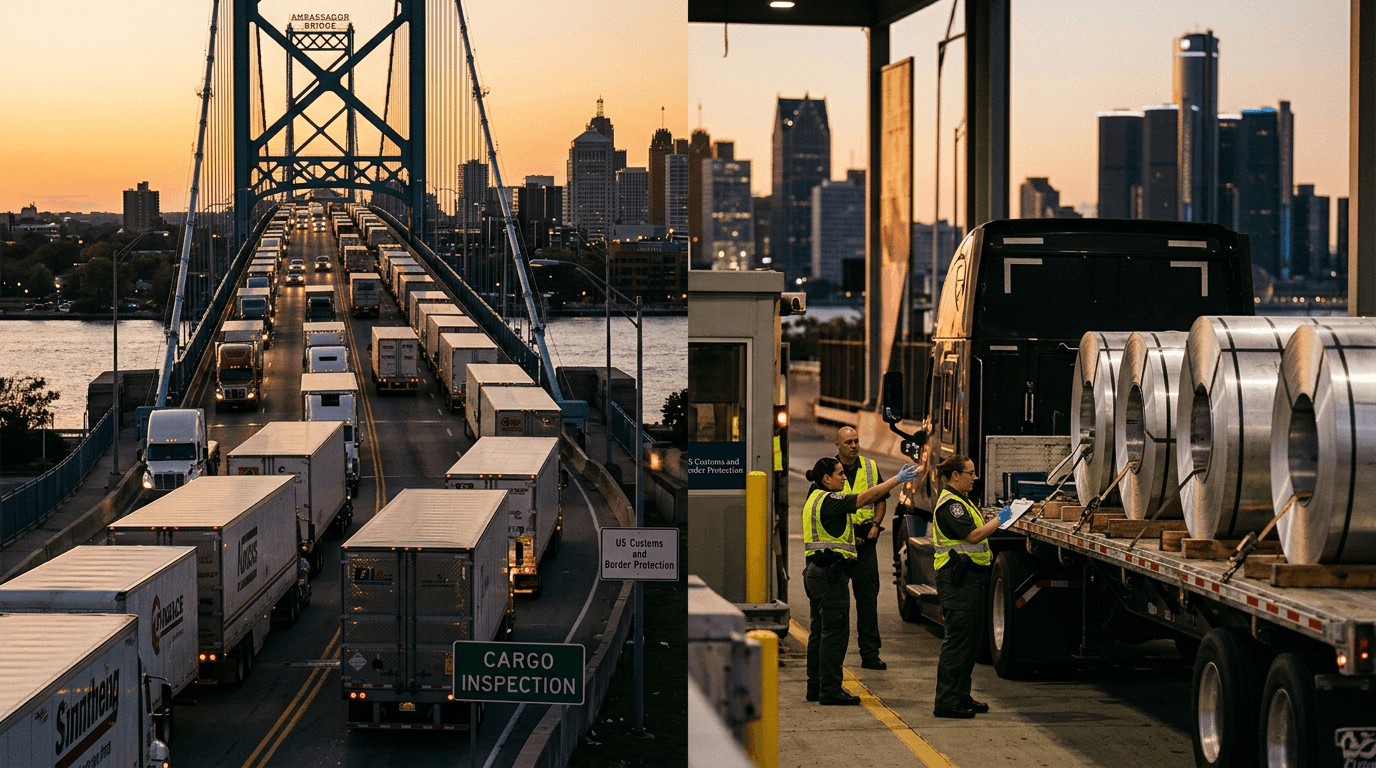
Washington’s move to impose 50% tariffs on billions of dollars’ worth of Canadian imports marks a sharp escalation in North American trade tensions and a material new risk for markets tied to cross‑border flows.[1][3][11] With Ottawa vowing to retaliate “dollar for dollar,” traders now face a more volatile backdrop for growth-sensitive assets and the Canadian dollar in particular.[5][8][13]
Trade Tensions Reach A New Level
The new US tariffs target roughly $20–28 billion of Canadian goods, representing about 5% of Canada’s exports to its largest trading partner.[3][11][14] The measures follow the collapse of last‑ditch trade talks in Washington, with both sides blaming the other for derailing negotiations and allowing the deadline to pass.[1][4][13] This is not a marginal adjustment to existing duties; a 50% rate is among the steepest applied to any major US ally in recent years.[2][15]
Products in the crosshairs range from electronics and industrial machinery to consumer goods such as wine, furniture, clothing, and sporting equipment including hockey sticks.[3][5][9] Many of these sectors were already facing legacy tariffs on steel, lumber, and autos, so the cumulative burden is now substantially higher.[1][3][6] For Canadian businesses that depend heavily on the US market, the new measures push some product lines close to uneconomic territory, forcing decisions about price hikes, margin compression, or re‑routing supply chains.[10][12][15]
Canada’s response is designed to be symmetrical, with Prime Minister Mark Carney committing to match US tariffs “dollar for dollar” starting in early September.[5][8][11] Ottawa’s retaliation list is expected to mirror US targeting, hitting US exports of consumer goods, machinery, and agricultural products in a calibrated effort to generate political pressure without crippling Canadian firms.[5][8][12] The result is a classic trade war dynamic: each new move invites a counter‑move, increasing uncertainty rather than resolving the underlying dispute.[3][13][14]
What Tariffs Mean For North American Growth
At the macro level, these tariffs function as a tax on cross‑border trade, raising costs, disrupting pricing, and slowing decision‑making for firms on both sides of the border. The hit to trade volumes may be modest at first—given that only around 5% of Canadian exports are directly affected—but the signal to businesses is far more negative.[3][11][14] Executives now face questions about whether this episode is temporary brinkmanship or the start of a structurally more protectionist environment.[10][12][15]
Capital spending is particularly vulnerable in such situations. When trade rules become uncertain, firms postpone investment, delay hiring, and push out expansion plans until policy becomes clearer.[10][12][15] For a North American economy already navigating interest‑rate shifts, sector‑specific challenges, and uneven demand, an additional layer of trade uncertainty can shave growth at the margin over the coming quarters.[1][4][13] US regions tightly integrated with Canadian supply chains—such as auto and machinery hubs in the Midwest—may feel the impact alongside export‑oriented provinces in Canada.[10][12][15]
From an inflation perspective, higher tariffs tend to push up import prices, although the pass‑through depends on how much producers absorb via margins versus how much retailers pass on to consumers.[3][11][15] Policymakers in both countries must weigh the inflationary impulse of tariffs against the growth drag from weaker investment and trade, complicating future rate decisions.[1][13][15] For traders, that interplay between growth, inflation, and policy paths is central to positioning in bonds, equities, and currencies.
Impact On The Canadian Dollar And Markets
The Canadian dollar (CAD) is especially sensitive to shifts in trade and commodity demand, so a sustained dispute with the US tends to feed into currency volatility. The immediate risk is a combination of softer growth expectations and potential capital outflows, as foreign investors reassess exposure to sectors most affected by tariffs. If markets begin to price a weaker medium‑term outlook for Canadian exports, CAD can come under pressure even if the headline trade numbers remain resilient in the short run.
Equity markets will likely respond in a differentiated way. Companies with heavy exposure to the newly targeted export categories—electronics, machinery, dairy, wine, furniture, and sporting goods—face the most direct headwinds, from reduced competitiveness to possible demand destruction if prices rise sharply.[3][5][9] At the same time, firms with domestic or diversified revenue streams may benefit if investors rotate away from tariff‑exposed names into more insulated business models. For US firms in the firing line of Canada’s retaliation list, earnings guidance and forward‑looking commentary will be key signals for traders.
Fixed income markets could see spreads widen for issuers in affected sectors, particularly those with leveraged balance sheets and limited pricing power. If growth expectations are revised lower, long‑term yields could drift down on safe‑haven demand, while credit instruments reprice to reflect higher idiosyncratic risk. In such an environment, cross‑asset correlations can shift quickly, making diversification and scenario planning essential.
How Traders Can Navigate Heightened Uncertainty
For active traders, trade wars are as much about sequencing and sentiment as they are about tariffs themselves. Policy headlines can trigger rapid intraday swings in FX and equity markets long before the economic data reflects any impact. Learning to trade these moves requires a clear framework for separating noise from signal and for sizing positions appropriately relative to headline risk.
A simulated finance environment such as E8 Markets’ SimFi platform is well suited to this kind of regime. Traders can build and test trade‑war scenarios—such as extended tit‑for‑tat tariffs, negotiated rollbacks, or escalation into autos and energy—without putting capital at risk. By running parallel strategies in a simulated setting, it becomes easier to see how different portfolios respond when CAD sells off, credit spreads widen, or sector‑specific equities gap on new announcements.
Practical applications include constructing pairs trades between US and Canadian firms with similar business models but different tariff exposure, or testing hedging strategies that combine FX positions with sector ETFs. Traders can also practice event‑driven setups around scheduled milestones—such as the start date of Canada’s retaliation, new negotiation rounds, or court challenges to the tariffs—refining execution and risk management in a controlled environment.[5][8][11]
Key Takeaways For Simulated Finance Traders
First, treat the US–Canada tariff dispute as an evolving process rather than a single event. As new lists, deadlines, and negotiation updates emerge, markets will continue to reprice the outlook for growth, earnings, and policy across North America.[1][4][13] Second, recognize that the Canadian dollar and trade‑sensitive sectors are the natural pressure points and therefore logical focal areas for analysis and simulated strategies.
Third, use this episode to deepen understanding of how political risk translates into market behavior—through volatility, spread changes, and shifting correlations—rather than focusing solely on headline numbers. Finally, leverage simulated trading to stress‑test portfolio construction and hedging approaches, so that when real opportunities arise, execution is informed by prior practice rather than improvised under pressure.
The escalation in US–Canada trade tensions, underpinned by 50% tariffs and reciprocal retaliation, is a textbook example of how policy uncertainty can ripple through currencies, equities, and fixed income. For traders on SimFi platforms, it is also a timely opportunity: a live case study in trade‑driven market dynamics, and a chance to turn volatility into structured learning and, eventually, more confident real‑world decision‑making.