
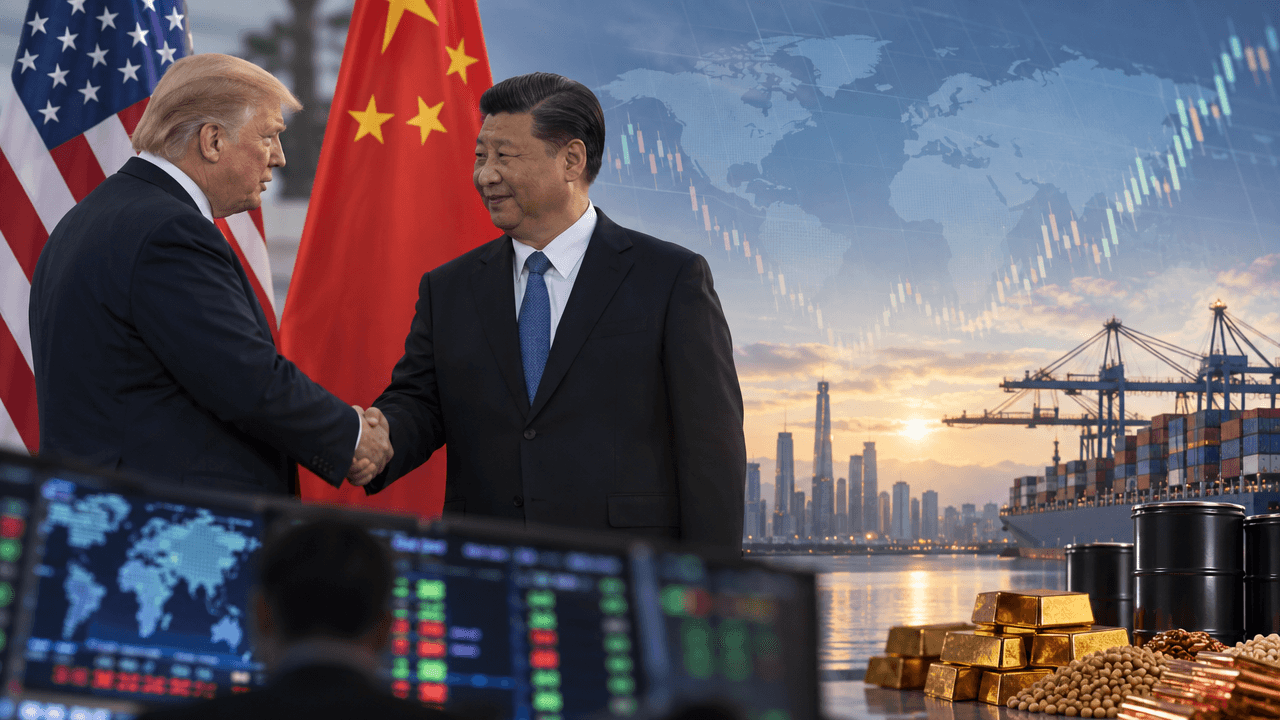
Asian markets are waking up to a world where Washington, not macro data, is setting the tone for risk sentiment, as Xi Jinping’s state visit to the United States and the extension of the US–China trade truce to January 10 reshape the near‑term outlook for equities, currencies and commodities.[1][3][4] For traders, the next few weeks will be defined less by surprise, and more by how they interpret this temporary breathing space.
US–CHINA SUMMIT: WHY IT MATTERS FOR RISK
Xi’s arrival in Washington for his first US state visit in more than a decade signals that both sides are willing to keep dialogue alive despite deep strategic tensions.[3][10] The optics are deliberately choreographed: a tarmac greeting by President Trump, a formal White House ceremony and a high‑profile summit that markets will treat almost like a major policy meeting.[3][10]
This summit is not designed to produce a full trade deal overnight, but to set the tone for negotiations covering tariffs, technology access, supply chains and industrial policy.[4][6][12] Each of these areas maps directly into market pricing: tariffs and quotas affect corporate earnings, tech restrictions shape growth expectations, and supply‑chain agreements influence inflation and production costs.
For risk assets, the key question is whether the summit narrative remains “constructive but unresolved” or flips toward renewed confrontation. A constructive outcome tends to support Asian equities, emerging‑market currencies and cyclical sectors, while a breakdown in talks would almost instantly feed into higher volatility and safe‑haven demand.
Trade Truce Extension: A Pause, Not Peace
The so‑called Busan Agreement—an 11‑month trade truce that was due to expire in November—has been extended by two months to January 10.[2][4][7] In practical terms, this means Washington and Beijing are postponing tariff escalation and keeping current duties and quotas broadly unchanged while talks continue.[5][8][9]
Treasury Secretary Scott Bessent framed the extension as a way “to give us more time to see what we can do on the economic front,” underscoring that the real work lies ahead rather than behind.[3][12][13] Officials have openly acknowledged that this is a short extension, not a long‑term settlement, and that China still has “deliverables” outstanding under the existing truce framework.[5][6][8]
For traders, the most important takeaway is that this is a window, not a resolution. The market now has a clear date—January 10—around which to anchor scenarios: either the truce is rolled again, upgraded into a more comprehensive deal, or allowed to lapse, opening the door to renewed tariff threats.[4][6][11]
Market Reaction: Dollar, Yuan, Equities And Commodities
Currency markets are treating the summit and truce extension as a mild positive for pro‑risk FX, but with tight stop‑losses in case headlines turn.[1][4][11] The dollar tends to soften when investors feel more comfortable rotating into higher‑beta currencies and emerging markets, while the yuan benefits from reduced immediate tariff risk and a perception of policy stability.[1][5][11]
Asian equities, particularly export‑driven sectors and technology names, respond favorably to any sign that tariffs will stay on hold and supply‑chain disruptions will not intensify in the near term.[1][2][3] Futures on major indices often gap higher on constructive diplomatic headlines, but remain sensitive to any suggestion that talks are stalling or the extension could be the last.
Industrial commodities—such as copper, iron ore and energy products—are closely tied to expectations for Chinese demand and global manufacturing.[1][5][9] An extended truce supports the view that growth will not face an immediate trade shock, which can underpin prices, especially when combined with existing infrastructure and green‑transition narratives.
In short, risk sentiment improves on the extension, but remains conditional. The entire move is “headline‑dependent,” with intraday swings likely each time new details or comments emerge from Washington.
HOW TRADERS CAN NAVIGATE HEADLINE‑DRIVEN RISK
For discretionary and systematic traders alike, the current environment calls for disciplined headline risk management rather than aggressive directional bets.
First, position sizing should reflect the binary nature of upcoming developments. With a known event window and a clear truce expiry date, it is sensible to reduce leverage ahead of key summit press conferences or official statements, then re‑assess once the market digests new information.
Second, volatility tools become critical. Options on equity indices, currency pairs involving the dollar and yuan, and commodity benchmarks can be used to hedge downside while maintaining exposure to potential upside if the summit narrative remains constructive.
Third, correlation awareness is essential. During trade‑related events, assets that usually diversify risk can move together—for example, Asian equities, EM FX and industrial commodities may all respond to the same US–China headlines. Portfolio construction needs to account for this clustering rather than assume historical diversification will hold.
SimFi platforms like E8 Markets provide an ideal environment to practice managing these dynamics without real‑world capital at risk. Traders can build simulated portfolios that test how different strategies behave across possible January 10 scenarios—from “truce extended again” to “tariffs resume.”
US–CHINA RISK THEMES TO WATCH BEYOND JANUARY 10
While the immediate focus is the summit and the two‑month extension, several medium‑term themes will continue to shape risk sentiment long after the cameras leave Washington.
One is industrial policy and “overcapacity” concerns, particularly around sectors such as EVs, solar and batteries, where the United States has floated the idea of new tariffs or restrictions.[15] Any concrete measures here would affect specific equities and supply chains, potentially altering growth forecasts and sector rotation patterns.
Another is technology and data. Export controls on advanced chips, cloud services and AI‑related hardware are likely to evolve regardless of the truce, creating a structural overhang for certain tech names while simultaneously generating new winners in onshoring and diversification plays.
Finally, capital‑flow regulation and market access will remain key. Even in a truce environment, the US and China can tighten or relax rules around listings, investment screening and cross‑border financing, influencing liquidity and valuation in both markets.
For traders, these themes are a reminder that the summit and truce extension are part of a longer narrative about how the world’s two largest economies manage competition and interdependence.
Conclusion: A Window Of Calm In A Structural Storm
The US–China summit in Washington and the two‑month extension of the Busan trade truce to January 10 collectively provide markets with a temporary anchor and a clearer set of expectations.[2][4][7] Risk sentiment has improved as immediate tariff escalation is taken off the table, supporting Asian equities, the yuan and cyclical assets, but this is still a pause rather than peace.[1][3][5]
For traders on live and simulated platforms, the opportunity lies in treating this window as a testing ground: refine headline‑risk playbooks, stress‑test portfolios against different January outcomes and deepen understanding of how macro diplomacy translates into price action. Whether the truce is extended again or not, the skills developed in navigating this period will remain relevant long after the current summit fades from the news cycle.