
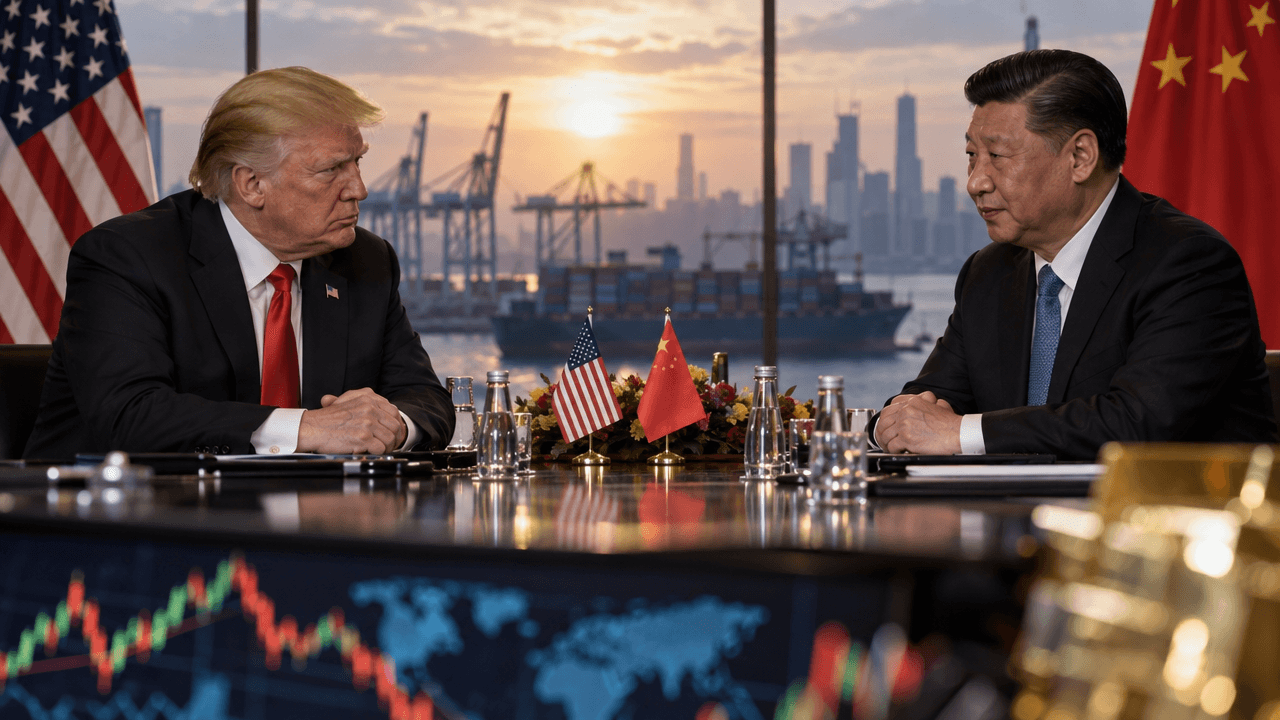
The upcoming U.S.–China summit is arriving at a moment when macro headlines can move futures markets in minutes, not days. Equity index, currency, commodity and rate futures are all tethered to the evolving tariff truce, rare earths supply discussions, technology controls and Taiwan tensions, making this meeting a central event risk for traders, even with a temporary extension of the current truce in place[5][9][11].
Global Backdrop: Why This Summit Matters
Since the Busan trade truce cooled a tariff war that had pushed duties on some Chinese goods above 100%, markets have treated the arrangement as a fragile détente rather than a durable treaty[1][14]. The original ceasefire, extended in Kuala Lumpur, left a 10% reciprocal tariff rate in place and was slated to expire on November 10, 2026[3][8]. That date had become a focal point for futures markets, particularly in equities and FX, which were pricing scenarios ranging from a smooth renewal to a sudden re-escalation[1][4].
U.S. Treasury Secretary Scott Bessent has now confirmed that Washington and Beijing agreed to extend the trade truce by roughly two months, pushing the new expiry to January 10 and buying time to work on a “bigger deal”[6][9][11][15]. This reprieve removes the immediate cliff-edge, but it does not remove the underlying uncertainty around tariffs, export controls and strategic issues like Taiwan[4][12][14]. For futures traders, that means less near-term mechanical risk from a scheduled tariff snapback, but sustained headline risk as negotiators attempt to turn a stopgap into something more durable[4][9][11].
Tariff Truce And Futures Pricing
The existing framework keeps reciprocal tariffs around 10% on a wide range of goods, far below the triple‑digit levels seen during the height of the conflict, but still higher than pre‑trade‑war conditions[3][14]. Discussions ahead of the summit include whether to extend the truce further, tweak the tariff level, or selectively reduce duties on non‑strategic consumer products like footwear and apparel[5][10][12]. Any movement on those points feeds directly into corporate earnings expectations, inflation assumptions and supply chain planning, all of which are embedded in equity index, sector and rate futures.
News outlets report that the U.S. is holding off on announcing new tariffs until after the summit, preserving the threat as negotiating leverage[7]. Markets are aware that if talks stall, the administration could restore second‑term duties on China to levels around 20% or higher, effectively re‑pricing a large portion of U.S.–China trade flows[7][14]. For S&P 500, Nasdaq and Asian equity futures, that risk translates into potential re‑rating of exporters, manufacturers and consumer discretionary names heavily exposed to China[1][13]. Currency futures tied to the yuan, dollar and trade‑sensitive G10 currencies would also need to adjust quickly to any change in the expected tariff path[1][7].
Rare Earths, Technology And Taiwan: Hidden Levers
Tariffs are only one layer of the story. China dominates processing of many rare earths and critical minerals used in electric vehicles, electronics, renewable energy, aerospace and defense systems[2][10][12][14]. Washington has been seeking more reliable flows of these materials while maintaining its own export controls on sensitive technology, creating a delicate balance between security and economic efficiency[2][10][12][14]. Negotiators are reportedly exploring ways to reduce disruptions to rare earths supply without trading away leverage on technology and national‑security issues[2][10][12].
At the same time, Beijing has pressed the U.S. to delay rules that would cut thousands of Chinese firms off from advanced American technology, while Washington wants commitments on industrial overcapacity and fair competition in sectors like EVs and AI[2][5][10][12]. These dynamics matter for futures beyond the obvious tech indexes. Copper, nickel and other industrial metals futures respond to any sign that Chinese heavy industry could face new constraints or that Western buyers may diversify supply chains away from China[2][10][12]. Taiwan’s status, repeatedly described by Xi as a “red line,” adds another layer of geopolitical risk, with investors aware that missteps could trigger sanctions, export bans or defense‑related moves that ripple through electronics, semiconductor and shipping futures[12][14].
For futures traders, rare earths and technology controls are “slow burn” risks: they may not move prices intraday like a surprise tariff headline, but they can reshape medium‑term trends in tech, clean‑energy and industrials, altering term structure, volatility regimes and relative value across sectors.
What This Means For Futures Traders
The key takeaway is that the summit is less about a single binary outcome and more about a cluster of linked risks—tariffs, rare earths, tech export controls, Taiwan and broader strategic competition—that can reprice entire curves across multiple futures markets[1][4][10][12][14]. Even with the January 10 extension, markets are dealing with a defined window during which policy can either stabilize or lurch back toward confrontation[6][9][11][15]. That kind of bounded uncertainty often shows up as elevated implied volatility, fatter tails in option pricing, and sharper reactions to headlines.
For index futures traders, this environment favors scenario planning. If the summit produces a longer truce and limited tariff reductions on non‑strategic goods, risk assets could enjoy a relief rally, especially in consumer and industrial names that depend on predictable cross‑border trade[5][10][12][13]. If talks falter and higher tariffs are put back on the table, equity futures could sell off, while volatility futures and safe‑haven rate contracts might rally[1][4][7]. In FX futures, a constructive outcome might support the yuan and other Asia‑linked currencies, whereas renewed confrontation could trigger defensive flows toward the dollar and yen[1][7][10].
Commodity futures traders should pay particular attention to any language around rare earths, critical minerals and industrial overcapacity. Stronger assurances on supply continuity could stabilize sentiment in EV‑related metals and some industrial commodities, while tougher language on overcapacity or technology access could increase uncertainty and widen spreads between regional benchmarks[2][5][10][12]. Energy futures may also respond to broader implications for global growth and manufacturing, especially if trade frictions spill into other regions[1][14].
How Simulated Finance Traders Can Prepare
For traders using simulated finance platforms, this summit is an ideal case study in managing event risk without financial exposure. By building and testing strategies around multiple policy scenarios, SimFi users can learn how different futures markets react to macro shocks and how to size positions appropriately when catalysts are binary, but outcomes are uncertain.
Practical steps include mapping out three core paths—bullish détente, muddling‑through extension, and renewed confrontation—and designing futures portfolios for each case, adjusting leverage, diversification and hedge ratios. Traders can experiment with tightening stops and position sizes ahead of key summit days, then loosening constraints once the initial headlines are absorbed. They can also practice using options on futures to structure asymmetric payoffs around the event, capturing upside if volatility spikes while capping downside if the meeting turns into a non‑event.
Perhaps most importantly, simulated environments allow traders to experience how quickly prices can gap on unscheduled comments, tweets or leaks from closed‑door sessions. That experience reinforces the need to respect overnight risk, liquidity conditions and the possibility that markets may temporarily trade more on politics than on fundamentals.
Conclusion
The U.S.–China summit and ongoing tariff negotiations are not just diplomatic theater; they are live inputs into how equity, currency, commodity and index futures are priced over the coming months[1][4][9][10][12][14][15]. The short‑term extension of the tariff truce to January 10 buys time, but it also concentrates event risk into a defined window when trade, technology and security issues must be confronted[6][9][11][15]. For futures traders, the challenge is to treat these headlines as quantifiable scenarios rather than unpredictable shocks, using robust risk management, diversified exposures and disciplined execution. In a simulated setting, this summit becomes an opportunity to sharpen those skills—so that when the next macro event hits live markets, traders are ready to respond, not react.