
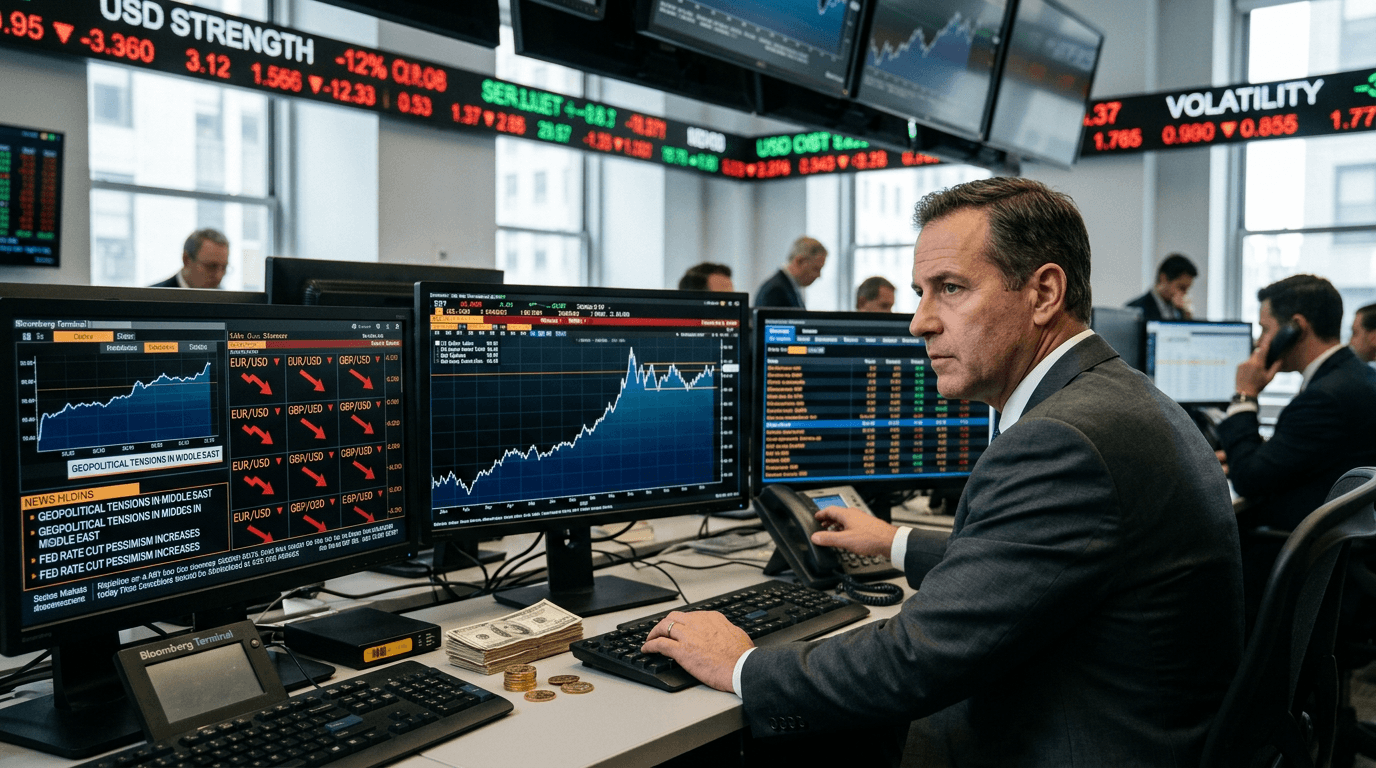
The US dollar is sending a curious mixed message to traders in March 2026. While the Dollar Index has consolidated near 98.40 rather than executing a dramatic rally, the greenback itself remains remarkably resilient across major currency pairs, benefiting from a powerful combination of hawkish monetary policy expectations and safe-haven demand driven by escalating geopolitical tensions. This seemingly paradoxical environment—where calm technical price action masks underlying strength—represents one of the most important market dynamics for forex traders to understand as we navigate the remainder of Q1 2026 and look toward a catalyst-rich spring.
Rate Cut Pessimism Reshapes The Monetary Policy Landscape
When 2026 began, the consensus view held that the Federal Reserve would steadily reduce rates throughout the year. That narrative has undergone a dramatic reversal. Markets are now pricing in just one 0.25% rate cut for all of 2026, likely arriving in September at the earliest. The March 17-18 FOMC meeting shows only a 4.7% probability of a rate cut, and policymakers have made clear they remain unconvinced that inflation has been sufficiently tamed to justify aggressive monetary easing.
This hawkish repricing stems from data-dependent realities. While headline inflation has moderated from its peaks, sticky services inflation continues to trouble policymakers. The labor market remains remarkably robust with unemployment holding near cycle lows, removing any urgency for rate cuts. For dollar traders, this translates into a powerful structural advantage: elevated US Treasury yields relative to comparable foreign instruments create a compelling interest rate differential that incentivizes international investors to hold dollar-denominated assets.
The Safe Haven Premium In An Uncertain World
Running parallel to rate cut pessimism is a resurgence of geopolitical risk premium that has decisively favored the dollar. Middle East tensions surrounding Iran have created conditions where traditional safe-haven flows command substantial premiums. While some analysts have questioned whether the dollar retains legitimate safe-haven status in recent years, the current environment demonstrates that it continues to benefit when investors seek shelter during risk-off episodes.
This safe-haven bid is particularly notable because it has the power to override traditional rate-driven currency dynamics. Normally, when a central bank's hawkish stance prevents rate cuts, we expect currency support primarily from yield differentials. In this case, geopolitical flows are providing an additional layer of support that reinforces dollar strength independent of interest rate considerations alone. Oil prices have climbed in tandem with these geopolitical developments, creating complex secondary effects—while elevated crude prices typically benefit commodity-linked currencies like the Canadian dollar and Mexican peso, they simultaneously heighten global economic uncertainty and drive more investors toward dollar safety.
Central Bank Divergence Amplifies Currency Trends
The dollar strength narrative becomes even more compelling when examining the divergence unfolding across major central banks. While the Federal Reserve maintains its hold and messages caution, other central banks are signaling unexpected policy moves. The Reserve Bank of Australia, for instance, is signaling a potential rate hike in March, creating a striking contrast with Fed inaction. This widening policy gap between monetary authorities creates well-defined structural trends across major currency pairs rather than the consolidation that dominated earlier in the year.
Currency traders are increasingly pricing this divergence into positions, with the Australian dollar showing particular weakness as the RBA's hawkish surprise meets a Fed that shows no inclination to follow suit. These structural policy shifts create opportunities for longer-term positioning even as short-term volatility from geopolitical headlines and economic data continues to generate headline risk.
The Technical Picture And Near-term Catalysts
The DXY's consolidation around 98.40 represents neither full capitulation to a worst-case scenario nor a return to previous optimism. The 3-month moving average positioned near the 98 threshold provides technical support to the downside, while upside moves above 98 could signal a push toward the 99.30 to 99.70 intermediate resistance zone. Many analysts expect the dollar index to remain pinned somewhere between the high 90s and low 100s for the foreseeable future as markets digest the balance between geopolitical risk and monetary policy signals.
Critical catalysts in the coming weeks include March employment data and inflation releases. Stronger-than-expected economic readings will reinforce the hawkish dollar narrative, while softer data could revive earlier rate cut expectations and create downside pressure. Fed communications remain equally important, with any signals of policy flexibility potentially serving as a near-term headwind for dollar strength.
Practical Positioning In A Volatile Environment
For active traders, the current environment suggests a tactical approach centered on relative yield differentials and risk sentiment shifts. The combination of hawkish Fed policy and geopolitical risk creates a robust foundation for dollar strength in the near term, but this environment remains highly data-dependent and sentiment-driven. Markets could reprice rapidly if economic data softens, geopolitical tensions ease, or if central banks elsewhere signal unexpected policy shifts.
Monitor labor data and Fed communications closely while remaining mindful of oil markets and Middle East developments as critical variables shaping dollar direction.