
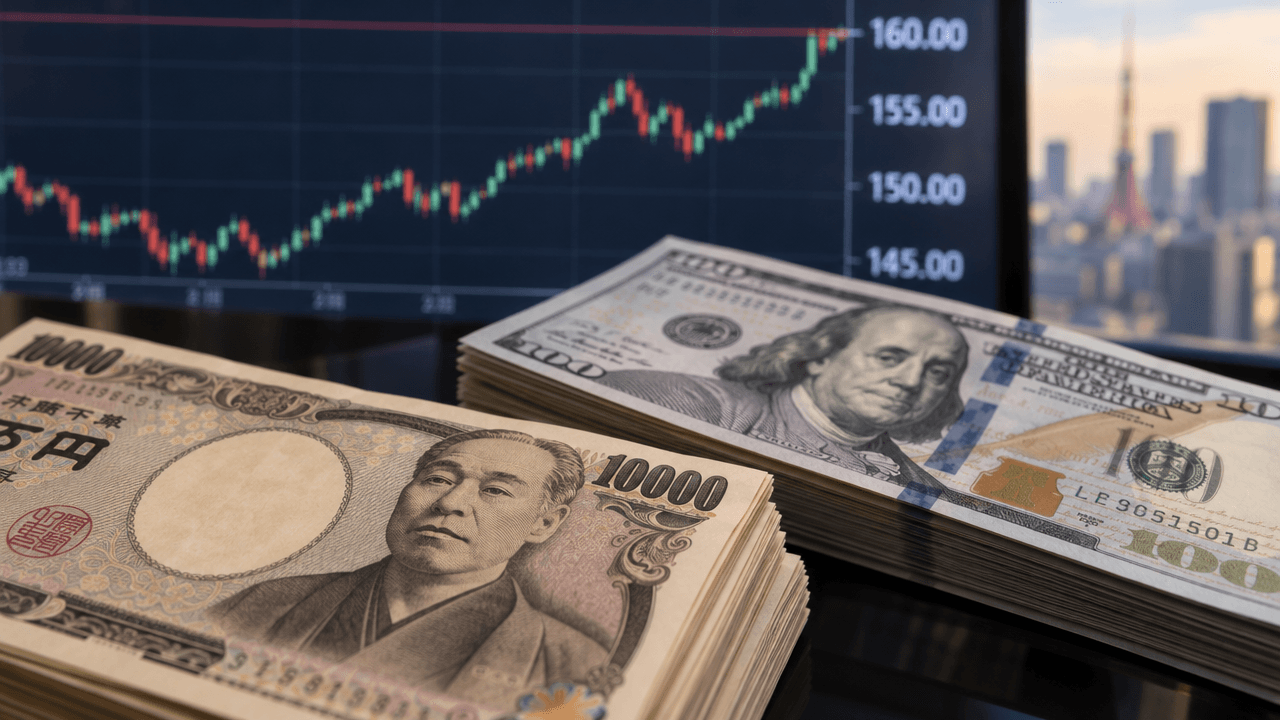
The USD/JPY exchange rate is approaching one of the most closely watched levels in global currency markets. The pair rose roughly 0.7% to trade around 159.86–159.90 on November 12, 2026, as stronger expectations for US interest rates outweighed signals that the Bank of Japan may continue tightening policy. [3]
The move has pushed the yen toward 160 per US dollar, a psychologically important threshold with a much deeper significance. Japan has previously intervened near similar levels to slow excessive yen depreciation, making the area a potential turning point for traders, risk managers, and policymakers.
THE RATE DIFFERENTIAL DRIVING USD/JPY
At its core, the latest USD/JPY advance reflects the interest-rate gap between the United States and Japan. When US yields rise relative to Japanese yields, global investors often find dollar-denominated assets more attractive. That can increase demand for the dollar while putting additional pressure on the yen.
Recent market pricing has reflected a more hawkish outlook for the Federal Reserve. Markets are assigning approximately a 91% probability to a US rate increase next month, while additional hikes in January and potentially April are also being considered. [7] Expectations for higher US rates have helped lift Treasury yields and supported the dollar across major currencies.
Japan is not standing still. Domestic producer prices rose 7.1% year over year in October, above the 6.5% expected increase, reinforcing speculation that the Bank of Japan could raise interest rates next month and continue tightening into next year. [7] However, expectations of future Japanese rate increases have so far been insufficient to offset the immediate impact of rising US yields.
This creates a familiar tension. Longer-term policy expectations may support the yen, but short-term yield movements and positioning can still favor the dollar.
Why 160 Matters
Round numbers often attract attention in financial markets because they influence trading orders, options positioning, and investor psychology. In USD/JPY, 160 carries additional importance because Japanese officials have previously acted when yen weakness became too rapid or appeared disorderly.
Japan’s top currency diplomat, Atsushi Mimura, warned that recent currency movements were excessively rapid and said it was too early for markets to forget the intervention conducted during the summer. [1] Japan spent approximately 15.4 trillion yen across interventions on July 30, July 31, and August 3, when the yen had weakened toward levels near 164 per dollar. [1]
The key point is that intervention is not triggered by a precise number alone. Officials typically focus on the speed and character of a move, rather than simply defending a specific exchange rate. A steady, orderly rise may be tolerated longer than a sudden surge driven by speculative activity.
That means a break above 160 would not automatically guarantee intervention. It could, however, increase the probability of stronger verbal warnings, closer market monitoring, and potentially direct yen buying if authorities conclude that volatility has become excessive.
What Traders Should Watch
The first signal is price behavior around 160. A clean breakout followed by sustained trading above the level could encourage momentum traders to add dollar positions. Conversely, a sharp rejection could trigger profit-taking and a rapid decline as traders unwind crowded positions.
The second signal is official language. Statements from Japan’s Ministry of Finance and senior currency officials can move USD/JPY even before any transaction occurs. Phrases describing excessive, speculative, or one-sided moves may indicate that authorities are becoming more uncomfortable.
The third factor is US Treasury yields. If yields continue rising, USD/JPY may remain supported despite intervention concerns. If US inflation data softens, Federal Reserve expectations shift, or yields retreat, the dollar could lose momentum and give the yen some relief.
Finally, traders should monitor volatility and liquidity. Intervention risk can create unusually sharp price movements, particularly during periods when market depth is limited. Stop-loss orders may be triggered quickly, and spreads can widen around official comments or unexpected policy actions.
Practical Lessons For Simfi Traders
For traders practicing in a simulated finance environment, USD/JPY near 160 offers a valuable risk-management case study. The objective should not be to predict intervention with certainty. Instead, traders can build scenarios around several possible outcomes.
In a bullish-dollar scenario, USD/JPY breaks above 160 as US yields rise and Japanese officials limit themselves to verbal warnings. In a reversal scenario, the pair fails at resistance and falls as traders take profits or intervention fears intensify. A third scenario involves a volatile range, with the exchange rate moving sharply in both directions as markets react to headlines.
Each scenario should include a defined entry, invalidation point, position size, and maximum acceptable loss. Traders can also compare the result of entering before an official comment with waiting for confirmation after the market has reacted.
The broader lesson is that a technically attractive setup can still carry event risk. A breakout may be correct from a chart perspective but poorly timed if it occurs directly into a potential policy response.
The Bigger Market Message
USD/JPY’s approach toward 160 highlights how monetary policy, inflation, market psychology, and government action interact in foreign exchange markets. The dollar’s strength is being supported by rising US rate expectations, while Japan faces the challenge of limiting imported inflation without disrupting market confidence.
For now, 160 is best viewed as a zone of heightened uncertainty rather than a guaranteed ceiling. A sustained move above it could signal that market forces are overwhelming official warnings, while a rejection could demonstrate that intervention risk is enough to restrain bullish dollar positions.
The most disciplined approach is to respect both possibilities. Traders should focus on price confirmation, remain alert to policy headlines, and control exposure carefully. In a market where a single comment can produce a violent reversal, survival and consistency matter more than forcing a prediction.