
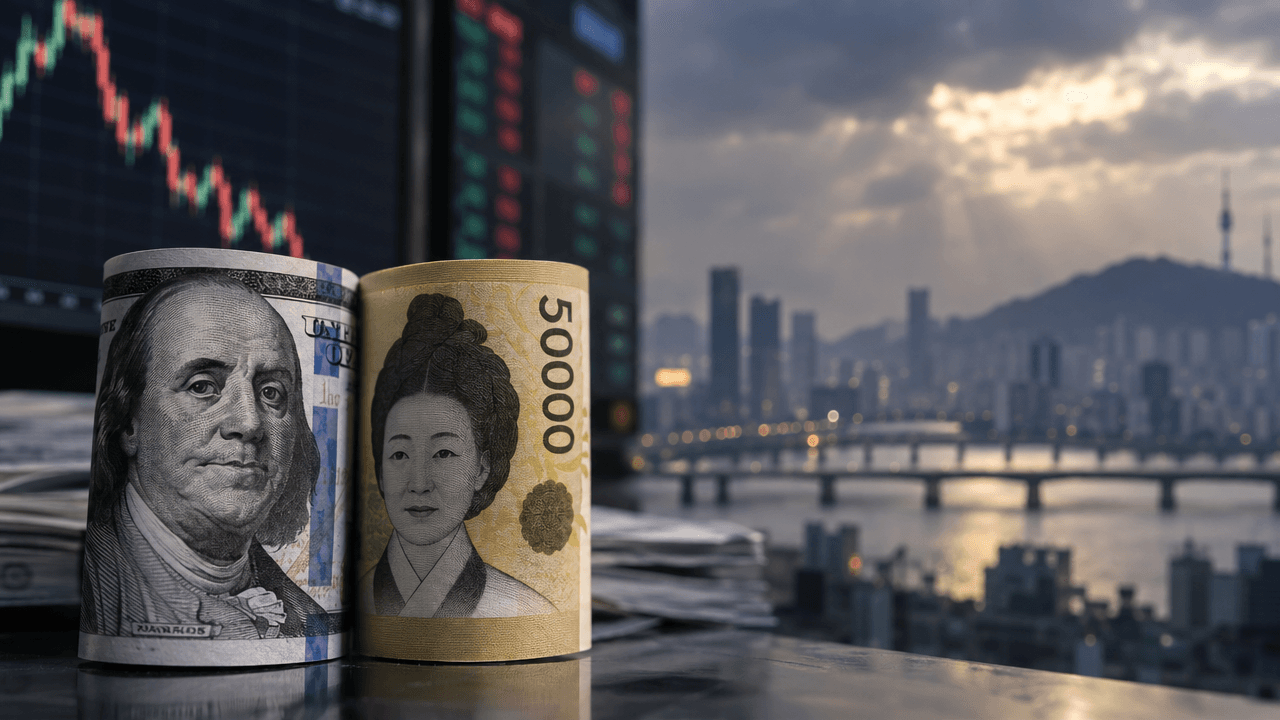
The Korean won is back under pressure as the dollar climbs, with USD/KRW recently trading around the 1,368 level after a roughly 9-won gain from the prior session.[4][11] This move reflects a classic combination of risk-off sentiment and firmer U.S. rate expectations, and it is part of a broader theme of renewed stress across Asian foreign exchange markets as global investors reassess where capital is safest and most productive.[4][8][11]
Market Snapshot: A Stronger Dollar, A Softer Won
The latest leg higher in USD/KRW has pushed the pair into the mid‑1,360s to high‑1,360s region, marking a notable day-on-day increase in favor of the dollar.[4][11] For context, recent data show the pair trading in the 1,360–1,370 band, with intraday moves of around 0.3–0.5%, underscoring how sensitive the cross has become to shifts in U.S. yield expectations and risk appetite.[4][8][11]
The key driver is not a local shock in Korea, but a global repricing of dollar assets as U.S. yields move higher and markets lean toward a “higher for longer” path for Federal Reserve policy. When investors anticipate that U.S. interest rates will stay elevated, the dollar tends to draw in capital from lower‑yielding markets, and export‑oriented Asian currencies like the won often feel the pinch first.
Combined with a risk‑off tone in equity and credit markets, this creates a two‑way headwind for the won: international investors reduce exposure to Korean assets and simultaneously increase demand for dollar cash, pushing USD/KRW upward.
Why Risk-off Mood Lifts The Dollar
In risk‑off environments, investors prioritize liquidity, safety, and depth, and U.S. dollar assets rank at the top of that hierarchy. Treasuries and high‑grade dollar credit offer a perceived safe haven, particularly when other regions face slower growth or policy uncertainty.
Higher U.S. rate expectations amplify this dynamic. If market participants expect the Fed to keep policy tight, the yield pickup from holding dollars versus won becomes more attractive. This widens interest rate differentials in favor of the USD, encouraging carry trades into the dollar and out of emerging and regional Asian currencies.
At the same time, risk‑off phases tend to trigger the unwinding of leveraged positions in equities, credit, and FX. Investors who had been short the dollar and long higher‑yielding currencies frequently close those trades, buying back USD and selling local currencies like KRW. The mechanical closing of these positions can accelerate the move in USD/KRW beyond what fundamentals alone would imply.
Pressure On The Korean Won And Local Assets
For Korea, the won’s weakness is closely tied to cross‑border flows. The country’s markets are deeply integrated into global portfolios, particularly in technology and manufacturing equities. When global risk aversion rises, foreign investors often trim holdings in Korean stocks and bonds, repatriating funds into dollars and other core currencies.
A softer won can be a double‑edged sword for the real economy. On one hand, it can support export competitiveness by making Korean goods cheaper in foreign currency terms. On the other hand, it raises the local currency cost of dollar‑denominated imports, such as energy, and can complicate inflation dynamics. If imported inflation resurfaces at the same time that U.S. rates stay high, the Bank of Korea faces a difficult balancing act between growth support and price stability.
From a capital markets perspective, persistent won weakness may also raise questions about the pace and direction of domestic monetary policy. If rate differentials versus the U.S. widen too far, the incentive for capital outflows grows. Policymakers therefore watch levels like 1,350–1,400 on USD/KRW carefully, as they often coincide with stronger policy communication or, in some cases, intervention signaling.
Implications For Traders In Simulated Finance
For traders using a Simulated Finance (SimFi) environment such as E8 Markets, this USD/KRW move is a timely case study in how macro sentiment and policy expectations translate into FX price action. SimFi allows market participants to explore scenarios that may be difficult or risky to replicate with real capital, while still requiring realistic risk management and decision‑making.
First, traders can model how different paths for U.S. yields and Fed guidance might impact USD/KRW over various horizons. For example, scenarios where 10‑year Treasury yields rise another 25–50 basis points and the Fed signals few near‑term cuts may show continued dollar strength against the won, with the pair testing prior resistance zones.
Second, these environments are ideal for practicing event‑risk management. The upcoming Fed decision, key U.S. data releases, and regional growth indicators can all be incorporated into simulated strategies around USD/KRW. Traders can experiment with whether to stay flat into events, hedge via options, or scale positions based on volatility expectations—all without the emotional pressure that comes from real P&L swings.
Third, SimFi platforms allow for structured testing of correlation behavior. Historically, the won has shown links to global semiconductor cycles, the KOSPI equity index, and broader Asian FX baskets. By examining how USD/KRW reacts alongside these assets in different risk‑off phases, traders can develop more robust multi‑asset frameworks.
PRACTICAL TAKEAWAYS FOR ACTIVE USD/KRW WATCHERS
Several practical points emerge from the latest USD/KRW strength:
1) Keep a close eye on Federal Reserve communication and market‑implied rate expectations. Shifts in the expected policy path often show up in U.S. yields first and USD/KRW shortly thereafter.
2) Track U.S. Treasury yields across the curve, not just the policy rate. Moves in 2‑year and 10‑year yields are useful signals of how aggressively markets are pricing the “higher for longer” narrative.
3) Monitor regional FX performance, especially other Asia‑ex‑Japan currencies. Broad weakness in this basket can indicate that moves in the won are part of a systemic risk‑off trend rather than a Korea‑specific story.
4) Align leverage and position sizing with volatility regimes. When risk‑off sentiment is dominant and central bank decisions loom, intraday ranges can widen, increasing the need for conservative sizing and disciplined stops.
5) Use simulated environments to rehearse responses to sharp FX moves. Running playbooks for sudden spikes in USD/KRW—such as testing how to adjust exposure if the pair jumps 20–30 won in a short period—helps build confidence and consistency.
Conclusion: Navigating A Higher-for-longer Landscape
USD/KRW’s recent rise around the 1,368 zone encapsulates a broader story: in a world where risk‑off episodes collide with expectations of prolonged U.S. tightness, the dollar tends to dominate and Asian currencies, including the won, come under pressure.[4][8][11] For market participants, this is not simply a headline about one currency pair, but a reminder that FX is where global risk sentiment, yield differentials, and capital flows converge.
Whether trading live or in a SimFi setting, the current environment rewards those who integrate macro drivers, event risk, and disciplined risk management into their approach. By treating moves like the latest USD/KRW rally as learning opportunities rather than isolated surprises, traders can build frameworks that remain resilient even as the policy and risk backdrop evolves.