
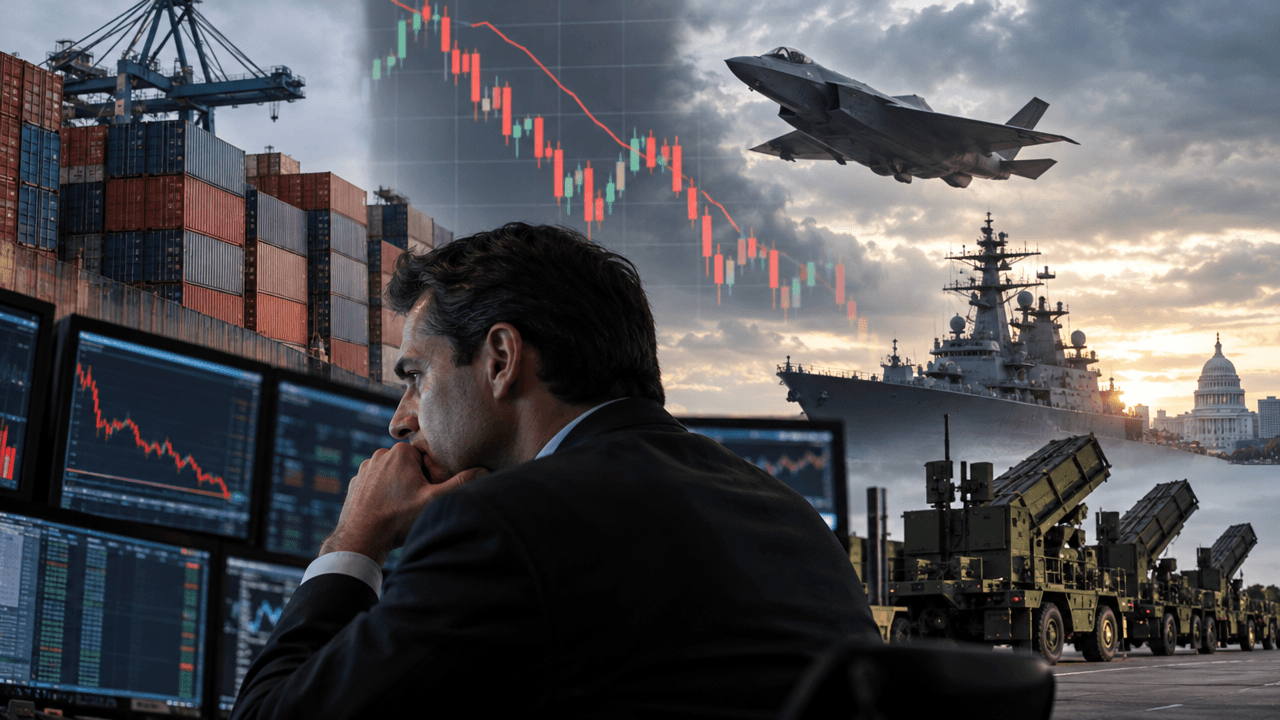
Volatility jumps as global markets turn defensive, forcing traders to reassess risk, valuations and the outlook for economic growth. The Cboe Volatility Index, or VIX, rose roughly 18% to around 31, a level that signals substantially greater demand for protection against further equity-market swings. At the same time, European and Asian shares weakened as investors responded to a difficult mix of persistent inflation, stronger-than-expected U.S. growth, renewed tariff concerns and a sharp correction in artificial-intelligence stocks. [4][6]
This is more than a single-session sell-off. It reflects a broader change in market psychology. For much of the year, investors were willing to pay high prices for growth, technology and AI-related exposure. Now, they are questioning whether corporate earnings can justify those valuations while interest rates remain restrictive and trade policy threatens to increase costs.
What Is Driving The Defensive Shift
Several pressures are reinforcing one another. First, inflation remains uncomfortable enough to limit expectations for rapid monetary easing. If price pressures stay elevated, central banks may need to keep rates higher for longer, raising the discount rate applied to future corporate earnings. That particularly affects long-duration growth stocks, whose valuations depend heavily on profits expected years in the future.
Second, stronger U.S. economic growth is creating an unusual complication. A preliminary estimate showed the U.S. economy growing at an annualized 4.3% in the third quarter, above expectations of 3.5%. While healthy growth is generally positive, it can also reduce the urgency for interest-rate cuts and encourage central banks to maintain a more cautious stance. [3]
Third, tariff concerns have returned to the foreground. Proposed tariffs affecting major trading partners have revived fears of higher import prices, disrupted supply chains and weaker global trade. Tariffs can pressure companies from both directions: input costs may rise while demand falls if consumers and businesses face higher prices. Investors are therefore treating trade policy as a potential earnings risk as well as an inflation risk. [1][6]
The Ai Correction Changes The Market Leadership
The AI-related sell-off has added another layer of uncertainty. Investors are no longer focused only on the promise of artificial intelligence; they are asking how quickly enormous infrastructure investments will produce sustainable revenue and cash flow. Concerns about financing costs, data-center constraints, regulation and the return on AI spending have made highly valued technology shares especially vulnerable. [7]
When market leadership is concentrated in a small group of large technology companies, weakness in those names can affect major indexes disproportionately. A decline in a prominent AI stock may also influence sentiment across chipmakers, cloud providers, software companies and other businesses associated with the theme.
That does not automatically mean the long-term AI opportunity has disappeared. It does mean that investors are becoming more selective. Strong technology companies with durable demand, credible profits and manageable balance sheets may be treated differently from businesses whose valuations depend primarily on optimistic future assumptions.
What A Vix Near 31 Means
The VIX measures the market’s expectations for S&P 500 volatility over the next 30 days, based on options prices. It is often called the market’s fear gauge, although a high reading does not predict the direction of stocks. Instead, it indicates that investors expect larger price movements and are paying more for hedging protection.
A VIX near 31 is materially above the calmer range around 15 to 20 that had prevailed for months. Recent reporting also showed the index moving from around 20 to above 37 during the week’s sell-off, demonstrating how quickly risk perceptions can change. [10]
For traders, elevated volatility has practical consequences. Stop-loss orders can be triggered more easily, spreads may widen and overnight price gaps can become more common. A strategy that works in a quiet market may produce very different results when daily ranges expand.
Defensive Positioning Without Panic
Turning defensive does not have to mean abandoning markets altogether. It means matching exposure to current uncertainty. Traders may reduce position size, limit leverage and avoid concentrating risk in correlated technology names. They can also define the maximum acceptable loss before entering a position instead of adjusting risk emotionally after prices move.
Diversification deserves renewed attention. Holding different sectors, regions and asset classes cannot eliminate losses, but it can reduce dependence on one market narrative. Defensive sectors, high-quality balance sheets and assets with lower sensitivity to economic growth may become relatively more attractive, although no category is guaranteed to rise during a broad sell-off.
For SimFi traders, the current environment offers a useful testing ground. Track how a simulated portfolio behaves when volatility rises, spreads widen and correlations increase. Compare fixed-percentage risk with fixed-dollar risk, and examine whether a portfolio remains within its drawdown limits after several consecutive losing trades.
Key Takeaways For Traders
The first takeaway is that volatility is a risk condition, not a trading signal. A rising VIX can accompany both sharp declines and violent rebounds, so direction still requires an independent market thesis.
The second is that macroeconomic variables are interacting. Inflation, interest rates, tariffs and growth should not be analyzed separately because each can amplify the others.
The third is that valuation matters most when liquidity becomes less forgiving. Companies priced for perfection may experience larger declines when expectations change, even if their underlying businesses remain viable.
Finally, risk management should lead strategy. Smaller positions, defined stops, diversified exposure and patience can help traders remain active without allowing a single market shock to dictate the outcome.
Conclusion
Global markets have turned defensive because investors are confronting several uncertainties at once: inflation that may keep rates elevated, growth strong enough to delay policy easing, tariffs that could pressure prices and earnings, and an AI correction challenging one of the market’s most crowded trades. The jump in the VIX is a clear warning that the cost of being complacent has increased.
The next phase may bring further declines, stabilization or a sharp rebound. No outcome is certain. What traders can control is preparation: understand the drivers of volatility, size positions responsibly and treat every trade as a risk decision before it becomes a profit-and-loss result.