
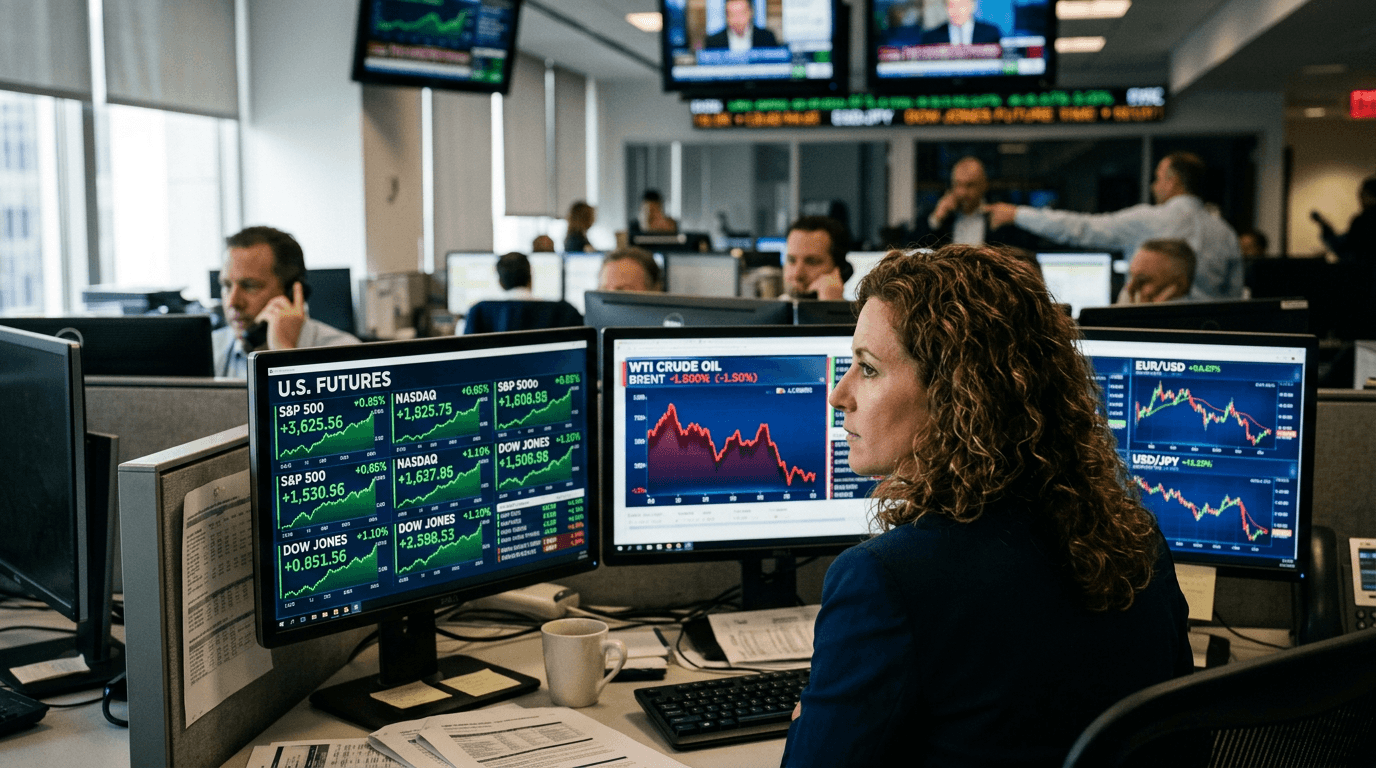
Wall Street futures are catching a bid again as oil prices back off their recent highs, giving investors a brief respite from the latest U.S.-Iran flare-up and its ripple effects across global markets.[9] The move higher in index futures follows a period of volatility in which fresh strikes and geopolitical headlines pushed crude higher, stoked inflation fears, and briefly jarred risk sentiment across equities, commodities, and currencies.[9][8] With oil now retreating and headlines pointing to a pause rather than an escalation, traders are recalibrating their views on growth, inflation, and the path of interest rates—and that is showing up clearly in futures pricing.[9][13]
Markets Find Their Footing
Recent trading has underscored how quickly sentiment can swing when geopolitics and commodities collide.[9] After renewed U.S. attacks on Iranian targets raised concerns about disruptions to energy supply and shipping routes, oil prices moved sharply higher, unnerving investors already sensitive to inflation and interest-rate risks.[9] As crude eased from those peaks, U.S. stock index futures edged higher, signaling that traders were willing to re-engage with risk assets rather than simply de-risk portfolios.[9][13]
In cash trading, growth-oriented segments such as technology have helped lead the rebound.[8] One recent session saw the Nasdaq rally more than 1%, supported by chip stocks, even as headlines continued to highlight the possibility that the U.S.-Iran conflict could prolong Middle East instability and keep inflation pressures elevated.[8] The S&P 500 and Dow also finished higher, though with more modest gains, suggesting broad participation but stronger conviction in sectors less directly tied to energy costs.[8]
For simulated traders and active investors alike, the key takeaway is that markets can accommodate a high level of geopolitical noise as long as the underlying economic story—earnings, growth, and central-bank policy—does not fundamentally break.[9][8] Futures markets become the first arena where traders express those shifting views before they filter into the cash session.
Why Oil Prices Drive Risk Sentiment
Oil is more than just another commodity quote on a screen; it is a critical input into the global inflation and growth narrative.[9] When crude spikes on geopolitical risks, as happened during the latest U.S.-Iran tensions, investors quickly reprice expectations for corporate margins, consumer spending, and central bank decisions.[9][18] Higher energy costs can squeeze transportation, manufacturing, and logistics companies, and they can feed through to headline inflation data that policymakers closely track.
The retreat in oil prices changes that narrative at the margin.[13] As crude pulls back from conflict-driven highs, traders can reasonably infer less immediate pressure on fuel costs, shipping rates, and headline inflation readings in the coming months.[9][13] That, in turn, reduces the probability of more aggressive central-bank tightening relative to what might have been feared during the height of the tension-induced rally in oil.
There is a psychological dimension as well. A stabilizing oil market often signals that the worst-case scenarios around supply disruption—such as prolonged closures of key shipping lanes—have not materialized.[9][13] When traders see crude pulling back while diplomatic channels stay open or attacks pause, they are more comfortable rotating back into cyclical and growth assets instead of hiding exclusively in defensive names.
For simulated trading, this dynamic is a powerful lesson: macro shocks linked to commodities are rarely one-way. Scenario analysis that includes both “oil spike” and “oil retreat” paths can help traders prepare positions that are robust across different outcomes rather than overreacting to the initial headline.
Sector Winners And Losers From An Oil Retreat
The stabilization and pullback in oil prices tends to create distinct sector winners and losers, and that is visible in recent market action.[8][13] Technology and other growth sectors—where valuations are sensitive to interest-rate expectations—have generally benefited from the easing of inflation fears tied to energy costs.[8] Chipmakers, software companies, and AI-linked names have been able to refocus investor attention on earnings and long-term growth drivers once the immediate commodity shock faded.[8][11]
On the other side, energy producers can see some pressure as crude backs off.[13] Lower realized prices for oil and gas can translate into weaker revenue expectations, especially after a period when investors priced in elevated cash flows from higher spot and futures prices.[9][13] However, large integrated energy companies often have diversified businesses, including refining, chemicals, and trading operations, which can cushion the impact of a short-term pullback.
Industrials and consumer-facing sectors may find themselves in a sweet spot. With fuel and transportation costs potentially easing from conflict-driven highs, airlines, logistics firms, and retailers can benefit from lower expense pressure without necessarily seeing a sharp drop in demand.[9][13] For investors, this can create tactical opportunities to rotate into these areas when oil retreats and futures signal a broader rebound in risk appetite.
In a simulated environment, traders can test sector-rotation strategies that respond to changes in oil and volatility: overweight growth and cyclicals when oil retreats and inflation risk cools, while trimming pure-play energy exposure or hedging with options.
Implications For Currencies And Global Flows
The oil retreat after U.S.-Iran tensions is not just an equity story; it has currency and global capital-flow implications as well.[9] During the height of the conflict and crude’s rally, traditional “safe haven” currencies and assets often see inflows, while oil-linked currencies and emerging markets can experience heightened volatility.[9][18] The easing in energy prices can partially reverse these flows, as traders unwind defensive FX positions and reconsider carry trades and risk-on exposures.
Oil-linked FX pairs—such as those tied to major exporters—often move in tandem with crude prices.[18] When oil surges on supply fears, these currencies can gain, but they may also become more volatile as traders price in policy responses and external-balance shifts. As prices retreat, volatility can normalize, creating a more stable backdrop for cross-border investment and carry strategies that depend on relatively predictable rate differentials.
For the U.S. dollar, the picture is more nuanced. A retreat in oil that alleviates inflation concerns can support the idea of a less aggressive Fed path, which may diminish some dollar strength tied to safe-haven and yield appeal.[9][18] At the same time, if lower energy prices bolster global growth expectations and equity risk-taking, international investors may continue to allocate to U.S. assets, maintaining demand for dollar-denominated instruments.
Simulated traders can use this environment to practice multi-asset positioning: pairing equity index futures trades with FX exposure, testing how shifts in oil reshape correlations and portfolio risk. Understanding these linkages is crucial for building resilient strategies.
What Simulated Traders Can Learn
The rebound in Wall Street futures as oil retreats after U.S.-Iran tensions is a textbook case of how geopolitics, commodities, and macro expectations collide in modern markets.[9][8][13] It highlights several enduring principles:
First, markets react to the rate of change in risk, not just the level. The initial spike in oil on conflict headlines triggered de-risking, but the subsequent pullback opened the door to a futures rebound as perceived tail risks eased.[9][13]
Second, cross-asset relationships matter. Equities, oil, FX, and rates are intertwined through inflation expectations, growth forecasts, and policy paths, and traders who see the full web of connections can respond more intelligently than those focused on a single asset.[9][18]
Third, simulated environments offer an ideal testing ground. By replaying scenarios like the U.S.-Iran flare-up and oil retreat, traders can stress-test strategies, examine drawdowns, and refine risk management without capital at stake—so they are better prepared when similar dynamics play out in live markets.
In a world where headlines can shift risk sentiment in minutes, the ability to interpret moves in oil, understand their macro implications, and translate them into disciplined futures and FX positioning is a core skill. This latest episode on Wall Street is not just another news cycle—it is a practical training module for anyone serious about developing their trading edge.