
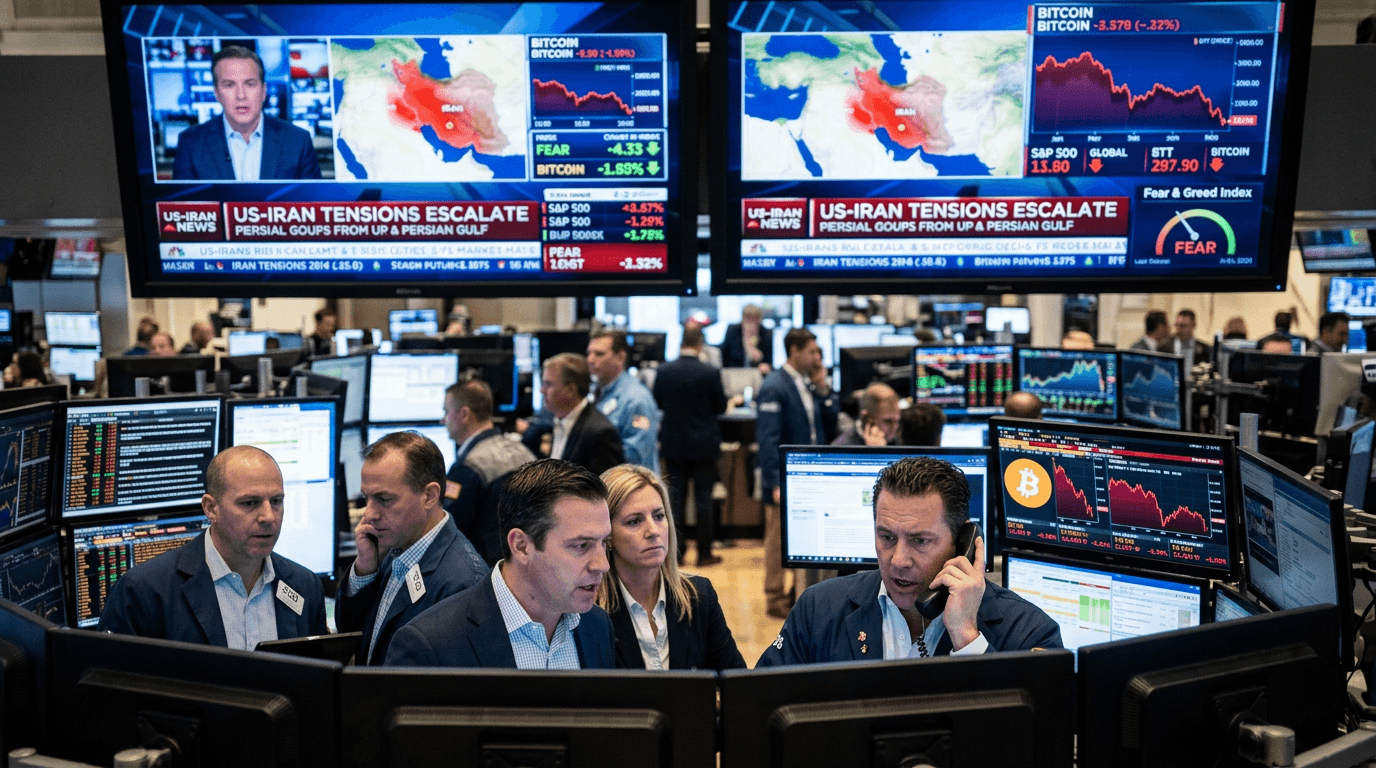
Bitcoin’s latest pullback from recent highs is a reminder that even in a structurally bullish environment, macro shocks can quickly shift the tone. After a roughly 2% slide, Bitcoin is holding just above the $71,000 area, while Ethereum trades near $2,000 and majors like XRP are also softer. The move is modest in percentage terms, but the driver behind it—rising war jitters and a broader risk‑off mood—is what has traders paying attention.
WHAT’S DRIVING THE LATEST CRYPTO PULLBACK?
On the surface, not much has changed inside the crypto ecosystem. Long‑term narratives around institutional adoption, on‑chain activity, and layer‑2 scaling remain intact. But in the short term, those crypto‑native factors are being overshadowed by a deeper macro concern: the escalating conflict between the US and Iran and the broader risk of regional spillover.
That geopolitical tension is feeding directly into traditional risk assets. Equity indices have stalled after strong runs, volatility futures are ticking higher, and investors are rotating selectively into perceived havens like the US dollar and short‑dated government bonds. Crypto, which still behaves more like a high‑beta tech asset than a defensive store of value in these environments, is getting caught in the downdraft.
The result is a classic “de‑risking” phase. Traders are trimming leveraged longs, high‑beta tokens are underperforming Bitcoin, and derivatives metrics show a cooling of the aggressive bullish positioning that had built up as BTC and majors approached recent highs.
Key takeaway: The pullback is less about deteriorating crypto fundamentals and more about capital stepping back from risk across the board as war headlines intensify.
How War Jitters Translate Into Market Volatility
Geopolitics affects markets through several channels, and all of them matter for digital assets:
1. Energy and inflation expectations If conflict threatens oil supply routes, crude prices tend to rise. Higher oil filters into inflation expectations, which can force central banks to maintain tighter monetary policy for longer. A “higher for longer” interest‑rate narrative usually pressures risk assets, particularly those with long‑duration growth stories like tech equities and crypto.
2. Flight to safety When investors worry about war, they often reallocate from equities and speculative positions into cash, short‑term bonds, or established safe havens. Crypto, especially Bitcoin, is sometimes framed as “digital gold,” but in practice its short‑term behavior still tracks growth and risk sentiment more than it tracks classic havens.
3. Volatility repricing As war risk rises, implied volatility in equity indices and volatility futures typically climbs. That repricing can spill over into crypto options and futures: funding rates normalize, options premiums rise, and it becomes more expensive to hold leveraged or option‑based directional bets.
For traders, the key is understanding that these macro channels can override even strong crypto‑specific news. In the current environment, positive headlines—whether about institutional inflows, ETF demand, or new adoption milestones—might support the floor, but they are struggling to drive price discovery while war risk dominates the narrative.
Bitcoin, Ethereum, And Xrp: Price Action In Context
The current retreat looks more like a pause at elevated levels than a structural breakdown, but the details matter.
Bitcoin hovering just above $71,000 signals that dip‑buyers are still present, yet less aggressive than they were earlier in the rally. Momentum has cooled, and traders are more sensitive to intraday headlines. Short time frames show quick directional swings as markets react to each new update on the US‑Iran front.
Ethereum near $2,000 reflects similar dynamics with an added twist: ETH typically exhibits higher beta than BTC, and it’s more central to leveraged DeFi strategies. When traders unwind risk, they often deleverage on ETH pairs first, which can amplify downside moves relative to Bitcoin.
XRP and other large‑cap altcoins are echoing the same story: shallow pullbacks from highs, but with underperformance versus BTC when sentiment turns risk‑off. This is consistent with historical patterns where capital rotates into Bitcoin as the “least risky” asset within the crypto complex, even as risk appetite generally contracts.
Key takeaway: The pullback is healthy in scale but important in tone. Majors are still elevated, yet they’re trading more reactively and defensively as macro risk takes the driver’s seat.
DERIVATIVES, HIGH‑BETA TOKENS, AND THE LEVERAGE EFFECT
Where the war‑driven risk‑off mood is most visible is in crypto derivatives and high‑beta tokens.
On futures and perpetual swaps, several shifts are typical in this type of environment:
- Funding rates cool from elevated positive levels toward neutral or even briefly negative, reflecting reduced demand to be leveraged long.
- Open interest contracts as traders close positions rather than adding new exposure into uncertainty.
- Liquidation cascades become more likely if an adverse headline hits a crowded positioning landscape.
High‑beta tokens—smaller altcoins, DeFi governance tokens, and meme coins—tend to feel the brunt of this. They are often heavily margin‑financed, thinly liquid, and more sentiment‑driven. A modest 2% pullback in Bitcoin can translate into double‑digit intraday swings in these names when risk appetite shrinks.
For active traders, derivatives metrics can provide early warning signs:
- Rapid drops in open interest after a price dip can indicate forced unwinds and a reduction in speculative leverage.
- Rising implied volatility in options markets, especially when coupled with flat or falling spot prices, signals that traders are willing to pay up for protection and are bracing for wider ranges.
Key takeaway: In a war‑sensitive tape, monitoring leverage, funding, and volatility becomes just as important as watching spot prices.
HOW TRADERS CAN NAVIGATE A RISK‑OFF CRYPTO ENVIRONMENT
A risk‑off phase does not automatically mean an extended bear market, but it does call for adjustments in strategy and risk management.
1. Reassess position sizing Positions sized for a calm, trending market can be too large when volatility is headline‑driven. Consider scaling down notional exposure, especially on leveraged products, to avoid being forced out by short‑term swings.
2. Shorten your reaction time In macro‑sensitive environments, catalysts arrive via news wires, not blockchain metrics. Traders should pay closer attention to cross‑asset signals—equity index futures, volatility futures, oil prices, and the US dollar—since crypto is currently trading in lockstep with these risk gauges.
3. Focus on liquidity Prioritize trading pairs with deep liquidity. Slippage and gaps widen fastest in illiquid altcoins when risk sentiment sours. For many traders, concentrating risk in majors like BTC and ETH during war‑driven uncertainty can be more prudent than stretching into smaller names.
4. Use simulated environments to refine playbooks Practicing in a simulated or paper‑trading environment can help test how your strategies perform under macro‑driven volatility without real capital at risk. It’s an effective way to refine stop‑loss placement, scaling rules, and reaction protocols to news‑based shocks.
5. Define your time horizon If you are trading intraday, war headlines and macro releases are critical inputs. If you are investing with a multi‑year view, it can be more useful to watch whether structural adoption trends, regulatory developments, and institutional flows remain on track rather than reacting to every geopolitical flare‑up.
Outlook: What To Watch Next
The current retreat in Bitcoin and major altcoins is best understood as a recalibration of risk rather than a rejection of the crypto narrative. As long as war jitters and macro uncertainty remain elevated, digital assets are likely to trade as part of the broader risk‑asset complex—tightly linked to equities, volatility futures, and the global appetite for leverage.
Going forward, traders should watch three key areas:
- Geopolitical headlines and their impact on energy markets.
- Shifts in central bank rhetoric as inflation expectations react to any oil shock.
- Derivatives positioning and funding rates across BTC, ETH, and high‑beta tokens.
If tensions ease and volatility subsides, the same bullish factors that recently pushed Bitcoin and majors to highs can reassert themselves. Until then, a disciplined approach to risk, a close eye on macro signals, and a clear trading plan are essential to navigating this war‑sensitive, risk‑off crypto landscape.