
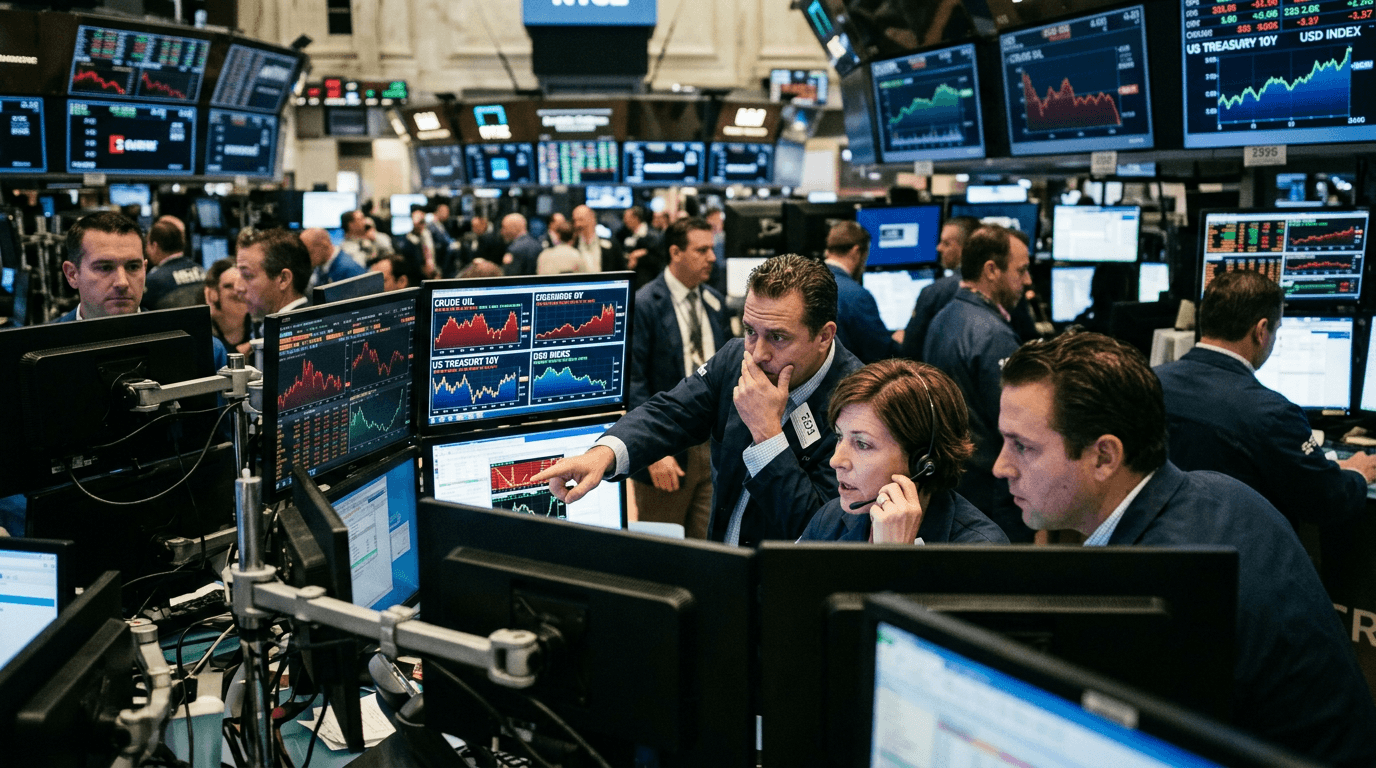
Geopolitical risk often lurks in the background of markets, but every so often it steps firmly into the spotlight. That is what we are now seeing as escalating Middle East tensions finally start to weigh on Wall Street. After weeks of relative resilience, U.S. equities are coming under pressure while war jitters push oil prices, Treasury yields and the U.S. dollar higher[5][8][11]. For traders, this is not just a headline story—it is a live stress test of portfolios, risk models and macro assumptions.
Markets Finally Price In Middle East Risk
For much of the recent conflict, Wall Street had managed to shrug off the geopolitical noise. Renewed interest in beaten‑down chip stocks and anticipation of major tech earnings had helped support benchmarks even as headlines from the region grew more alarming[5][2][3]. Futures at times were flat to mildly lower, suggesting investors were still willing to lean on the AI and semiconductor narrative despite the uncertainty[3][12].
That dynamic has shifted. U.S. stock indices are now closing decisively lower as tensions escalate and investors reassess how long the conflict could drag on[5][8]. Reports of a deepening crisis and concern about disruption to key energy routes, including the Strait of Hormuz, have sharpened focus on the potential economic fallout[1][7]. As a result, risk premia—the extra return investors demand to hold risky assets—are being repriced across equities, commodities, rates and FX.
Importantly, this is not yet a panic‑driven capitulation, but it is a broad‑based adjustment. Losses have widened in the S&P 500 after earlier attempts to stabilize[2][5], while global indices from Europe to Asia have joined the move lower[1][11]. For traders, the message is clear: geopolitical risk is no longer just a tail scenario in the model; it is a current driver of price action.
Why Oil, Yields And The Dollar Are Rising Together
The most visible market response has been in energy. Crude oil has surged, with some measures showing gains of more than 40% from recent lows as the conflict stretches into multiple weeks[7][11]. The catalyst is both actual and perceived supply risk—worries that shipping lanes or production capacity across the Gulf could be disrupted for longer than initially expected[1][8][11].
Higher oil prices feed directly into inflation expectations. Traders now need to consider not just the immediate impact on fuel costs, but also second‑round effects on transportation, manufacturing and consumer spending. That has pushed bond markets into focus. U.S. Treasury yields are climbing again, with benchmark maturities rising several basis points as investors price in the risk of more persistent inflation and a slower path to interest‑rate cuts[8][10][11]. For a market that had been hoping for a more dovish Federal Reserve stance, this is a meaningful shift.
At the same time, the U.S. dollar is firming as global investors seek liquid, defensive assets in a risk‑off environment[8][11]. The dollar index has moved higher, while major and emerging‑market currencies have generally weakened against it[11]. This combination—higher oil, higher yields, stronger dollar—is classic in periods of geopolitical stress, but it creates a complex backdrop for global portfolios. Energy importers face a double hit from commodity prices and FX, while dollar‑denominated borrowing costs rise for many issuers.
Sector Winners, Losers And Rotation On Wall Street
The move is not uniform across sectors. Energy stocks, unsurprisingly, have been among the relative winners, supported by higher crude prices and improving margins[2][7]. Defense companies and selected industrials have also seen buying interest as investors look for names that could benefit from increased spending or risk hedging[3][9].
On the other side of the ledger, rate‑sensitive and fuel‑intensive businesses are coming under pressure. Airlines, cruise lines and parts of the travel sector have been hit by concerns over rising fuel costs and weaker discretionary demand if the conflict drags on[2][10]. High‑growth, high‑valuation segments—such as some AI‑linked and private‑credit plays—are also being re‑examined as higher yields challenge previous assumptions about cheap funding and elevated multiples[8][11].
Tech has been more nuanced. Chip stocks, which previously helped prop up the indices, are now trading within a more volatile range as investors balance strong secular demand against cyclical and macro risks[2][3]. The result is sector rotation rather than a one‑direction sell‑off: money is moving from pure growth stories into a mix of cash‑generative defensives, energy and select cyclical names that can pass through higher costs.
For traders, the takeaway is that geopolitical shocks rarely hit all sectors equally. Understanding factor exposures—energy sensitivity, duration risk, FX and geographic revenue mix—becomes critical when deciding whether to hedge, rotate or hold through the volatility.
How Active Traders Are Adjusting Risk And Positioning
In this environment, risk management is as important as directional views. Volatility has risen across equities, rates, commodities and FX, with correlations shifting as macro narratives evolve[8][11]. Many traders are responding in several ways:
- Re‑scaling position sizes: With headline risk elevated, some are cutting gross exposure while maintaining core themes, allowing portfolios to absorb larger intraday swings without breaching risk limits.
- Adding macro hedges: Equity traders are increasingly using crude futures, rate futures and dollar exposure as portfolio hedges—shorting indices while going long energy, or pairing growth stock exposure with long‑dollar positions against vulnerable currencies[7][10][11].
- Stress‑testing scenarios: Desk risk teams are updating stress tests to reflect prolonged conflict, higher energy prices and stickier inflation—examining how portfolios might behave under different paths for yields and the dollar[8][11].
- Shortening time horizons: With event risk clustered around geopolitical developments and central‑bank communication, intraday and short‑term swing trading strategies are gaining favor over longer‑dated, highly leveraged positions.
For a SimFi platform audience, these conditions offer a powerful learning environment. Traders can practice how to react to sudden macro shocks, test hedging combinations and observe how cross‑asset relationships evolve under stress—without the capital risk of live markets.
Key Lessons For Simulated Finance Traders
Middle East tensions now weighing on Wall Street are a reminder that markets are always balancing growth, inflation and risk premia. For simulated and real‑money traders alike, several practical lessons stand out:
- Geopolitics matters, but timing is uncertain. Markets initially shrugged off the conflict before repricing aggressively. Scenario planning should consider both immediate and delayed reactions.
- Cross‑asset awareness is essential. Oil, yields and the dollar are moving together, and equity sectors are responding differently. Effective strategies increasingly span indices, commodities, rates and FX rather than focusing on a single asset class[7][8][11].
- Inflation and central‑bank expectations drive second‑round effects. The key story is not just the war, but how it alters the path for growth, inflation and monetary policy—and, by extension, valuations and discount rates[8][10][11].
- Risk management is part of alpha. The traders who navigate episodes like this best are often those who adjust exposure, hedge intelligently and stay disciplined when volatility spikes.
As the situation in the Middle East evolves, markets will continue to recalibrate. For now, the message from Wall Street is unmistakable: geopolitical risk is back on the front line, and it is lifting oil, yields and the dollar while forcing a rethink of equity valuations and sector leadership. In a SimFi environment, this is exactly the kind of complex, real‑world backdrop that can sharpen trading skills, refine macro frameworks and prepare market participants for the next regime shift—whenever and wherever it arrives.