
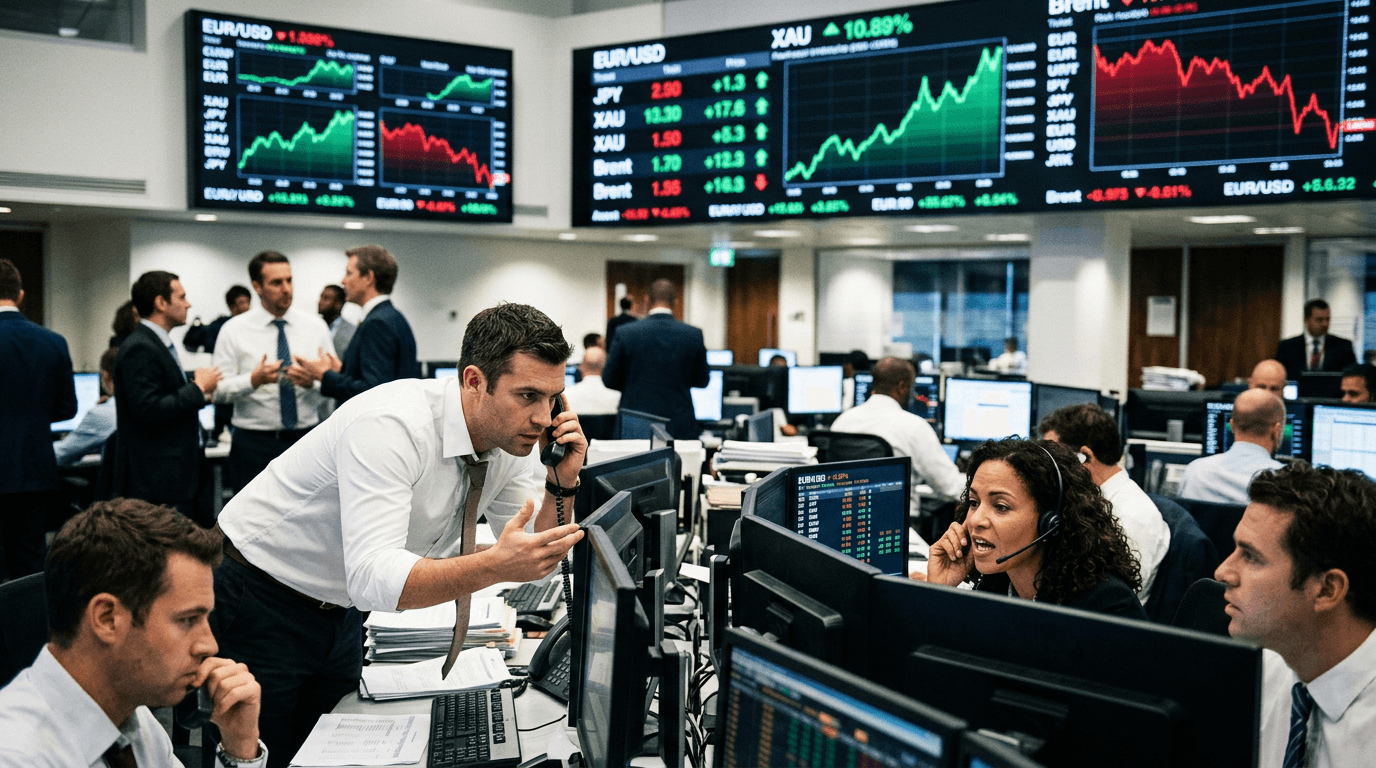
Oil and currency markets have been jolted back into geopolitics as the Middle East war and rising tensions with Iran push crude prices sharply higher and revive demand for classic safe havens like gold and the Japanese yen.[1][8] For traders, this is a powerful reminder that macro events, not just data releases or central bank meetings, can rapidly reset the landscape across commodities, FX, and broader risk assets.
Oil Supply Shock: Why The Strait Of Hormuz Matters
To understand why oil is moving so violently, start with geography. The Strait of Hormuz is a narrow shipping chokepoint through which roughly a fifth of the world’s oil flows under normal conditions.[10] Current hostilities and attacks on shipping in and around the strait have severely disrupted this flow, effectively blocking or delaying millions of barrels of crude and natural gas per day.[2][8][10]
The International Energy Agency has described the situation as one of the largest supply disruptions in the history of oil markets, with Middle Eastern production and exports curtailed by as much as 10–14 million barrels per day.[2][5] Even with other producers ramping up output, the global balance has tightened dramatically, and traders have quickly priced in a higher risk premium.
Since the war began, Brent crude has surged more than 50%, spiking from around $70–$72 to peaks near $120 per barrel in an exceptionally short period.[1][4] March alone saw one of the biggest monthly price jumps on record, with Brent rising more than 50% as shipping through the Strait of Hormuz was disrupted.[1][4] Analysts had warned that sustained blockages could easily push oil above $100, and that threshold has now been consistently breached.[4][8][10]
Policymakers have attempted to counter the shock by releasing emergency reserves. The IEA coordinated the largest drawdown of strategic stocks in its history, with member countries agreeing to release hundreds of millions of barrels, and the United States adding a record release from its own reserves.[2] These actions have helped cap the upside for now, and prices have eased at times on talk of ceasefires or temporary truces, but the overarching risk remains skewed to further spikes if fighting escalates or diplomatic efforts falter.[4][5][12]
For traders, the key point is that oil is no longer trading purely on economic fundamentals or OPEC+ decisions. It is trading on headlines, troop movements, and the credibility of ceasefire announcements.
Safe-haven Rush: Fx, Gold, And Risk Sentiment
When geopolitical risk jumps, markets typically respond in two ways: by bidding up the price of essential commodities like oil and by seeking shelter in perceived safe-haven assets. That is exactly what has been playing out.
Gold, the classic crisis hedge, has seen renewed demand as investors look for an asset that is not tied to the fortunes of any single government or central bank.[7][8] With inflation still a concern in many economies, higher oil prices feed the narrative of “stagflation risk,” making gold even more attractive as a store of value and portfolio diversifier.
In FX, safe-haven currencies such as the Japanese yen and, to a lesser extent, the Swiss franc and U.S. dollar tend to benefit when risk sentiment deteriorates. The yen, in particular, often strengthens despite Japan being a major energy importer, because it serves as a funding currency for carry trades and a destination for capital when volatility spikes. As traders unwind riskier positions financed in yen, they must buy yen back, pushing it higher.
At the same time, risk-sensitive currencies—especially those tied to global growth or emerging markets—tend to come under pressure. Higher energy costs raise import bills, squeeze corporate margins, and dampen growth expectations, all of which can drive investors out of higher-yielding but riskier FX exposures in favor of safer alternatives.
Winners And Losers Across Currencies
Not all currencies respond the same way to an oil shock, and understanding this dispersion is crucial.
Energy exporters like Canada and Norway can see their currencies supported by the terms-of-trade boost from higher oil prices. Their government revenues and trade balances improve, at least in the short term, when crude prices climb. However, that support can be offset if risk aversion gets extreme, as global investors reduce exposure to anything perceived as cyclical or commodity-driven.
Energy importers such as Japan, India, and many euro area countries typically face a deterioration in trade balances and upward pressure on inflation. Ordinarily, that would be negative for their currencies. But in a crisis, safe-haven dynamics can overpower fundamentals, which is why the yen can rally even while Japan’s import bill is rising.
Emerging market currencies are often the most vulnerable. Higher oil and shipping costs drive up inflation and import costs, while weaker global risk appetite can lead to capital outflows. Countries with current account deficits or large external financing needs may find their currencies particularly exposed, leading to bouts of sharp depreciation.
For traders in FX and cross-asset strategies, this creates a complex puzzle: oil-linked FX pairs are driven not just by crude prices, but also by macro growth expectations, risk sentiment, and the evolving geopolitical narrative.
Trading Implications: Volatility, Risk, And Scenario Planning
Geopolitical markets are headline-driven markets. Price gaps, intraday reversals, and volatility spikes are common, especially around major announcements about ceasefires, new sanctions, or military escalations. That makes risk management as important as directional views.
Several practical principles stand out
First, position sizing matters more than ever. When oil can move several dollars a day and safe-haven FX can swing rapidly on breaking news, leverage amplifies both gains and losses. Smaller positions and wider—but pre-defined—stop levels can help avoid being knocked out by noise.
Second, scenario planning is essential. Traders should map out at least three base scenarios: escalation (with further supply disruptions and more risk-off), fragile stalemate, and credible ceasefire with partial normalization of flows. Each scenario has different implications for oil, gold, safe havens, and risk FX. Having these pathways thought through ahead of time reduces emotional decision-making when headlines hit.
Third, watch correlations. In calmer times, oil, equities, and FX may trade on domestic fundamentals. In crises, correlations often spike, with “risk assets” moving together and safe havens trading in tandem. A portfolio that looks diversified in normal markets can become highly concentrated when geopolitics dominates.
This is where simulated trading environments can be particularly valuable. In a SimFi setting, traders can test how their strategies perform under stress: What happens to an equity-heavy portfolio if oil jumps another 20% and the yen rallies sharply? How does a carry trade basket behave if markets suddenly price in prolonged conflict and higher inflation? Practicing these scenarios without real capital at risk can sharpen instincts and improve playbooks for when it truly matters.
Conclusion And Key Takeaways
The Middle East war and intensifying tensions with Iran have reasserted the central role of geopolitics in markets, pushing oil prices sharply higher and reviving demand for safe-haven assets like gold and the yen.[1][4][7][8] The disruption of shipping through the Strait of Hormuz has triggered one of the largest supply shocks the oil market has seen in decades, while emergency reserve releases and ceasefire talks offer only partial relief.[2][4][10]
For traders, the environment is defined by elevated volatility, shifting correlations, and sudden moves driven by headlines rather than scheduled data. Energy-linked currencies, safe havens, and risk-sensitive FX are all in play, and the balance between them can change rapidly depending on whether the news points to escalation or de-escalation.
The most resilient trading approaches in this kind of market are those that respect volatility, prioritize risk management, and are grounded in clear scenario analysis. Whether operating in live markets or using simulated finance platforms to rehearse strategies, the goal is the same: understand the macro drivers, anticipate how different assets react, and be prepared to adapt as the geopolitical narrative evolves.