
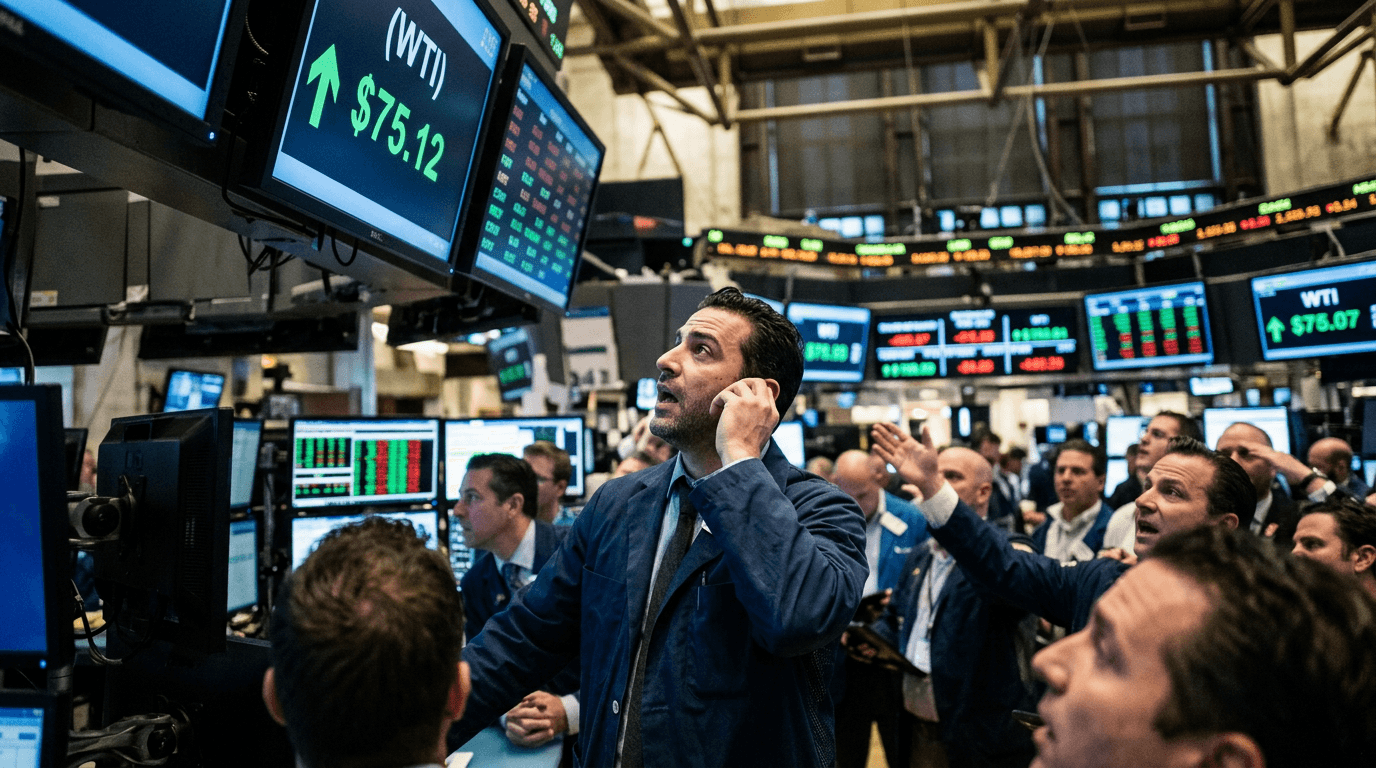
WTI crude oil has just logged a sharp move higher, jumping more than 6% and breaking above $75 per barrel as the war risk between the U.S. and Iran intensifies and raises fears of supply disruptions across key Middle East routes.[5][9] This move is not just about energy markets; it is already feeding into higher inflation expectations and forcing traders to reprice the interest-rate path in futures across the curve.[7][9] For anyone trading crude, rates, or multi‑asset portfolios in live or simulated environments, this is the kind of macro shock that can reshape risk and opportunity in a single session.
Market Move: Wti Crude Spikes On Middle East War Risk
The latest surge in WTI follows a pattern seen repeatedly during escalations in the Gulf: military strikes, disrupted shipping lanes, and the threat of further attacks trigger an immediate reassessment of supply risk.[1][5] Recent reports highlight U.S. and Israeli actions against Iranian assets and retaliatory strikes on bases and tankers in and around the Strait of Hormuz, a chokepoint through which a significant share of global seaborne crude flows.[1][5][10] As traffic through the Strait slows and some operations are temporarily halted, traders are forced to price in a higher probability of sustained supply interruptions.[5][11]
In this environment, a 6% intraday move in WTI over $75 is not simply a demand story; it is a risk‑premium story.[5] The underlying physical balances—global inventories, OPEC+ decisions, and non‑OPEC supply growth—matter, but in the short term, the dominant driver is geopolitical uncertainty.[1][5] Newswires have noted that visible oil inventories remain relatively comfortable in historical terms, yet price gains are outsized, underscoring how quickly markets can shift from fundamentals to fear.[5]
For traders, this type of move highlights why macro and geopolitical monitoring is as important as traditional technical analysis. Price levels like $75 in WTI are not just chart points; they are thresholds where the narrative can flip from “range‑bound market” to “energy shock risk.”
Why Geopolitical Shocks Hit Oil So Hard
The Middle East still accounts for a large share of global exports, and the Gulf sea lanes remain central to crude and refined product flows.[1][5] When conflict threatens infrastructure, shipping routes, or production sites, the market reacts immediately because the potential scale of disruption is enormous. Analysts have warned that even a three‑ to four‑week severe blockage in the Strait of Hormuz could force Gulf producers to shut in output and drive benchmark prices far above current levels.[5] Others have suggested that if hostilities persist for months, Brent could be pushed into a triple‑digit regime for an extended period.[4][7]
This is where the concept of a geopolitical risk premium comes in. Under normal conditions, oil prices reflect expected supply and demand plus a modest cushion for routine risks. During a war scare, that cushion expands sharply. Futures and options traders start to price higher probability tails: sabotage of pipelines, missile strikes on export terminals, further sanctions on major producers, or extended interruptions to shipping.[3][5][9] Each of these scenarios might be low probability individually, but together they justify higher prices today to compensate for uncertainty tomorrow.
Practically, this means you will often see:
- Front‑month futures leading the move as traders hedge near‑term supply risk.[5]
- Volatility in options increasing, particularly in out‑of‑the‑money calls, as participants pay up for upside protection.[7]
- Spreads between different delivery months and benchmarks (WTI vs Brent) widening or compressing depending on which regions are most exposed to the shock.[1][5]
Recognizing that a move is risk‑premium‑driven rather than demand‑driven can help traders avoid misinterpreting price action as a signal about global growth.
From Oil To Inflation: Transmission Channels
A rapid jump in crude is almost immediately reflected in refined product prices, especially gasoline and diesel, in the world’s largest fuel‑consuming economies.[5] In recent Middle East flare‑ups, gasoline futures have spiked alongside crude, with analysts warning of pump prices pushing back above psychologically important levels such as $3 per gallon in the U.S.[5] That matters because energy is both a direct component of headline inflation and an indirect driver of broader price pressures.
The transmission channels from oil to inflation include:
Higher transport and logistics costs: When fuel becomes more expensive, freight rates go up, raising the cost of moving goods across supply chains. This increases input costs for manufacturers and retailers.
Household energy bills: Elevated gasoline and heating fuel costs reduce disposable income, but they also show up quickly in consumer price indices.
Business margins and pricing power: Firms faced with higher energy costs may try to pass them on, especially if demand is resilient. This can nudge both headline and core inflation higher.
Markets quickly incorporate these dynamics into inflation expectations. Breakeven inflation rates derived from inflation‑linked bonds, as well as inflation swap pricing, tend to rise when oil spikes, especially if the move is seen as persistent rather than transient. Recent commentary from analysts on the current Middle East conflict points to fears that this is not just a one‑day spike but part of a broader, “game‑changing” energy shock.[7][9] When expectations shift, central banks pay attention—and that leads directly to repricing of the rate path.
Rate-path Repricing: What Futures Are Signaling
Rate‑sensitive assets respond quickly when inflation risks rise. In the current episode, bond and money‑market futures have already begun to adjust implied policy trajectories. Traders are marking down the probability of near‑term rate cuts and, in some cases, pricing a higher terminal rate or a longer period of restrictive policy.[7][9]
Fed funds futures and similar contracts are designed to reflect the market’s best guess about where policy rates will be at future dates. When an oil shock lifts inflation expectations, these futures typically move to:
- Reduce the odds of aggressive easing, as central banks may fear reigniting inflation.
- Push back the timing of the first cut, or price in a slower pace of cuts.
- Add risk that rates could even rise again if inflation proves sticky.
At the same time, nominal Treasury yields can climb due to both higher expected inflation and a wider term premium, while inflation‑linked bonds may outperform. Equity markets often respond with sector rotation: energy and some commodity‑linked names gain, while rate‑sensitive growth stocks and consumer‑facing businesses can come under pressure.
For traders in simulated or live markets, reading this repricing correctly is crucial. It is not just about the direction of crude; it is about understanding how a single geopolitical shock cascades through rates, FX, equities, and credit.
Trading And Risk Management Takeaways
The current Middle East war risk episode offers several practical lessons for traders and portfolio managers:
Stay macro‑aware: Major geopolitical events can overwhelm micro setups. Even if your primary focus is technical levels or single‑name equities, ignoring oil and rates in a war‑driven market is dangerous.
Watch cross‑asset correlations: Periods of stress often see tighter links between crude, inflation expectations, and rate‑sensitive assets. A move in WTI can be an early warning for bond or equity volatility.
Manage leverage carefully: A 6% intraday move in a major commodity reflects a regime of elevated volatility. Position sizing, margin usage, and stop‑loss discipline become more important when risk premiums dominate.
Use scenario analysis: Ask how your portfolio performs if oil stabilizes, if it spikes another 20%, or if the conflict de‑escalates quickly. Mapping best‑, base‑, and worst‑case paths can help you avoid reactive decisions.
For SimFi traders, this environment is a live case study in macro shock management. Simulated markets allow you to stress‑test strategies—long energy, short rate‑sensitive equities, curve trades in interest‑rate futures, or inflation hedges—without capital at risk. The goal is to build playbooks that you can apply more confidently when similar events unfold in the real world.
What To Watch Next
Looking ahead, markets will be highly sensitive to a few key variables:
Conflict trajectory: Any signs of de‑escalation, cease‑fire talks, or restored shipping flows could compress the geopolitical risk premium and pull crude back toward more fundamentally driven levels.[3][6] Conversely, fresh attacks on tankers or infrastructure could trigger another leg higher.[10][11]
Policy responses: Statements from central bankers about how they view energy‑driven inflation shocks will be closely parsed. If policymakers signal tolerance for temporary headline spikes, rate‑path repricing may stabilize; if they hint at renewed tightening bias, rate futures could move again.
OPEC+ and supply management: Coordinated production decisions can either amplify or offset war‑related price moves. Recent history shows the cartel is willing to adjust output in response to market stress, and any surprise announcements could quickly change the tone.[1][5]
For now, the combination of a 6% WTI jump above $75, heightened Middle East war risk, and rising inflation expectations places this firmly in the “macro‑relevant” category. It is not yet a full‑blown oil crisis, but it is a reminder that geopolitics can reprice entire asset classes in a matter of hours—and that disciplined, well‑informed trading frameworks are essential in both live and simulated markets.