
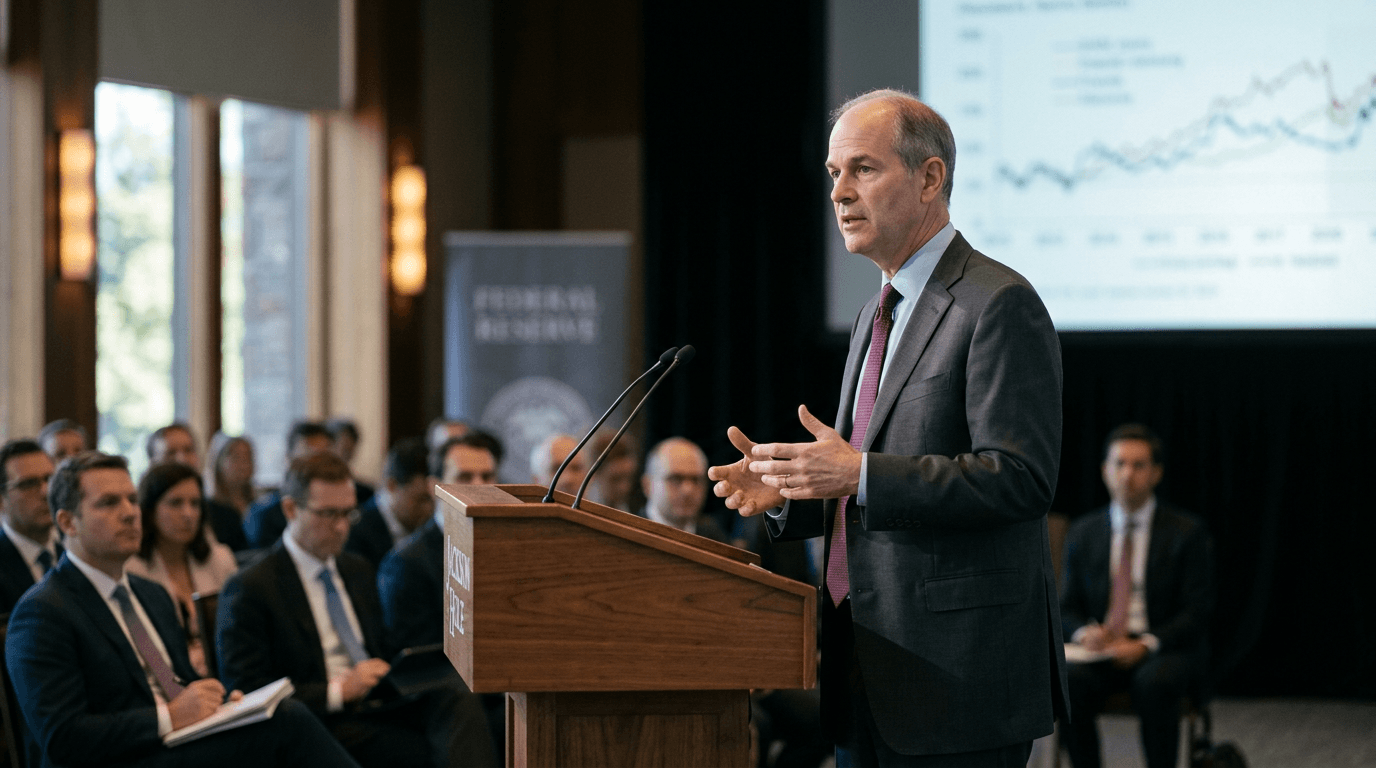
Financial markets are still digesting the message from Jackson Hole: the Federal Reserve is not ready to declare victory over inflation, and rate hikes remain firmly on the table. Fed Chair Kevin Warsh’s hawkish tone has kept September hike expectations alive, supporting the U.S. dollar, capping gold, and injecting fresh volatility into both forex and crypto markets[2][4][7][8]. For traders, this is a reminder that the “higher for longer” narrative is more than a slogan—it is a real policy risk that must be managed.
Jackson Hole Puts Inflation Back In The Spotlight
In his keynote remarks at the Jackson Hole Economic Policy Symposium, Warsh reiterated that inflation is still running above the Fed’s 2% target and remains the central bank’s primary focus[2][6][9]. The Fed’s preferred inflation gauge, the PCE price index, is hovering around 3.7% on a 12‑month basis, with shorter‑term measures even higher, underscoring that price pressures have not yet fully retreated[6][12][13]. Warsh acknowledged that recent inflation readings were “better than expected,” but stressed that they do not show a meaningful improvement in underlying trends[4][5][15].
Importantly, he emphasized that the 2% inflation objective is a “firm, fixed target,” not a flexible aspiration that can be casually revised when achieving it becomes uncomfortable[6][13]. That framing signals a willingness to tolerate short‑term growth or market pain in order to restore price stability, a classic hallmark of a hawkish policy stance[2][7]. Warsh also highlighted that, despite prior tightening, overall financial conditions in the economy do not look genuinely restrictive, suggesting that current rates may not be high enough to fully contain inflationary pressures[7][11].
In short, Jackson Hole was not about new tools or abstract debates on artificial intelligence or balance‑sheet strategy; it was about using short‑term interest rates as the primary lever to push inflation decisively back to target[2][6]. For traders, that clarity matters: when the Fed explicitly prioritizes inflation over growth, the reaction function to incoming data tilts toward tightening rather than easing.
Market Reaction Across Asset Classes
Warsh’s comments immediately shifted rate expectations, with markets moving to price in a significantly higher probability of a September hike compared with the day before his speech[1][15]. CME FedWatch data show odds of a hike jumping from roughly the mid‑30% range to above 50%, reflecting a rapid repricing of the near‑term policy path[15]. That repricing has supported the U.S. dollar as traders anticipate higher yields and a more attractive carry profile relative to other major currencies[2][7][8].
Gold, which typically struggles in a rising‑rate, strong‑dollar environment, has been kept in check as investors reassess the opportunity cost of holding non‑yielding assets[2][4][8]. In the forex space, higher‑for‑longer expectations have contributed to bouts of volatility, particularly in dollar‑sensitive pairs where positioning had started to lean toward a more dovish Fed narrative[2][7]. Crypto markets have also seen de‑risking, as tighter policy and elevated real yields reduce appetite for speculative risk and leverage[2][4][7][8].
For traders, this cross‑asset reaction reinforces a simple but powerful principle: central bank tone can move markets even in the absence of an actual rate decision. A single speech that changes the perceived distribution of future rates can shift currencies, metals, equities, and digital assets all at once.
WHAT WARSH’S HAWKISHNESS MEANS FOR SEPTEMBER
Warsh carefully avoided explicit forward guidance, declining to spell out a mechanical rule for when or how the Fed will hike[2][4][8]. However, his insistence that policymakers must be “confident” that underlying inflation is moving toward the target “clearly and at sufficient speed” before easing off the fight is revealing[9][12][15]. In practice, that means upcoming data on PCE, CPI, and labor‑market conditions will be judged against a relatively strict standard.
The message from Jackson Hole is that modest improvement in headline numbers is not enough if core measures and trend dynamics remain sticky[3][4][5]. With the economy still described as strong and the labor market near full employment, Warsh signaled that the Fed has room to act without immediately threatening the expansion[3][8]. As a result, markets now see a live risk that the Fed could deliver at least one more rate increase if inflation fails to decelerate more convincingly by the September meeting[1][2][15].
For traders, the key takeaway is that the path of policy is more asymmetric than it appeared after the July meeting. The Fed is not on autopilot toward cuts; instead, it is data‑dependent with a hawkish bias. That asymmetry should shape scenario planning and risk management.
Practical Takeaways For Traders And Simfi Participants
First, revisit rate and dollar assumptions in your strategies. If you have been trading on the premise that the Fed was effectively done hiking and preparing to ease, Warsh’s stance suggests that this view is premature[2][7][15]. In a SimFi environment like E8 Markets, this is a prime opportunity to stress‑test strategies under scenarios where U.S. yields push higher and the dollar remains firm against major peers.
Second, pay close attention to the data calendar between now and the September meeting. Inflation releases (PCE, CPI) and labor‑market reports will be the primary catalysts for repricing hike odds[3][4][6]. Use simulated trading sessions around these events to practice managing slippage, spreads, and execution risk when volatility spikes. The goal is to build muscle memory for reacting to surprise prints that either validate or challenge Warsh’s hawkish narrative.
Third, align leverage and position sizing with policy uncertainty. A live hike risk increases the chance of abrupt moves in rate‑sensitive assets, from gold and high‑beta currencies to growth stocks and crypto[2][4][7][8]. In simulation, experiment with scaling into positions, using tighter stop‑losses, and diversifying across uncorrelated instruments to understand how different risk frameworks behave under stress.
Finally, think in terms of regimes, not single events. Warsh’s emphasis on elevated, persistent inflation and non‑restrictive financial conditions suggests that the current regime remains one of cautious tightening rather than imminent easing[6][7][13]. In SimFi, backtest strategies across prior periods of hawkish Fed pivots to see which approaches—carry trades, trend‑following, mean‑reversion—performed best when rates were still rising or plateauing at high levels.
Conclusion
Kevin Warsh’s Jackson Hole message has kept the possibility of further Fed tightening very much alive, re‑anchoring markets around the idea that inflation control remains the central bank’s overriding objective[2][6][9]. The result has been a firmer dollar, restrained gold, and renewed volatility and de‑risking across forex and crypto markets as traders adjust to a more hawkish policy path[2][4][7][8].
For market participants and SimFi traders alike, the lesson is clear: central bank communication is a tradable risk factor, not background noise. With September hike odds elevated and data‑dependence skewed toward further tightening, the coming weeks are an ideal time to refine frameworks, test scenarios, and build disciplined trading habits before the next Fed decision forces real‑world portfolios to adapt.